10-K: Annual report [Section 13 and 15(d), not S-K Item 405]
Published on
UNITED STATES
SECURITIES AND EXCHANGE COMMISSION
Washington, D.C. 20549
FORM 10-K
(Mark One) | |
Annual Report Pursuant to Section 13 or 15(d) of the Securities Exchange Act of 1934 | |
For the Fiscal Year Ended March 31 , 2026
Transition Report Pursuant to Section 13 or 15(d) of the Securities Exchange Act of 1934 |
For the transition period from to
Commission File Number: 001-36436

(Exact name of registrant as specified in its charter)
(State or other jurisdiction of incorporation or organization) | (I.R.S. Employer Identification No.) |
(Address of principal executive offices) (Zip Code)
(805 ) 967-7611
(Registrant’s telephone number, including area code)
Securities registered pursuant to Section 12(b) of the Act:
Title of each class | Trading Symbol(s) | Name of each exchange on which registered |
Indicate by check mark if the registrant is a well-known seasoned issuer, as defined in Rule 405 of the Securities
Act. Yes ☒ No ☐
Indicate by check mark if the registrant is not required to file reports pursuant to Section 13 or Section 15(d) of
the Act. Yes ☐ No ☒
Indicate by check mark whether the registrant: (1) has filed all reports required to be filed by Section 13 or 15(d) of
the Securities Exchange Act of 1934 during the preceding 12 months (or for such shorter period that the registrant
was required to file such reports), and (2) has been subject to such filing requirements for the past 90 days. Yes ☒
No ☐
Indicate by check mark whether the registrant has submitted electronically every Interactive Data File required to be
submitted pursuant to Rule 405 of Regulation S-T (§232.405 of this chapter) during the preceding 12 months (or for
such shorter period that the registrant was required to submit such files). Yes ☒ No ☐
Indicate by check mark whether the registrant is a large accelerated filer, an accelerated filer, a non-accelerated
filer, a smaller reporting company, or an emerging growth company. See the definitions of “large accelerated filer,”
“accelerated filer,” “smaller reporting company,” and “emerging growth company” in Rule 12b-2 of the Exchange Act.
☒ | Accelerated filer | ☐ | ||
Non-accelerated filer | ☐ | Smaller reporting company | ||
Emerging growth company |
If an emerging growth company, indicate by check mark if the registrant has elected not to use the extended
transition period for complying with any new or revised financial accounting standards provided pursuant to Section
13(a) of the Exchange Act. ☐
Indicate by check mark whether the registrant has filed a report on and attestation to its management’s assessment
of the effectiveness of its internal control over financial reporting under Section 404(b) of the Sarbanes-Oxley Act
(15 U.S.C. 7262(b)) by the registered public accounting firm that prepared or issued its audit report. ☒
If securities are registered pursuant to Section 12(b) of the Act, indicate by check mark whether the financial
statements of the registrant included in the filing reflect the correction of an error to previously issued financial
statements. ☐
Indicate by check mark whether any of those error corrections are restatements that required a recovery analysis of
incentive-based compensation received by any of the registrant’s executive officers during the relevant recovery
period pursuant to §240.10D-1(b). ☐
Indicate by check mark whether the registrant is a shell company (as defined in Rule 12b-2 of the Act).
Yes ☐ No ☒
At September 30, 2025, the last business day of the registrant’s most recently completed second fiscal quarter, the
aggregate market value of the voting and non-voting stock held by the non-affiliates of the registrant was
approximately $14,764,483,936 , based on the number of shares held by non-affiliates of the registrant as of that
date, and the last reported sale price of the registrant’s common stock, par value $0.01 per share, on the New York
Stock Exchange on that date, which was $101.37. This calculation does not reflect a determination that persons are
affiliates for any other purposes.
As of the close of business on May 1, 2026, the number of outstanding shares of the registrant’s common stock, par
value $0.01 per share, was 138,880,957 .
DOCUMENTS INCORPORATED BY REFERENCE
meeting of stockholders, to be filed with the Securities and Exchange Commission within 120 days after the end of
the fiscal year covered by this Annual Report on Form 10-K, are incorporated by reference in Part III within this
DECKERS OUTDOOR CORPORATION AND SUBSIDIARIES
TABLE OF CONTENTS
Page | ||
Item 4. | Mine Safety Disclosures | * |
Item 6. | [Reserved] | * |
Item 9. | Changes in and Disagreements with Accountants on Accounting and Financial Disclosure | * |
Item 9C. | Disclosure Regarding Foreign Jurisdictions that Prevent Inspections | * |
F-1 | ||
Item 16. | Form 10-K Summary | * |
*Not applicable. | ||
CAUTIONARY NOTE REGARDING FORWARD-LOOKING STATEMENTS
This Annual Report on Form 10-K for our fiscal year ended March 31, 2026 (Annual Report), and the information and documents
incorporated by reference within this Annual Report, contain “forward-looking statements” within the meaning of Section 27A of
the Securities Act of 1933, as amended (Securities Act), and Section 21E of the Securities Exchange Act of 1934, as amended
(Exchange Act). These forward-looking statements are intended to qualify for the safe harbor from liability established by the
Private Securities Litigation Reform Act of 1995. Forward-looking statements include all statements other than statements of
historical fact contained in, or incorporated by reference within, this Annual Report. We have attempted to identify forward-
looking statements by using words such as “anticipate,” “believe,” “could,” “estimate,” “expect,” “intend,” “may,” “plan,” “predict,”
“project,” “should,” “will,” or “would,” and similar expressions or the negative of these expressions. Such statements are subject
to a number of assumptions, risks and uncertainties, many of which are beyond our control. Consequently, actual future results
could differ materially from our expectations due to a number of factors including, but not limited to:
•global geopolitical conflicts, instability and uncertainty, including the resulting impact on our supply chain;
•United States (US) and international trade policies, tariffs and retaliatory measures, including the impact on
our results of operations;
•changes in consumer preferences and the purchasing behavior of wholesale partners and consumers,
including shifts in technology, impacting our brands and products, and the footwear and fashion industries;
•global economic trends, including foreign currency exchange rate fluctuations and the effectiveness of our
hedging strategies, changes in interest rates, inflationary pressures, commodity price volatility, and
recessionary concerns;
•the ability to effectively compete in a highly competitive footwear, apparel, and accessories industry;
•the operational challenges faced by our warehouses and distribution centers (DCs), wholesale partners, global
third-party logistics providers (3PLs), and third-party carriers, including those arising from global supply chain
disruptions, labor shortages, and logistics constraints;
•availability of materials and manufacturing capacity, the reliability of overseas production and storage, and the
geographic concentration of manufacturing operations;
•expansion of our brands, product offerings, and investments in our distribution facilities, e-commerce websites,
and retail store footprint;
•our business, operating, investing, capital allocation, marketing, and financing plans and strategies;
•changes to our product distribution strategies, including product allocation and segmentation strategies;
•trends, seasonality, and weather impacting the demand for our products;
•changes to the geographic and seasonal mix of our brands and products;
•the impact of our efforts to continue to advance sustainable and socially conscious business operations, and
our ability to meet the expectations of our investors and other stakeholders with respect to our environmental,
social, and governance (ESG) practices;
•the effects of climate change, natural disasters, and public health issues, and the resulting impact on our
business and our customers, consumers, suppliers, and business partners;
•security breach or other disruption to our information technology (IT) systems, or those of our vendors;
•our ability to effectively utilize and implement technological advancements, including artificial intelligence (AI),
and risks associated with third-party service providers and interconnected systems;
•the outcomes of legal proceedings, including the impact they may have on our business and intellectual
property rights;
•our interpretation of applicable global tax regulations and changes in global tax laws and audits that may
impact our tax liability and effective tax rates;
•our cash repatriation strategy regarding earnings of non-US subsidiaries and the resulting tax impacts; and
•the value of long-lived assets and potential write-downs or impairment charges.
Forward-looking statements represent management’s current expectations and predictions about trends affecting our business
and industry and are based on information available at the time such statements are made. Although we do not make forward-
looking statements unless we believe we have a reasonable basis for doing so, we cannot guarantee their accuracy or
completeness. Forward-looking statements involve numerous known and unknown risks, uncertainties, and other factors that
may cause our actual results, performance, or achievements to be materially different from any future results, performance or
achievements predicted, assumed, or implied by the forward-looking statements. Some of the risks and uncertainties that may
cause our actual results to materially differ from those expressed or implied by these forward-looking statements are described in
Part I, Item 1A, “Risk Factors,” and Part II, Item 7, “Management’s Discussion and Analysis of Financial Condition and Results of
Operations,” within this Annual Report, as well as in our other filings with the Securities and Exchange Commission (SEC), which
are available free of charge on the SEC’s website at www.sec.gov and our website at ir.deckers.com. You should read this
Annual Report, including the information and documents incorporated by reference herein, in its entirety and with the
understanding that our actual future results may be materially different from the results expressed or implied by these forward-
looking statements. Moreover, new risks and uncertainties emerge occasionally, and it is not possible for management to predict
all risks and uncertainties, nor can we assess the impact of all factors on our business or the extent to which any factor, or
combination of factors, may cause our actual future results to be materially different from any results expressed or implied by any
forward-looking statements. Except as required by applicable law or the listing rules of the New York Stock Exchange, we
expressly disclaim any intent or obligation to update any forward-looking statements. We qualify all our forward-looking
statements with these cautionary statements.

PART I
References within this Annual Report to “Deckers,” “we,” “our,” “us,” “management,” or the “Company” refer to
Deckers Outdoor Corporation, together with its consolidated subsidiaries. HOKA® (HOKA), UGG® (UGG), Teva®
(Teva), Koolaburra by UGG® (Koolaburra), AHNU® (AHNU), UGGpure® (UGGpure) and UGGplushTM (UGGplush)
are some of our trademarks. Other trademarks or trade names appearing elsewhere within this Annual Report are
the property of their respective owners. The trademarks and trade names within this Annual Report are referred to
without the ® and ™ symbols, but such references should not be construed as any indication that their respective
owners will not assert their rights to the fullest extent under applicable law.
Unless otherwise indicated, all figures herein are expressed in thousands, except share and per share data.
References to “domestic” refer to our business and operations in the US. The periods covered by the fiscal years
ended March 31, 2026, 2025, and 2024 are stated herein as “year ended” or “years ended.” We also refer to these
fiscal years as “fiscal year 2026,” “fiscal year 2025,” and “fiscal year 2024,” respectively. Fiscal year 2026 is also
referred to as “the current period” and fiscal year 2025 is referred to as “the prior period”.
ITEM 1. BUSINESS |
General
We are a global leader in designing, marketing, and distributing innovative footwear, apparel, and accessories
developed for both everyday casual lifestyle use and high-performance activities. We market our products primarily
under three proprietary brands: HOKA, UGG, and Teva.
Our brands compete across the fashion and casual lifestyle, performance, running, and outdoor markets. We
believe our products are distinctive and appeal to a broad demographic. Our brands sell our products through
quality domestic and international retailers and international distributors in our wholesale channel, and directly to
global consumers through our Direct-to-Consumer (DTC) channel, which is comprised of an e‑commerce and retail
store presence. We seek to differentiate our brands and products by offering diverse lines that emphasize fashion,
performance, authenticity, functionality, quality, and comfort, and products tailored to a variety of activities, seasons,
and demographic groups. Independent third-party contractors manufacture all of our products (independent
manufacturers).
Brands
 | The HOKA brand is an authentic premium line of year- round performance footwear, which offers enhanced cushioning and inherent stability with minimal weight. Originally designed for ultra-runners, the brand now appeals to world champions, tastemakers, and everyday athletes. Expansion into additional product categories, elevated marketing campaigns, and investments in brand experiences, coupled with strategic marketplace presence have fueled both domestic and international sales growth of the HOKA brand, which has quickly become a leading brand within run and outdoor specialty wholesale accounts and is growing across its global marketplace. The HOKA brand’s product line includes running, trail, hiking, fitness, and lifestyle footwear offerings, as well as apparel and accessories. | |
 | The UGG brand is one of the most iconic and recognized brands in our industry, which highlights our successful track record of building niche brands into consumer- focused fashion lifestyle market leaders. Born on the California coast to warm surfers after they caught and rode the waves, we create iconic products and experiences that are made for people to feel comfort, softness, warmth, and confidence. With loyal consumers around the world, innovative products, and elevated storytelling, the UGG brand has proven to be a highly resilient consumer-focused line of premium footwear, apparel, and accessories that has driven both domestic and international sales growth with year-round product offerings that appeal to a growing global audience and a broad demographic. | |
 | Other brands consist primarily of the Teva brand. The Teva brand’s products are built for a range of outdoor pursuits and include a variety of footwear options, from classic sandals and shoes to boots. |
The Other brands reportable operating segment includes financial results of the Koolaburra brand and AHNU brand,
for which the phase out of standalone operations were completed during the third and fourth quarters of fiscal year
2026, as well as financial results for the former Sanuk brand during the prior period through the sale date of August
15, 2024 (Sanuk Brand Sale Date).
Refer to the section titled “Reportable Operating Segments” below for further details about our reportable operating
segments.
Channel Distribution
We operate omnichannel global marketplaces for our brands where consumers can shop and experience our
brands seamlessly across both channels outlined below.
Wholesale. Our wholesale channel sells products to a network of third-party retailers, including partner retailers,
and distributors. This approach enables us to expand market reach and leverage the scale and operational
capabilities of our wholesale partners to serve a broad base of end consumers.
We sell our HOKA brand products primarily through full-service specialty retailers, outdoor and sporting goods
retailers, select online retailers, fashion lifestyle retailers, sports style partners, and higher-end department stores.
We continue to expand our HOKA brand wholesale distribution globally, including through additional mono-branded
locations operated by partner retailers.
We sell our UGG brand products primarily through fashion lifestyle retailers, higher-end department stores,
streetwear and sports style partners, online retailers and partner retailers. As the retail marketplace continues to
evolve to reflect changing consumer preferences, we continually review and evaluate our UGG wholesale
distribution and product segmentation approach.
We sell our Teva brand products primarily through outdoor and sporting goods retailers, fashion lifestyle retailers,
large national retail chains, higher-end department stores, and online retailers.
Direct-to-Consumer. Our DTC channel is comprised of our Company-owned e-commerce websites and retail
stores where products are sold at retail prices. Our e-commerce websites and retail stores are intertwined and
interdependent in an omnichannel marketplace, which engenders brand loyalty while increasing product sales and
improving our inventory productivity. In addition, we believe some of our consumers interact with both before making
purchasing decisions in store and online. For example, consumers may feel or try on products in our retail stores
and then place an order online later, or they may initially research products online and then make a purchase in
store.
E-Commerce Websites. Our global e-commerce websites provide us with an opportunity to directly engage and
connect with our consumers and communicate a consistent message that promotes awareness of our brands’
promises and key initiatives, offers targeted information to specific consumer demographics, and drives consumers
to our retail stores. Our e‑commerce websites provide consumers with access to the broadest selection and
assortment of our products. As of March 31, 2026, we operate Company-owned e-commerce websites in 54
different countries.
Retail Stores. Retail stores enable us to expose consumers to a curated selection of products and directly influence
our consumers’ experience with our brands. We continue to open mono-branded retail stores in key markets to
further grow the UGG brand and HOKA brand presence and appeal to a broader consumer base, while also
prioritizing the revitalization and recalibration of our existing retail store fleet to enhance overall brand impact and
consumer experience. As of March 31, 2026, we have a total of 203 global Company-owned retail stores (including
141 UGG brand retail stores and 62 HOKA brand retail stores), which include 105 concept stores and 98 outlet
stores.
Geographic Distribution
US Distribution. In our wholesale channel, we sell our products in the US through sales representatives, organized
by brand and either geography or account type, as each brand generally has certain strategic customers that expect
a dedicated sales team with specialized knowledge of the brand’s product offerings. In addition to our wholesale
channel, we sell products directly to consumers through our DTC channel and fulfill online orders through our
warehouses and DCs, and retail stores. We currently distribute products sold in the US through our DCs in Moreno
Valley, California, and Mooresville, Indiana. We also distribute products to our wholesale channel customers through
a DC bypass program.
International Distribution. Collectively, our brands are sold internationally, including in Canada, Europe, Asia, and
Latin America. We sell our products internationally in our wholesale channel through wholly owned subsidiaries and
independent distributors, some of which operate partner retail stores. In addition, in certain countries we sell
products through our DTC channel. For our wholesale and DTC channels, we distribute our products through a
number of warehouses and DCs managed by 3PLs in certain international locations. We are currently transitioning
one of our international 3PLs to a new partner.
Refer to Part I, Item 2, “Properties,” and Note 7, “Leases,” of our consolidated financial statements in Part IV within
this Annual Report for further information on our properties and leases. Refer to Note 2, “Revenue Recognition and
Business Concentrations,” of our consolidated financial statements in Part IV within this Annual Report for further
information regarding geographic areas and concentration of related business risks.
Reportable Operating Segments
As of March 31, 2026, our three reportable operating segments include the worldwide operations of the HOKA
brand, UGG brand, and Other brands (collectively, our reportable operating segments). Other brands consist
primarily of the Teva brand. The Other brands reportable operating segment includes current and historical results of
brands previously sold and brands for which standalone operations have been phased out, as discussed below.
Consistent with our continuous focus on pursuing the most profitable long-term opportunities, we have taken the
following strategic actions to streamline our brand portfolio within the Other brands reportable operating segment:
•During the second quarter of fiscal year 2026, we began phasing out standalone operations for the
AHNU brand. We closed Ahnu.com as of October 1, 2025, and completed the phase out of the
AHNU brand in the wholesale channel during third and fourth quarters of fiscal year 2026. We did
not incur material exit costs or obligations associated with this plan.
•During the third quarter of fiscal year 2025, we began phasing out standalone operations for the
Koolaburra brand. We closed Koolaburra.com as of the end of fiscal year 2025 and completed the
phase out of the Koolaburra brand in the wholesale channel during the third and fourth quarters of
fiscal year 2026. We did not incur material exit costs or obligations associated with this plan.
•The sale of the Sanuk brand was completed during the second quarter of fiscal year 2025. The
financial results for the reportable operating segments present the former Sanuk brand through the
Sanuk Brand Sale Date.
Refer to Part II, Item 7, “Management’s Discussion and Analysis of Financial Condition and Results of Operations,”
the section titled “Basis of Presentation,” in Note 1, “General,” and to Note 13, “Reportable Operating Segments,” of
our consolidated financial statements in Part IV within this Annual Report for further information on our reportable
operating segments.
Product Design and Development
We are committed to designing innovative, functional, and distinctive products that enable consumers to move
through the world with greater comfort, confidence, and performance. Our design and development teams
collaborate to create seasonal product lines that meet consumers where they are and exceed their expectations.
Each brand follows a disciplined product creation path that begins with engaging key consumer segments to gather
insights, conducting in-depth market and trend analysis, and incorporating color and material research. While this
process is consistent across the portfolio, each brand applies it differently based on its unique consumer and design
philosophy. The HOKA brand emphasizes high‑performance innovation informed by biomechanics, athlete
partnerships, and iterative dynamic testing to refine cushioning systems, rocker geometries, and technical
components. The UGG brand focuses on premium materials, sensory comfort, and modern lifestyle aesthetics, with
development centered on tactile experience, durability, and seasonal versatility. The Teva brand product creation
focuses on offerings to reflect its modern outdoor versatility. These differentiated approaches ensure that each
brand delivers products that reflect its identity and the expectations of its target consumer.
Throughout the creation process, our teams conduct concept and design reviews, develop prototypes assembled by
our independent manufacturers, and complete multiple rounds of sampling for fit, comfort, and performance.
Depending on the brand and product application, this may include athlete testing or specialized laboratory testing
performed by external partners. Our internal research and development specialists collaborate with experts in
engineering, industrial design, chemistry, and materials science to advance new technologies, cushioning systems,
and material innovations that can be leveraged across brands. At every stage, we evaluate raw material availability
and cost, manufacturing capabilities and capacity, and target product pricing. Our multi‑brand portfolio enables us to
share learnings, scale innovations, and drive efficiencies across product lines, supporting both product excellence
and operational performance.
Marketing and Advertising
Our marketing and advertising efforts are designed to strengthen brand awareness, deepen consumer engagement,
and drive purchase intent across our portfolio of brands. We seek to connect with consumers through distinctive
brand storytelling, product innovation, consumer insights, and integrated marketing campaigns that communicate
the unique positioning of each brand and support long-term brand affinity.
We invest in a mix of digital advertising, social media, influencer and ambassador partnerships, experiential
activations, content, public relations, and traditional media to deliver relevant and impactful messaging. These
efforts are intended to attract new consumers, retain and engage existing consumers, and reinforce the authenticity,
relevance and desirability of our brands.
Our campaigns reflect the distinct positioning of each brand. The HOKA brand highlights its premium performance
heritage rooted in enhanced cushioning, inherent stability, and minimal weight, appealing to world champions,
tastemakers, and everyday athletes across running, trail, hiking, fitness, and lifestyle categories for its footwear,
apparel, and accessories. The UGG brand emphasizes its iconic status and year‑round premium footwear, apparel,
and accessories that resonate with a broad global audience, creating iconic products and experiences made for a
growing global demographic to feel comfort, softness, warmth, and confidence. The Teva brand emphasizes modern
outdoor versatility, responsible materials, and elevated design.
We continually evaluate the effectiveness of our marketing investments and adjust our strategies to align with
evolving consumer behaviors and marketplace trends.
Manufacturing and Supply Chain
The production of our finished goods is outsourced to independent manufacturers, the majority of which are in
Southeast Asia. During the year ended March 31, 2026, production of our finished goods was predominantly from
Vietnam and Indonesia, while less than 5% was from China or any other individual country. We continue to diversify
our independent manufacturers and the regions in which they operate.
Production by our independent manufacturers is performed in accordance with our detailed product specifications
and rigorous quality control and operating compliance standards. We maintain a buying office in Hong Kong, as well
as on-site supervisory offices in Vietnam, China, and Indonesia, which collectively serve as a strong link to our
independent manufacturers. We believe our substantial regional presence enhances our manufacturing processes
by providing predictability of material availability and ensuring adherence to quality control standards and final
design specifications.
We generally purchase products from independent manufacturers on the basis of individual purchase orders, rather
than maintaining long-term purchase commitments, which provides us greater flexibility to adapt to changing
consumer preferences, shifts in economic conditions, changes in international trade relations, and evolving
inventory management requirements.
The majority of the raw materials and components used in the production of our products by our independent
manufacturers are purchased from independent suppliers that we designate (designated suppliers), who work with
subcontractors that extract, process, or convert these raw materials.
Sheepskin used to manufacture a significant portion of our UGG brand products is sourced primarily from Australia
and processed by two tanneries in China. We currently enter into fixed purchasing contracts with designated
suppliers of sheepskin and sugarcane-derived ethylene-vinyl acetate (sugarcane-derived EVA) to manage price
volatility and ensure availability. Excluding sheepskin, UGGplush, UGGpure, sugarcane-derived EVA, and certain
branded components, we believe that substantially all raw materials and components used to manufacture our
products are generally available from multiple sources at competitive prices. While alternative materials may be
available for certain branded components, which may be limited, such alternatives would not include the same
trademarks. We believe current supplies are sufficient to meet our anticipated demand for the next 12 months.
Refer to the subsection titled “Contractual Obligations” under the section “Liquidity” within Part II, Item 7,
“Management’s Discussion and Analysis of Financial Condition and Results of Operations” and Note 8,
“Commitments and Contingencies,” of our consolidated financial statements in Part IV within this Annual Report for
further information on our purchase obligations.
We require our independent manufacturers and designated suppliers to adopt our Ethical Supply Chain Supplier
Code of Conduct (Supplier Code of Conduct), which requires them to comply with all local laws and regulations
governing human rights, working conditions, anti-corruption, restricted substances, and environmental compliance,
including animal welfare and conflict minerals, before we are willing to conduct business with them. Refer to the
section titled “Environmental, Social, and Governance” below for further information.
Inventory Management and Product Returns
We have an extended design and manufacturing process, which involves product designs, the purchase of raw and
other materials, inventory accumulation, the subsequent sale of finished product, and the collection of resulting
accounts receivable. This production cycle results in significant liquidity requirements and working capital
fluctuations throughout our fiscal year. Because the cycle typically involves long lead times, which requires us to
make manufacturing decisions several months in advance of anticipated customer demand, it is challenging for us
to accurately estimate and manage our inventory and working capital requirements.
We manage our inventory levels by considering existing orders, as well as forecasted sales and budgets by brand
for both the wholesale and DTC channels, taking into account customer delivery requirements. Our systems and
processes are designed to improve our product planning and forecasting, inventory control and supply chain
management capabilities, including our Company-owned e-commerce websites. In addition, added discipline
around SKU productivity, product purchasing decisions, lead time reduction, and selling excess inventory through
our liquidation channels, are key areas of focus that have enhanced inventory performance, including higher
inventory turnover, and partially mitigated product cost increases.
We encourage our customers to place a significant portion of orders through pre-season programs, which are
typically placed up to 12 months prior to shipment, while also allowing for in-season replenishment orders. These
pre-season programs enable us to better plan our production schedules, inventory levels, and shipping
requirements.
Our general practice, consistent with industry standards, is to offer customers in our wholesale channel the right to
return defective or improperly shipped merchandise, and to accept returns from our consumers in the DTC channel
between 30 to 90 days from the point of sale for cash or credit.
Refer to the section titled “Liquidity” within Part II, Item 7, “Management’s Discussion and Analysis of Financial
Condition and Results of Operations,” within this Annual Report for further information on our liquidity.
Environmental, Social, and Governance
As a global leader in designing, marketing, and distributing innovative footwear, apparel, and accessories, our
worldwide reach and impact is significant. We believe consumers are increasingly buying brands that deliver quality
products while striving for minimal environmental impact by employing sustainable business practices. Our
sustainability policies and strategies are informed by our ongoing efforts with multi-stakeholder initiatives, which
involve our stockholders, employees, suppliers, and customers, as well as other brands and non-governmental
organizations.
Through our holistic ESG program, we are committed to advancing our sustainable business initiatives. As a result
of our efforts, during fiscal year 2026, we were recognized as a Net Zero Leader by Forbes, by Wall Street Journal
as one of the Best-Managed Companies and by Newsweek as one of America’s Most Responsible Companies, one
of the World’s Greenest Companies and one of America’s Most Charitable Companies.
ESG Oversight. Our Corporate Responsibility, Sustainability & Governance Committee (Corporate Governance
Committee) is comprised of four independent members of our Board of Directors (Board) who oversee our ESG
strategy and have ultimate oversight over all sustainability initiatives, strategies, and programs, including those
related to climate change, human rights, community engagement, charitable giving, and belonging. The Corporate
Governance Committee and Board regularly receive updates on the status of our ESG program. In addition, the
Audit & Risk Management Committee (Audit Committee) of the Board periodically assesses risk management,
including climate-related risks and policies, to ensure a consistent corporate strategy. The Board considers whether
the ESG program adequately identifies material risks in a timely fashion, implements appropriate responsive risk
management strategies, and ensures that management transmits necessary information with respect to material
risks within the organization. Our Chief Administrative and Legal Officer (CALO) is responsible for the day-to-day
management of our ESG program. The program’s execution is driven by our leadership team and various cross-
functional teams including our ethical sourcing, facilities, warehouses and DCs, brands, innovation, materials, and
supply chain teams.
Our ESG program aligns our internal teams with our Sustainable Development Goals (SDGs), which we adopt to
guide our ESG strategy, and establishes policies to encourage our partners and suppliers to employ sustainable
business practices. We annually assess risks related to ESG issues as part of our overall enterprise risk
management approach. In addition, our internal audit team provides periodic targeted reviews of our ESG-related
policies and procedures to the Audit Committee.
Sustainable Development Goals. We work to establish SDGs that we believe are the most relevant to our
business, our operations, our stockholders, and the communities in which we operate. We are a member of the
United Nations Global Compact (UNGC), the world’s largest voluntary corporate sustainability initiative. This
membership requires an annual statement of progress, which is reflected in our Corporate Responsibility and
Sustainability Report (Creating Change Report). Our CALO identifies specific SDGs established by the UNGC,
which we adopt to guide our ESG strategy.
Our annual Creating Change Report for fiscal year 2026, which will be published in calendar year 2026, will provide
more information regarding our fiscal year 2026 ESG achievements with a focus on the SDGs. In addition, during
fiscal year 2026, we adopted a comprehensive Climate Transition Plan, reflecting our commitment to proactive
environmental stewardship.
We recognize that agility and continuous improvement are essential to advancing our global ESG strategy, enabling
us to respond effectively to evolving challenges and opportunities in sustainability. To that end, we have aligned the
reporting standards included in our Climate Transition Plan to the Transition Plan Taskforce and our Creating
Change Report with various frameworks including the Financial Stability Board’s Task Force on Climate-Related
Financial Disclosures (commonly referred to as TCFD), Global Reporting Initiative’s (commonly referred to as GRI)
Core Standards, and Sustainability Accounting Standards Board’s (commonly referred to as SASB), and now part of
the International Finance Reporting Standard (or IFRS) Foundation Consumer Goods Sector Apparel, Accessories
and Footwear Index.
Stakeholder Engagement. We highly value stakeholder input and have consistently demonstrated our commitment
to maintaining open and interactive dialogue on ESG matters with our stakeholders, including non-governmental
organizations, employees, stockholders, suppliers, industry groups, communities, and governments, to ensure their
views are actively considered in executing our ESG program. Our stakeholder outreach program is led by a cross-
functional team that includes members of our investor relations, compliance, sustainability, and legal teams.
Additionally, we actively engage with our employees to obtain valuable feedback and track progress, including
through regular employee engagement surveys.
Human Capital - Our People and Our Culture
Employees. As of March 31, 2026, we employed approximately 6,000 global employees, reflecting an increase of
9.1%, compared to March 31, 2025. This includes approximately 2,200 employees in our retail stores but excludes
temporary and seasonal employees.
Culture. Our key values, which guide our journey onward together to improve our business and create a better
world around us, and help hold us accountable to deliver on this purpose, are as follows:

Our values define our Company and serve as the driving force behind how we work together and with our
customers, consumers, partners, suppliers, and communities. We also have detailed policies that support our
commitment to ethical behavior and legal compliance across our Company. Through our open-door policy and
culture, employees are encouraged to approach their managers if they believe violations of standards or policies
have occurred and are able to make confidential and anonymous reports using a 24/7 online or telephone hotline
hosted by an independent third-party provider.
At Deckers, we believe our culture makes us unique. We regularly conduct employee surveys to understand our
employees’ experiences on a variety of topics focused on employee engagement. Our latest survey completed in
August 2025 had a participation rate of 92.3%. Of those employees who completed the survey, 88.4% noted they
were proud to work for Deckers.
We believe an inclusive workplace that promotes belonging for everyone brings together those with a unique set of
experiences, opinions, and thoughts on critical issues. In turn, these varied perspectives enhance our business and
drive better outcomes. Our people are at the center of everything we do. Their perspectives and passion for
innovation enable us to build brands and create products that people around the world love. We strive to create an
environment where employees can come as they are and are free to bring their authentic selves to work every day.
We publish workforce metrics in our annual Equal Employment Opportunity filing (EEO-1) which is publicly available
at deckers.com/responsibility/policies. The content of our website, including our annual EEO-1 filing, is not
incorporated by reference into this Annual Report or in any other report or document we file with the SEC.
Charitable Giving and Volunteering. Our charitable contributions, product donations, and employee volunteer
efforts are an essential part of our culture. We annually contribute to our local communities through monetary
donations, volunteer efforts, and in-kind donations. During fiscal year 2026, we donated over $5,400 to various non-
profit organizations around the globe, primarily to organizations focused on uplifting youth, community, belonging,
education, and the environment. We also continued our Art of Kindness events, where employees volunteer during
a week-long event in our local communities. Despite having only one event during fiscal year 2026, our employees
volunteered approximately 10,500 hours. Our strategic giving and community-engagement efforts continued to be
aligned with our SDGs.
Talent Development and Retention. The ability to attract, develop, and retain employees is critical to our long-term
success. We focus on our employees’ growth, creating experiences that align with our strategic priorities and
promote inclusion, performance, connection, and opportunities for development. For example, we offer a week fully
dedicated to employee learning, connection, and development across the globe (Explore Week), and four global
leadership development programs for leaders at varying levels (Voyagers, Trailblazers, Navigator, and Ascent).
Further, our executive leadership team and Board commit substantial time to succession planning, evaluating the
bench strength of our leadership and supporting their career development while improving organizational
performance. We are proud to offer a wide range of programs intended to support global employee development
and retention.
We have demonstrated a history of investing in our workforce by offering competitive salaries and wages. We
provide tuition reimbursement for eligible US employees up to $5 thousand per calendar year. Further, to foster a
stronger sense of ownership and align the interests of management with stockholders, equity awards are granted to
a substantial proportion of our leadership team. In addition, employees across the US business have the opportunity
to purchase stock at a discounted price through our Employee Stock Purchase Plan. Further, we engage an
independent compensation consultant, FW Cook, which provides us with information to evaluate the effectiveness
of our executive compensation program, including competitive pay practices and trends in our industry, the design
and structure of our executive compensation program, and the formulation of and benchmarking against our peers
within our industry.
Employee Wellness. We strive to be one of the best places to work and recognize our employees are at different
stages of life and have individual needs. We offer affordable, innovative, comprehensive, and competitive benefits
package that range from health insurance, retirement plan, life insurance, disability, accident coverage, paid time
off, paid and unpaid leave including parental leave, mental health benefits, and other voluntary benefits such as
health savings accounts and our solar and electric car reimbursement program.
Employee Health and Safety. The health and safety of our employees is our highest priority. We have
comprehensive safety training programs to help ensure our employees know how to do their jobs safely and in
compliance with laws and regulations. We prioritize the safety of our facilities and work to ensure they are modern
and efficient.
Seasonality
A significant part of the UGG brand’s business has historically been seasonal, with the highest percentage of net
sales occurring in the third fiscal quarter, which has contributed to variation in results of operations from quarter to
quarter. However, as the HOKA brand’s net sales have increased as a percentage of our aggregate net sales, the
impacts of seasonality have been partially mitigated as HOKA brand sales are generally more evenly distributed
throughout the fiscal year, although quarterly results may fluctuate based on the timing of product launches. This
trend is expected to continue. In addition, we have further mitigated the impacts of seasonality by diversifying and
expanding our year-round product offerings across our brands.
Refer to Part I, Item 1A, “Risk Factors,” and Part II, Item 7, “Management’s Discussion and Analysis of Financial
Condition and Results of Operations,” within this Annual Report for further discussion of the impacts of seasonality.
Competition
The industry and markets in which we operate are highly competitive. Our competitors include fashion, casual,
lifestyle, and athletic footwear companies, branded apparel companies, and retailers with their own private labels.
Although the industry is fragmented, some of our competitors are larger and have substantially greater resources,
and several sell products that compete directly with our products. In particular, we face competition from domestic
and international competitors selling products designed to compete directly or indirectly with products similar to
those of our HOKA brand and UGG brand. In addition, access to offshore manufacturing and the growth of e-
commerce have made it easier for new companies to enter the markets in which we compete, further increasing
competition in the footwear, apparel, and accessories industry.
We believe our ability to successfully compete depends on numerous factors, including our ability to predict, assess,
and respond quickly to changing consumer tastes and preferences, produce exceptional and innovative products
that meet expectations for product craft, quality and technical performance, maintain and enhance the image and
strength of our brands, price our products competitively, and manage the impacts of supply chain disruptions. In
addition, we believe our key customers face intense competition from other department stores, sporting goods
stores, retail specialty stores, and online retailers, among others, which could negatively impact the financial stability
of their businesses and their ability to conduct business with us. Refer to Part I, Item 1A, “Risk Factors,” within this
Annual Report for further discussion of the potential impact of competition on our business.
Trademarks and Patents
We utilize trademarks for virtually all our products, and we believe having distinctive marks that are readily
identifiable is an important factor in establishing and maintaining a market for our products, promoting our brands,
and distinguishing our products from the products of others. We currently hold trademark registrations for “HOKA,”
“UGG,” and “Teva,” and other marks in the US, and for certain of the marks in many other countries, including
Canada, China, the United Kingdom (UK), various countries in the European Union (EU), Japan, and Korea. As of
March 31, 2026, we hold 201 designs and inventions with corresponding design or utility patent registrations, plus
29 designs and inventions which are currently pending registration. These patents expire at various times. Current
figures reflect natural expiration and strategic portfolio rationalization undertaken during the current period. We
regard our proprietary rights as valuable assets and vigorously protect such rights against infringement by third
parties.
Government Regulation
We are subject to a wide range of laws and regulations, including US federal, state, and local laws; the laws of
jurisdictions where we operate or plan to operate; and the laws of jurisdictions from which we source our products.
Based on the information and circumstances known to us at this time, compliance with such applicable laws and
regulations is not expected to have any material effect on our business, results of operations, financial condition, or
competitive position.
Available Information
Our annual reports on Form 10-K, quarterly reports on Form 10-Q, current reports on Form 8-K, proxy statements
and information statements (and any amendments or supplements to the foregoing) filed with or furnished to the
SEC pursuant to the Exchange Act are available free of charge on our website at ir.deckers.com. Such documents
and information are available as soon as reasonably practicable after they are filed with or furnished to the SEC. We
also make certain corporate governance and responsibility documents available through our website at
ir.deckers.com/governance, deckers.com/responsibility, and deckers.com/responsibility/policies, respectively,
including Ethical Supply Chain Supplier Code of Conduct, Audit & Risk Management Committee Charter, Talent &
Compensation Committee Charter, Corporate Responsibility, Sustainability, & Governance Committee Charter,
Code of Ethics, Creating Change Report, Climate Transition Plan, Accounting and Finance Code of Ethics, EEO-1
Report, and Corporate Governance Guidelines. The information contained on or accessed through our website
does not constitute part of this Annual Report, and references to our website address within this Annual Report are
inactive textual references only.
ITEM 1A. RISK FACTORS |
Our short and long-term success is subject to numerous risks and uncertainties, many of which involve factors that
are difficult to predict or beyond our control. As a result, investing in our common stock involves substantial risk.
Before deciding to purchase, hold or sell our common stock, stockholders and potential stockholders should
carefully consider the risks and uncertainties described below, in addition to the other information contained in or
incorporated by reference into this Annual Report, as well as the other information we file with the SEC. If any of
these risks are realized, our business, financial condition, results of operations, and prospects could be materially
and adversely affected. In that case, the value of our common stock could decline, and stockholders may lose all or
part of their investment. Furthermore, additional risks and uncertainties of which we are currently unaware, or which
we currently consider to be immaterial, could have a material adverse effect on our business.
Certain statements made in this section constitute “forward-looking statements,” which are subject to numerous
risks and uncertainties including those described in this section. Refer to the section entitled “Cautionary Note
Regarding Forward-Looking Statements” within this Annual Report for further information.
Risks Related to Our Business and Industry
The footwear, apparel, and accessories industry is subject to rapid changes in consumer preferences, and
if we do not accurately anticipate and promptly respond to consumer demand and spending patterns, we
could lose sales, our relationships with customers could be harmed, and our brand loyalty could be
diminished.
The footwear, apparel, and accessories industry is subject to rapid changes in consumer preferences and fashion
tastes, which makes it difficult to anticipate demand for our products and forecast our results of operations. Our
success depends, in part, on brand loyalty, and there can be no assurance that consumers will continue to prefer
our brands. Consumer demand for our products relies on the continued strength of our brands, which in turn
depends on our ability to anticipate, understand, and respond promptly to evolving preferences, fashion trends, and
consumer spending patterns with appealing merchandise and effective brand-building initiatives. As our brands and
product offerings evolve, our products must appeal to a broader and more diverse range of consumers whose
preferences cannot be predicted with certainty. New products may not achieve market acceptance, including due to
pricing that consumers are unwilling to bear, or our brands may fall out of favor, which could impede our ability to
maintain or grow sales, adversely affect brand perception, and negatively impact our results of operations. If we do
not effectively respond to these changes, we could experience reduced sales and pressure on our gross profit as a
percentage of net sales (gross margin), including as a result of reduced pricing power and increased reliance on
promotional activity.
The value of our brands is also driven by evolving consumer perceptions, including shifting ethical, political, or
social standards. Concerns related to product pricing, quality, design, technical performance, components or
materials (including sustainability), customer service, or the effectiveness of our brand loyalty initiatives, including
loyalty programs, could result in negative perceptions, diminished consumer engagement, and a loss of brand
loyalty or value. These risks may be amplified by adverse publicity concerning us or our products, brands, marketing
campaigns, partners, or endorsers, particularly where social media and digital marketing channels accelerate the
dissemination, amplification, or persistence of negative claims, regardless of their accuracy, which could harm our
reputation and sales and have a material adverse effect on our business. In addition, actions or statements by
third‑party partners, collaborators, or organizations with which we are associated, including in connection with social
or political issues, could lead to consumer backlash, operational disruptions, or reputational harm. If our brand-
related initiatives, including loyalty programs, fail to drive sustained consumer engagement or incremental demand,
or involve increased costs or operational complexity that negatively affect customer perceptions, we could
experience reduced sales and pressure on our gross margin, adversely affecting our results of operations.
Changes to economic conditions may adversely affect our financial condition and results of operations.
Volatile economic conditions and changes in the market have affected, and may continue to affect, consumer
confidence and discretionary spending. A significant portion of our HOKA brand and UGG brand products are
premium, discretionary purchases, and demand for these products is sensitive to macroeconomic factors, including
inflation, wages and employment, consumer debt, declines in net worth driven by market conditions, interest rates,
tariffs, and public health issues such as a pandemic. During periods of economic uncertainty, consumers may
reduce discretionary purchases, trade down to lower-priced alternatives, or delay buying decisions, which could
require us to increase promotional activity or reduce prices, adversely affecting our sales and profitability.
We sell a significant portion of our products through higher-end specialty and department store retailers and online
marketplaces. These customers may be adversely affected by economic conditions, geopolitical instability, foreign
currency fluctuations, reduced demand for premium products, limited access to credit, and increased competition.
Financial difficulties among our customers could negatively affect our credit exposure, reserves, and relationships
with key customers, and could reduce orders or increase the risk of delayed payments or defaults.
We face intense competition from both established companies and newer entrants into the market, and our
failure to compete effectively could cause our market share to decline, which could harm our reputation and
have a material adverse effect on our financial condition and results of operations.
The footwear, apparel, and accessories industry is highly competitive and subject to rapidly changing consumer
preferences. If we are unable to compete effectively, we could experience a decline in market share, reduced
demand for our products, pricing pressure, or damage to our reputation, which could have a material adverse effect
on our financial condition and results of operations. Competition in our markets is influenced by factors such as
brand recognition, product innovation and performance, pricing, speed‑to‑market, marketing effectiveness, use of
data analytics and AI, access to manufacturing capacity, and control of distribution channels.
Our competitors include both established global brands and newer market entrants, including competitors whose
broader product assortments and higher sales volumes may be more important to certain customers. We believe
that the growth and visibility of our HOKA brand and UGG brand have attracted competitors specifically targeting
the categories in which we operate. Barriers to entry have been reduced by access to offshore manufacturing and
evolving technologies, allowing competitors to develop and scale products more quickly and at lower cost.
Some of our competitors also have substantially greater financial, technological, manufacturing, marketing, and
distribution resources than we do, as well as broader brand awareness, which may enable them to compete more
effectively on price, accelerate product development, leverage advanced data analytics or AI, adapt to technological
changes, and withstand periods of excess inventory or reduced consumer demand. As a result, we face ongoing
competition for customer relationships and distribution channels, including competition for preferred access to key
retail accounts, shelf space, and digital visibility.
Consistent with these dynamics, we have experienced, and expect to continue to experience, pricing and
promotional pressure across our brands and channels, particularly during periods of elevated industry inventory
levels or inflationary pressure. Increased discounting or promotional activity by competitors may require us to
reduce prices or increase promotions to remain competitive, negatively affecting our gross margin and results of
operations, and could cause consumers to shift purchases to competing products. In addition, many of our key
wholesale customers face intense competitive pressures, and deterioration in their financial condition could
adversely affect their ability to do business with us.
If we are unsuccessful at managing inventory planning, forecasting, and global supply chain execution, we
may be unable to accurately forecast our inventory and working capital requirements, which may have a
material adverse effect on our financial condition and results of operations.
Like other companies in our industry, we have an extended design and manufacturing process, which involves
product design, material purchases, inventory accumulation and the subsequent sale of the inventories, and
accounts receivable collection. This cycle requires us to incur significant expenses relating to the design,
manufacturing, and marketing of our products in advance of the realization of sales, and results in significant
liquidity requirements and working capital fluctuations throughout our fiscal year, which may be amplified by supplier
performance issues and broader supply chain constraints. As a result, these liquidity and working capital demands
may limit our ability to adjust inventory levels and respond efficiently to changes in consumer demand, particularly
during periods of macroeconomic uncertainty. Our forecasting processes rely on assumptions, data, and systems
that may not accurately reflect future consumer or customer demand, or supply chain conditions, including
manufacturing capacity, raw material availability, and logistics constraints. Further, variability and constraints within
our global supply chain may drive higher inventory procurement positions that could negatively affect our working
capital and gross margin as a result of selling excess quantities through close out channels. As a result, our
inventory levels, working capital requirements, and results of operations may be adversely affected by a number of
factors, including:
•constraints or inefficiencies in transportation capacity, delivery timing, inventory flow, or production
scheduling, which may contribute to uneven inventory receipts, elevated inventory levels, or delays
in fulfilling demand;
•unfavorable or unexpected weather patterns that affect consumer demand for seasonally-driven
products, particularly within our UGG brand, which may be intensified by the effects of climate
change;
•changes in consumer preferences, discretionary spending patterns, prevailing fashion trends, and
pricing pressure that may require increased promotional activity to sell inventory;
•macroeconomic conditions, including inflation, interest rate volatility, or global economic uncertainty,
that may affect consumer purchasing behavior, supplier capacity, or logistics costs; and
•market acceptance of our products and competing offerings, and variability in product availability.
The evolution and expansion of our brands and product offerings have made our inventory management activities
more challenging. For example, if we overestimate demand for any products or styles, we may be forced to increase
promotional activity or adjust pricing to sell excess inventories, which would result in lower sales and reduced gross
margin, and we may not be able to recover our investment in the development of new styles and product lines. On
the other hand, if we underestimate demand, or if our independent manufacturing facilities are unable to supply
products in sufficient quantities or on a timely basis, we may experience inventory shortages that may prevent us
from fulfilling customer orders or result in delays in shipments to customers. If that occurred, we could lose sales,
our relationships with customers could be harmed, and our brand loyalty could be diminished. In either event, these
factors could have a material adverse effect on our results of operations.
We rely upon a number of warehouse and distribution facilities to operate our business, and any damage to
one of these facilities, or any disruptions caused by incorporating new facilities into our operations, could
have a material adverse effect on our business.
We rely upon a broad network of warehouses and distribution facilities to store, sort, package and distribute our
products. Our distribution operations depend on the effective functioning of global transportation and logistics
networks, including ports, carriers, and third-party service providers. Disruptions to these networks, including labor
shortages or disputes, capacity constraints, fuel and freight cost volatility, routing inefficiencies, or infrastructure
limitations could increase delivery times, delay inbound or outbound shipments, strain distribution capacity, increase
fulfillment and other costs, and impair our ability to efficiently receive, store, and distribute products.
In the US, we distribute products primarily through self-managed warehouses and DCs in Moreno Valley, California,
and in Mooresville, Indiana, which feature a complex warehouse management system that enables us to efficiently
pack products for direct shipment to our customers and consumers. We could face a significant disruption in our
domestic warehouse and DC operations if our warehouse management system does not perform as anticipated or
ceases to function for an extended period of time, which could occur due to damage to the facility, failure of software
or equipment, cyber-security incidents, power outages or similar problems. Any significant disruption to our
domestic warehouse or DC operations could adversely affect our ability to fulfill customer orders. In addition,
increased reliance on automation, data analytics, and system integrations within our warehouse operations,
including to address outdated or no longer supported software, systems and equipment, may increase the risk of
system failures, data inaccuracies, or operational disruptions if such systems are not implemented or maintained
effectively, which could similarly have a material adverse effect on our business.
Internationally, we distribute our products through warehouses and DCs managed by 3PLs in certain international
locations. For example, we are currently transitioning certain international 3PL operations to a new partner. While
we conduct diligence prior to entering into service agreements with 3PLs, we depend on these providers to operate
their warehouses and DCs in a manner that meets our business and performance requirements, including with
respect to data security and compliance with applicable data protection and privacy laws, and the provision of
quality services on a timely basis at the prices we expect. If our 3PLs fail to manage these responsibilities, including
during or following an operational transition, system cutover, or data migration, or if their operations are disrupted as
a result of factors outside of their control, such as sanctions that could in the future be imposed by the US
government, or broader disruptions or inefficiencies in global logistics and transportation networks, our distribution
operations could face delays, reduced reliability, or increased costs. The loss of or disruption to the operations of
any one or more of these facilities could materially and adversely affect our sales, business performance, and
results of operations. Although we believe we possess adequate insurance to cover the potential effect of a
disruption to the operations of these facilities, such insurance may not be sufficient to cover all of our potential
losses and may not continue to be available to us on acceptable terms, or at all.
We rely upon independent manufacturers for all of our production needs, and the failure of these
manufacturers to manage these responsibilities would prevent us from filling customer orders, which
would result in loss of sales and harm our relationships with customers.
We rely upon independent manufacturers and their respective material suppliers for all of our production needs, the
majority of which are located in Southeast Asia, predominantly in Vietnam and Indonesia, which exposes us to
geographic concentration risk, including risks arising from regional economic, political, environmental, or operational
conditions, and we do not have direct control over these manufacturers or their suppliers. We expect our
independent manufacturers to finance the production of goods ordered, maintain manufacturing capacity, comply
with our policies, and store finished goods in a safe location pending shipment. The ability of our independent
manufacturers to meet these expectations may be adversely affected by liquidity constraints or limitations in their
access to third-party financing arrangements supporting their supply chains or working capital needs, which could
reduce available production capacity, delay shipments, or result in lost sales. Disruptions arising from these
geographic concentrations, our limited control over independent manufacturers and their suppliers, or our
manufacturers’ inability to meet these expectations could adversely affect our ability to manufacture products or
fulfill customer orders, which could negatively affect our results of operations.
There can be no assurance of a long-term, uninterrupted supply of products from our independent manufacturers.
Our dependence on a limited number of key manufacturing partners may increase our exposure to disruptions,
pricing changes, or capacity constraints. While we have long-standing relationships with most of these
manufacturers, they could terminate our engagement, seek to increase their prices, or extract other concessions
from us, and we may not be able to timely engage a suitable alternative. If we are required to find alternative
manufacturers, we could experience manufacturing delays, increased manufacturing costs, and substantial
disruption to our business, any of which could negatively affect our results of operations.
Interruptions in the supply of our products can also result from adverse events that impair our manufacturers’
operations. For example, we keep proprietary materials necessary to produce our products, such as shoe molds
and other materials, in the custody of our independent manufacturers. If these independent manufacturers were to
lose or damage these proprietary materials, we cannot be assured that the manufacturers would have adequate
insurance to cover such loss or damage, and, in any event, the replacement of such materials would likely result in
significant delays in the production of our products, which could result in a loss of sales and earnings.
Our financial success is influenced by the success of our customers, and the loss of a key customer could
have a material adverse effect on our results of operations.
Much of our financial success is related to the ability of our customers in the wholesale channel, including
international distributors and retail partners, to effectively market and sell our brands to consumers. These
relationships are typically governed by contractual arrangements. If a customer fails to meet contractual obligations,
satisfy our expectations and standards, or experiences operational or financial difficulties, it may be challenging and
time-consuming to identify and transition to an acceptable alternative. In addition, disputes under these
arrangements could result in litigation, arbitration, settlement costs, or operational disruptions.
We may also be adversely affected by our customers’ actions or omissions, including failures to comply with
applicable laws, regulatory requirements, labor or employment standards, or our policies. Such conduct could harm
our reputation, subject us to regulatory scrutiny or liability, disrupt our relationships with other customers and
business partners, and adversely affect demand for our products. Transitioning away from an existing customer,
whether due to performance or compliance concerns, may result in lost sales, significant transition costs, and
operational disruption as we identify, onboard, and integrate replacement distribution or retail partners, and there
can be no assurance that a replacement will generate comparable or improved results.
We face the risk that key customers may not increase their business with us as anticipated, may significantly reduce
purchases, or may terminate their relationships with us. However, no single customer accounted for 10.0% or more
of our total net sales during fiscal year 2026. The failure to increase sales to these customers could negatively affect
our growth prospects, and any reduction or loss of their business could materially and adversely affect our net sales
and results of operations, particularly if we are unable to offset such declines through our DTC channel. As of March
31, 2026, one customer represents 18.5% of trade accounts receivable, net, which is generally unsecured and
exposes us to collection risk that could affect our results of operations and liquidity.
We rely on customer purchase orders and delivery schedules for forecasting sales and results of operations. If
customers postpone, cancel, reduce, or discontinue orders, we may fail to meet our forecasts. These risks may be
exacerbated by structural changes in the retail industry including shifts in technology, consumer and wholesale
partner purchasing behavior, economic conditions, and a shrinking retail footprint. The loss of a key customer, or a
significant reduction in orders, could result in lower sales, excess inventory and related write-downs, and materially
and adversely affect our financial condition or results of operations. In addition, a key customer may liquidate
excess inventory through discounted channels, including unauthorized sellers, which could negatively impact brand
perception and divert demand from our authorized distribution channels.
We depend on qualified talent and, if we are unable to retain or hire executive officers, key employees, and
skilled talent, we may not be able to achieve our strategic objectives, which could adversely affect our
results of operations.
To execute our growth plan, we must continue to attract and retain highly qualified talent, including executive
officers and key employees. In addition, to develop new products and successfully operate and grow our key
business processes, we rely on employees with specialized expertise across design, marketing, merchandising,
sourcing, technology, operations, and support functions, including talent in areas such as data analytics, digital
commerce, and supply chain management. Competition for executive officers, key employees, and skilled talent is
intense within our industry, and we continue to experience upward pressure on compensation costs. Changes to our
office environment or work models may not meet employees’ expectations, and many of the companies with which
we compete for talent have greater name recognition and financial resources than we have. Continued strength in
our results may also increase the risk that our employees are targeted by competitors. If our overall employment
proposition, including compensation, benefits, culture, work model, or career development opportunities, is not
perceived as favorable relative to other employers, our ability to attract, hire, and retain qualified personnel could be
adversely affected. We are committed to offering competitive compensation and benefits, which may increase our
selling, general, and administrative (SG&A) expenses. Further, our domestic headquarters are located in Goleta,
California, which may further limit our ability to attract qualified professionals.
If we hire employees from competitors, their former employers may assert that we or these employees have
breached legal obligations, resulting in a diversion of management time and resources. Prospective and existing
employees also often consider the value of stock-based compensation when deciding whether to accept or remain
in a position. Accordingly, volatility in our stock price may adversely affect our ability to recruit and retain qualified
talent. Any inability to attract, retain, or motivate executive officers, key employees, or other skilled personnel could
adversely affect our ability to achieve our long-term strategic objectives, harm our results of operations, and impair
our ability to compete effectively.
The continued service of our executive officers and key employees is particularly important, and the departure of
such talent may disrupt our business or result in the depletion of significant institutional knowledge. Our executive
officers and key employees are employed on an at-will basis, which means that they can terminate their
employment with us at any time. The loss of one or more of our executive officers or other key employees or
significant turnover in our senior management, and the often-extensive process of identifying and hiring other talent
to fill those key positions, could have a material adverse effect on our results of operations.
Sheepskin and other raw materials are used to manufacture a significant portion of our products, and
disruptions in the availability, pricing, or quality standards of these inputs could have a material adverse
effect on our business.
We purchase raw materials and components that are subject to supplier and geographic concentration, most
significantly sheepskin, which is used in a substantial portion of our UGG brand products. Sheepskin is in high
demand and sourced primarily from Australia and processed largely by two tanneries in China capable of meeting
our quality, volume, and animal welfare standards. This geographic and supplier concentration exposes us to supply
disruption risk. We also rely on designated suppliers for certain other specialized raw materials, including
sugarcane-derived EVA, used in certain components of our products.
If suppliers of sheepskin, including tanneries involved in its processing, sugarcane-derived EVA, or other materials
are unable to meet our quality, sustainability, or volume requirements, or if their operations are disrupted or cease,
we may not be able to obtain adequate quantities of these materials or suitable substitutes on acceptable terms, or
at all. Although alternative materials may be available for certain branded components, which may be limited, such
alternatives would not include the same trademarks. As a result, supply disruptions could require product redesign
or delayed production, increase costs, reduce inventory availability, result in loss of sales or increased returns, and
harm our reputation.
In addition, the raw materials used in the manufacturing of our products are subject to commodity price volatility,
most significantly sheepskin. Although sheepskin pricing has been relatively stable in recent years, prices and
availability may fluctuate due to changes in supply and demand, weather conditions, energy and logistics costs,
labor disruptions, regulatory developments, disease incidence, the effects of climate change, and broader market
dynamics. While we use contracts and other pricing arrangements to mitigate price volatility, prolonged increases in
sheepskin costs or other key inputs could increase manufacturing expenses and negatively impact our gross
margin, and we may be unable to offset such increases through pricing actions or changes in product mix.
Evolving fashion trends, social expectations, and ethical considerations, including increased opposition to the use of
animal-derived materials, as well as existing or potential legislation restricting the sale of such products in certain
jurisdictions, could also reduce consumer demand for sheepskin products or limit our ability to sell them in key
markets. Because sheepskin is integral to the UGG brand, adverse changes in consumer preferences, regulatory
requirements, or sourcing standards applicable to sheepskin could have a material adverse effect on our business,
financial condition, and results of operations.
We rely on technical innovation to compete in the market for our products, and if we fail to innovate
effectively or in a timely manner, our competitive position and results of operations could be adversely
affected.
Our success relies in part on our continued innovation in both the materials we use and the design of our footwear.
In particular, our HOKA brand maintains its competitiveness through continuous product innovation and timely
introduction of new features and technologies that align with current and emerging consumer expectations,
including our ability to bring such innovations to market ahead of or in line with competitors. Also, we continue to
invest in research and development to increasingly incorporate recycled, renewable, regenerated, and certified/
natural materials (preferred materials) in our products as part of our sustainability efforts. We also increasingly use
preferred synthetics, regenerated or synthetic cellulosic fibers, and plant fibers. Although we continue to refine our
materials and develop new properties for specific applications, if we fail to introduce technical innovation in our
products in a timely or commercially successful manner, or experience issues with the quality of our products or
materials, consumer demand for our products could decline and we may experience reputational damage. In
addition, if our competitors introduce superior or more cost-effective innovations, we may lose market share or be
required to increase promotional activity to remain competitive. Further, as our brands transition to suppliers with
preferred materials, we may be subject to increased costs or supply constraints, which could reduce our sales and
profitability and have a material adverse effect on our financial condition and results of operations. Our investments
in research and development and new materials may not result in commercially successful products or may not
generate the expected return on investment, which could adversely affect our results of operations.
We may not succeed in implementing our growth strategies, in which case we may not be able to take
advantage of certain market opportunities and our competitive position and results of operations could be
adversely affected.
As part of our overall growth strategy, we seek to enhance the positioning of our brands, diversify our product
offerings, extend our brands into complementary product categories and markets, expand geographically, and
optimize our retail presence both in stores and online. Our future growth depends in part on our expansion efforts
outside of the United States (international growth strategy). For example, we have opened UGG brand and HOKA
brand retail locations in international markets through Company-owned stores and through third-party retailers. If we
are unable to identify new retail locations with consumer traffic sufficient to support a profitable sales level or elevate
our brand market positioning, our retail growth may be limited, and we may be unable to avoid losses or negative
cash flows from these locations. In addition, investments in new or expanded retail locations may not generate
expected returns and could result in impairments or reduced profitability. Furthermore, our future growth depends in
part on our ability to effectively manage the profitability of our existing retail locations. For example, our failure to
successfully identify and close underperforming stores in a timely manner could have a number of material adverse
effects, such as impairments and a negative impact on our financial condition and results of operations.
We also license the right to operate our brand retail stores to third parties through our partner retail program. All of
the partner retail stores are operated in international markets. We provide training to support these stores and set
and monitor operational standards. However, the quality of these store operations may decline due to the failure of
these third parties to operate the stores in a manner consistent with our standards or our failure to adequately
monitor these third parties, which could result in reduced sales and harm our brand image.
As part of our international growth strategy, we may transition certain brands in certain geographies from a third-
party distribution model to a direct distribution model or vice versa. Failure to effectively implement our growth
strategies, including transitioning between distribution models or developing our business in international markets,
or disappointing growth within existing markets, could negatively affect our sales growth rate. In addition, taking
steps to implement our growth strategies could have a number of negative effects, including increasing our working
capital needs, causing us to incur costs without corresponding benefits, and diverting management time and
resources away from our existing business. Our growth initiatives may not be successful, may take longer than
anticipated to achieve expected results, or may expose us to operational complexities that we are unable to
effectively manage.
Increasing expectations from investors, regulators, and other key stakeholders with respect to our ESG
practices may impose additional costs on us or expose us to additional risks.
Investors, advocacy groups, customers, consumers, employees, regulators, and other stakeholders are increasingly
scrutinizing companies’ ESG practices and disclosures, including the social and environmental impacts of their
operations. We periodically communicate ESG initiatives, including through our annual Creating Change Report and
may face heightened scrutiny, regulatory inquiries, or litigation regarding the accuracy, completeness, or
consistency of such disclosures, including allegations of “greenwashing.” Our ESG disclosures address a broad
range of topics, including human rights, governance, environmental compliance, sustainability, human capital
management, supply chain practices, and diversity and inclusion.
Despite our efforts, our ESG practices, the pace at which we implement related initiatives, or our disclosures may
not meet evolving stakeholder expectations. Perceptions regarding our ESG priorities, whether viewed as over- or
under-emphasized, could adversely affect customer demand, employee recruitment and retention, or investor
relations, or lead to reputational harm, regulatory action, or litigation. In addition, developing ESG goals, metrics,
and data collection processes is complex, costly, and subject to evolving standards, internal controls, and regulatory
regimes, including ESG-related disclosure requirements of the SEC, European, and other regulators, such as those
in California. Failure, or perceived failure, to achieve or accurately report progress against our ESG initiatives or
adapt to changing regulatory requirements could increase compliance costs, damage our reputation, and negatively
affect our business and results of operations.
Climate change, natural disasters, public health issues, or other events beyond our control, as well as
related regulations, have adversely affected, and could in the future adversely affect, our business.
Natural disasters and other catastrophic events, including those associated with climate change and extreme
weather conditions, may disrupt our operations, supply chain, international markets, and the global economy. Our
business is subject to interruption from events such as extreme weather, power shortages, pandemics, war, political
instability, terrorism, and failures of infrastructure or communications systems. Although we maintain disaster and
business continuity plans designed to support critical operations and information systems, these events could
disrupt our operations, impair employee availability, damage facilities, interrupt supply chains, or compromise the
integrity of our IT systems, which could materially increase costs, reduce sales, or otherwise adversely affect our
business continuity.
In addition, climate-related regulatory developments and evolving standards may require us to incur significant
capital expenditures or other costs to enhance the resiliency of our infrastructure, comply with legal requirements, or
implement mitigation measures. We may also experience increased costs for energy, transportation, raw materials,
production, and insurance, including higher premiums or deductibles. Our insurance coverage may not be sufficient
to cover all losses or may not remain available on acceptable terms. Further, severe weather events, health crises,
or other widespread disruptions may reduce consumer demand, impair the ability of our manufacturers, third-party
distributors, or other partners to operate effectively, or disrupt the supply of key raw materials, any of which could
adversely affect our results of operations.
We face risks associated with strategic acquisitions and divestitures, and our failure to successfully
integrate any acquired business could have a material adverse effect on our results of operations and
financial condition.
As part of our overall strategy, we may periodically consider strategic acquisitions to expand our brands into
complementary product categories and markets, or to acquire new brands, technologies, intellectual property, or
other assets. Our ability to do so depends on our ability to identify and successfully pursue suitable acquisition
opportunities. Such acquisitions involve numerous risks, challenges, and uncertainties, including the potential to:
•expose us to risks inherent in entering into new markets or geographic regions;
•lose significant customers or key personnel of the acquired business;
•encounter difficulties integrating and managing acquired assets;
•encounter difficulties marketing to new consumers or managing geographically dispersed
operations;
•divert management’s time and attention away from other aspects of our business operations; and
•incur costs relating to potential acquisitions that we fail to consummate, which we may not recover.
Additionally, we may not be able to successfully integrate acquired businesses into our operations or achieve the
expected benefits of such acquisitions. We may also face cannibalization of existing product sales by newly
acquired products unless we successfully differentiate target consumers and increase our overall market share.
Further, we may be required to issue equity securities to finance an acquisition, which would be dilutive to our
stockholders, and equity securities may have rights or preferences senior to those of our existing stockholders. If we
incur indebtedness to finance an acquisition, it will result in debt service costs, and we may be subject to covenants
restricting our operations or liens encumbering our assets.
As part of our overall strategy to allocate resources that best align with our long-term objectives, we may seek to
sell one or more brands. For example, during fiscal year 2026, we completed the phase out of the standalone
operations of the Koolaburra brand and AHNU brand. Further, during fiscal year 2025, we completed the sale of the
Sanuk brand. These transactions involve financial and operational risks, including diverting management and
employee time and attention from other aspects of our business, separating personnel and financial and other
systems, impairments, and adversely affecting relationships with existing suppliers and customers.
The process of completing any acquisitions or divestitures may be time-consuming, involve significant costs and
expenses, and the expected benefits of such acquisitions or divestitures may not be realized. Our business, results
of operations, and financial condition could be negatively impacted. In addition, we may overestimate the value of
acquisition targets or fail to realize anticipated synergies, which could result in impairments or reduced returns on
our investments.
Risks Related to Our Global Business Strategy and Operations, and
International Commerce
Our reliance on independent manufacturers and suppliers located primarily in Southeast Asia exposes us
to risks associated with unpredictable and evolving international trade policies, regulatory environments,
and geopolitical conditions that could materially increase our costs, disrupt our global supply chain, and
adversely affect our results of operations.
The production of our finished goods is outsourced to independent manufacturers, the majority of which are in
Southeast Asia. During fiscal year 2026, production of our finished goods was predominantly from Vietnam and
Indonesia, while less than 5% was from China or any other individual country. As a result, we are exposed to
geographic concentration risk arising from regional and global economic conditions, changes in diplomatic and trade
relationships (including the imposition of new or increased tariffs), political and social instability, armed conflict,
disease outbreaks, natural disasters, and other regulatory, environmental, and geopolitical developments.
The majority of raw materials and components used by our independent manufacturers are sourced from
designated suppliers, and tariffs, duties, or other trade restrictions may be imposed, modified, or expanded with
limited notice. These measures could require us or our independent manufacturers to seek alternative sourcing
options that may not be available in sufficient quantities, at acceptable quality levels, or in a timely manner. Evolving
international trade dynamics could materially increase our cost of goods sold, disrupt logistics or inventory flows,
adversely affect product pricing and demand, and reduce our gross margin. Customs authorities may also challenge
our tariff classifications or treatment of certain products, resulting in additional costs or penalties. In addition, certain
tariffs imposed under the International Emergency Economic Powers Act have been invalidated by a recent US
Supreme Court decision, and additional tariffs may be invalidated, modified, or refunded in the future. As a result,
we may face uncertainty regarding the treatment of tariff-related costs, including the potential recovery or refund of
tariff amounts previously paid or partially reflected in selective pricing actions or cost-sharing arrangements. These
and other judicial, regulatory, or trade policy developments could increase compliance complexity, create cost
volatility, impair our ability to plan sourcing, pricing, and inventory strategies, and result in disputes, claims,
unrecoverable costs, and reputational harm, regardless of the ultimate outcome.
In addition to trade-related risks, our international operations and independent manufacturers are subject to
regulatory, operational, and reputational risks. Although we require compliance with environmental, labor, ethical,
health, safety, and other business standards and conduct periodic audits, we do not directly control the practices of
our independent manufacturers or suppliers. As we continue to diversify within Southeast Asia, monitoring
compliance across a broader supplier base may be more complex. Any noncompliance could result in product
recalls, regulatory penalties, seizure or forfeiture of goods, reputational harm, termination of supplier relationships,
violations of US or international trade laws, increased costs, supply chain disruption, or the loss of import privileges.
Our international operations and independent manufacturers are also exposed to additional risks, including:
•logistics, infrastructure, transportation, and distribution constraints, including raw material
availability, and cost volatility related to fuel costs, labor disputes, inflation, port congestion, or
geopolitical or climate‑related disruptions;
•restrictions on fund repatriation or foreign currency volatility;
•local labor practices, workforce availability, or holidays;
•counterfeit, unauthorized or misclassified materials, or product integrity or compliance risks;
•health-related disruptions, including disease outbreaks; and
•adverse consumer perceptions of goods sourced from certain countries, including as a result of
geopolitical or social conditions.
Although we pursue mitigation strategies, including selective pricing actions and cost-sharing arrangements with
independent manufacturers, these measures may not fully offset trade-related and regulatory cost increases. If such
strategies are ineffective, it could materially and adversely affect our business, financial condition, and results of
operations.
Our sales in international markets are subject to a variety of legal, regulatory, political, cultural, and
economic risks that may adversely affect our results of operations.
Our ability to capitalize on growth in new international markets and to maintain the current level of operations in our
existing international markets is subject to risks associated with international operations that could adversely affect
our results of operations. These risks include:
•foreign currency exchange rate fluctuations between the US dollar and primarily the currencies of
Europe, Asia, Canada, and Latin America affect the prices at which products are sold to
international consumers and our reported results;
•limitations on our ability to move currency out of international markets or repatriate earnings;
•burdens of complying with a variety of international laws and regulations, which may change
unexpectedly, and the interpretation and application of such laws and regulations;
•legal costs related to defending allegations of non-compliance with international laws;
•inability to import products into a foreign country;
•difficulties associated with promoting and marketing products in unfamiliar markets and cultures;
•political or economic uncertainty or instability, which may disrupt the global economy and reduce
consumer spending, which could have a material adverse effect on our business, particularly for our
HOKA and UGG brands;
•anti-American sentiment in international markets in which we operate;
•changes in diplomatic and trade relationships between the US and other countries;
•general economic fluctuations in international markets; and
•challenges associated with local laws, regulations, and business practices, including employment,
tax, and data privacy requirements.
Global geopolitical developments, including armed conflicts, escalating global tensions, and related disruptions,
have resulted in, and could continue to result in, instability and heightened volatility in global markets.
We conduct business outside the US, which exposes us to foreign currency exchange rate risk, and could
have a negative effect on our results of operations.
We operate on a global basis, with 41.7% of our total net sales for the year ended March 31, 2026, generated from
operations outside the US. As we continue to expand our international operations, our sales and expenditures in
foreign currencies are expected to become increasingly material and subject to foreign currency exchange rate
fluctuations. A significant portion of our international operating expenses are paid in local currencies, and our
international distributors typically sell our products in local currency, which affects the price to international
consumers. Many of our subsidiaries operate with their local currency as their functional currency. Foreign currency
fluctuations, which can be exacerbated by volatility in global credit markets, may change the US dollar value of our
purchases or sales and, when converted to US dollars, could materially affect our net sales, gross margin, and
results of operations. When the US dollar strengthens relative to foreign currencies, our sales and profits
denominated in foreign currencies are reduced when converted into US dollars and our margins may be negatively
affected. We routinely utilize foreign currency forward contracts or other derivative instruments for the amounts we
expect to purchase and sell in foreign currencies to mitigate exposure to foreign currency exchange rate
fluctuations. As we continue to expand international operations and increase purchases and sales in foreign
currencies, we may utilize additional derivative instruments to hedge our risk. Our hedging strategies depend on our
forecasts of sales, expenses, and cash flows, which are inherently subject to inaccuracies. Further, such strategies
may not fully offset the effects of exchange rate fluctuations and may introduce additional volatility into our results of
operations. Foreign currency exchange rate hedges, transactions, remeasurements, or translations could materially
affect our consolidated financial statements.
Risks Related to Technology, Data Security and Privacy
A security breach or disruption to our IT systems could materially harm our business, disrupt our
operations, or result in unauthorized disclosure of sensitive information, which could damage our
relationships, expose us to litigation or regulatory proceedings, or harm our reputation, any of which could
materially and adversely affect our business and results of operations.
We store and transmit sensitive information, including personal information of customers, consumers, and
employees, payment card information, and proprietary operational, financial, and strategic data. Unauthorized
access to, loss, misuse, or disclosure of such information could result in reputational harm, litigation, regulatory
investigations, significant remediation costs and substantial losses. Our operations also depend on the continued
performance of internal information systems and third-party technology providers, including systems utilizing data
analytics and AI, to prevent unauthorized access and to respond quickly and effectively to data security incidents.
Cybersecurity threats continue to evolve in frequency and sophistication, and our reliance on interconnected
systems, cloud-based platforms, and third-party service providers increases the risk that a security incident affecting
us or these parties could disrupt our operations. Although we invest in security controls and monitoring, these
measures may not prevent all incidents or ensure timely detection.
A cyber-attack, data security incident, or system disruption could materially and adversely affect our business if:
•critical systems become inoperable or require significant time or cost to restore;
•employees are unable to perform their duties or communicate effectively with third parties;
•sensitive or confidential information is lost, misused, or disclosed without authorization;
•business operations, including order placement, fulfillment, or reporting, are disrupted;
•significant, unplanned investments in technology, security remediation, or recovery are required; or
•we incur additional liabilities, costs, claims, or regulatory exposure.
Any such event could result in reputational harm, loss of customer trust, strained relationships with partners and
suppliers, litigation, fines, penalties, or regulatory actions under domestic and international data protection and
privacy laws and could materially and adversely affect our business, financial condition, or results of operations.
If we are found to have violated laws concerning the privacy and security of consumers’ or other
individuals’ personal information, we could be subject to civil or criminal penalties, which could increase
our liabilities and harm our reputation or our business.
There are a number of laws protecting the privacy and security of personal information, as well as increased
scrutiny by regulators, such as the Federal Trade Commission, and state attorneys general focused on our industry.
Such laws include the California Consumer Privacy Act and California Privacy Rights Act, the EU’s General Data
Protection Regulation and member state directives, Canada’s Personal Information Protection and Electronic
Documents Act, and China’s Personal Information Protection Law, and limit how we may collect, use, share and
store personal information, and they impose obligations to protect that information. We may also be subject to new
or evolving data privacy and security laws and regulations. If we, or any of our service providers who have access to
the personal data for which we are responsible, are found to be in violation of the privacy or security requirements of
applicable data protection laws, we could be subject to civil or criminal penalties, which could increase our liabilities,
harm our reputation, and have a material adverse effect on our business, financial condition, and results of
operations. In addition, these laws may provide for private rights of action, statutory damages, or enhanced
regulatory enforcement, which could increase our exposure to litigation and liability. Although we utilize a variety of
measures to secure the data that we control, even compliant entities can experience security breaches or have
inadvertent failures despite employing reasonable practices and safeguards.
If the technology-based systems that give our customers the ability to shop or interact with us online do
not function effectively, our results of operations, as well as our ability to grow our e-commerce websites
globally or to retain our customer base, could be materially and adversely affected.
Many consumers shop with us through Company-owned e-commerce websites and third-party digital marketplaces,
where expectations and competitive pressures, including delivery speed, shipping costs, return policies, and mobile
functionality, continue to increase. Consumers increasingly use mobile platforms, social media, and digital channels
to shop, comparison shop, and engage with brands, and we rely on these channels to attract and retain customers.
Our success may depend on the continued effectiveness of third‑party digital platforms and marketplaces, which
may change algorithms, policies, fee structures, data access, or content moderation practices, including through
increased use of AI‑driven tools, in ways that reduce traffic, increase customer acquisition costs, or otherwise
diminish the effectiveness of our marketing and sales efforts. These platforms may also become subject to
regulatory actions that limit our ability to operate on them or require costly operational or technological changes.
Failure to provide effective, reliable, secure, and user-friendly digital platforms that offer competitive delivery options
and meet evolving consumer expectations or to scale our technical infrastructure to support increased demand,
could disrupt operations, reduce sales, harm our reputation, and adversely affect our results of operations.
Additional risks include channel conflict with Company-owned and third-party brick and mortar stores, challenges in
replicating the in-store experience online, and liability for online content.
If we are unsuccessful at improving our operational and IT systems and our efforts do not result in the
anticipated benefits to us or result in unanticipated disruption to our business, our results of operations
could be adversely affected.
We continually strive to improve and automate our operational and IT systems and processes to enhance the
efficiency and competitiveness of our business. Transitioning to these new or upgraded processes and systems
requires significant capital investments and personnel resources. Implementation is also highly dependent on the
coordination of numerous employees, contractors and software and system providers. While these efforts have
resulted in improvements to our operational systems, we expect to continue to incur expenses to implement
additional improvements and upgrades to our systems. Many of these expenditures have been and may continue to
be incurred in advance of realizing any direct benefits to our business. Moreover, our investments in operational and
IT systems may not generate the expected return on investment or may take longer than anticipated to deliver
benefits. We cannot guarantee that we will be successful in improving our operational systems, adapting to changes
in technology, including the effective use of data analytics, and other emerging technologies, or that these efforts will
result in anticipated benefits. We may also experience difficulties in implementing or operating our new or upgraded
operational or IT systems, including ineffective or inefficient operations, significant system failures, outages, delayed
implementation and loss of system availability, which could lead to increased implementation and operational costs,
loss or corruption of data, delayed shipments, excess inventory and interruptions of operations resulting in lost sales
or profits. If our operational or IT system upgrades, improvements and associated implementation efforts are not
successful, our financial condition and results of operations could be adversely affected, and our business may
become less competitive.
Risks related to our use of artificial intelligence technologies could adversely affect our business,
reputation, results of operations, or financial condition.
We and our third-party service providers are increasingly using AI, data analytics, and machine learning
technologies across our business, including operational and IT systems, digital platforms, and certain business
processes. While these technologies may improve efficiency and decision-making, they may not perform as
intended and may produce inaccurate, incomplete, or otherwise unreliable outputs, including due to deficiencies in
the data used to develop or operate such tools.
Our use of AI, and the use of AI by third parties on which we rely, may introduce additional risks related to the
integrity, security, and governance of data used by such technologies, including the potential for unauthorized use,
processing, or exposure of sensitive information in ways that may not be fully addressed by our existing data
protection controls, as well as operational disruptions resulting from reliance on AI-driven outputs or systems that do
not perform as intended. In addition, the use of AI technologies in the creation or development of content, designs,
or other intellectual property may present uncertainty regarding ownership, copyright-ability, or potential
infringement of third-party intellectual property rights. The legal and regulatory landscape governing AI is rapidly
evolving, and compliance with new or changing requirements may require additional resources or operational
changes. If we are unable to effectively manage these risks, our business and results of operations could be
materially and adversely affected.
Risks Related to Our Legal, Compliance, and Regulatory Environment
Failure to adequately protect our intellectual property rights could reduce sales and adversely affect the
value of our brands.
Our business could be significantly harmed if we are not able to protect our intellectual property rights. We believe
our competitive position is attributable to the value of our trademarks, patents, trade dress, trade names, trade
secrets, copyrights, and other intellectual property rights. As a result of the success of our brands, we have become
a target of counterfeiting and product imitation. Although we actively pursue legal and other actions against those
who infringe on our intellectual property rights, we cannot guarantee that these actions will be adequate to protect
our brands in the future, particularly because some countries’ laws do not protect these rights to the same extent as
US laws. If we fail to adequately protect our intellectual property rights, it may allow competitors to sell products that
are similar to and directly competitive with our products, or we could lose opportunities to sell our products to
consumers who instead purchase counterfeit or imitation products, which could reduce sales of our products and
adversely affect the value of our brands. In addition, any intellectual property lawsuits in which we are involved
could require significant time and expense and distract management’s attention from operating our business, which
may negatively affect our business and results of operations. In addition to enforcing our intellectual property rights,
we may need to defend claims against us related to our intellectual property rights. For example, we have faced
claims that the word “ugg” is a generic term. Such a claim was successful in Australia, but similar claims have been
rejected by courts in the US, China, the Republic of Türkiye, and the Netherlands. Any court decision or settlement
that invalidates or limits trademark protection of our brands, which allows a third-party to continue to sell products
similar to our products or to sell counterfeit products, could lead to intensified competition and a reduction in our
sales and adversely affect the value of our brands.
Our revolving credit facility agreements expose us to certain risks.
From time to time, we have financed our liquidity needs in part through borrowings under revolving credit facilities.
We may be unable to renew, extend, or replace our revolving credit facilities on acceptable terms, or at all, when
they mature, which could reduce our available liquidity. Our ability to borrow under our revolving credit facilities may
be limited if the lenders believe there has been a material adverse change to our business. In addition, our revolving
credit facility agreements contain a number of customary financial covenants and restrictions, which may limit our
ability to engage in transactions that would otherwise be in our best interests, or otherwise respond to changing
business and economic conditions, and may therefore have a material effect on our business. Failure to comply with
any of these covenants could result in a default, allowing our lenders to accelerate the timing of payments, which
could have a material adverse effect on our business, operations, financial condition, and liquidity. In addition, in
some cases, a default under one revolving credit facility could result in a cross-default under other facilities. Certain
of our revolving credit facility agreements bear interest at a rate that varies by currency. Any increases in interest
rates applicable to our borrowings would increase our cost of borrowing, which would reduce our net income and
liquidity.
The tax laws applicable to our business are complex, and changes in tax laws or audits by taxing
authorities could increase our worldwide tax rate and may subject us to additional tax liabilities, which may
materially affect our financial position and results of operations.
Changes in global tax laws, regulations, and treaties could materially affect our business. These tax laws require
significant judgment and specialized expertise to evaluate and estimate our worldwide provision for income taxes.
Changes in these tax laws (and our interpretation thereof), could result in a materially higher tax expense or a
higher effective tax rate on our worldwide earnings. For example, global tax authorities may take differing positions
in interpreting the Organization for Economic Co-operation and Development’s (commonly known as OECD)
guidance, including with respect to Pillar Two model rules, which could modify existing tax principles and increase
our tax liabilities; in addition, the enactment of H.R. 1, also known as the One Big Beautiful Bill Act, or similar future
legislation, may also affect applicable tax rules and interpretations. These changes and potential other tax law
changes could increase our income tax liability or adversely affect our long-term effective tax rates and net income.
Refer to Note 5, “Income Taxes,” of our consolidated financial statements in Part IV within this Annual Report for
further information regarding tax law changes.
Additionally, we are subject to tax audits, which may result in the assessment of additional taxes. Although we
believe our tax estimates are reasonable and our tax filings are prepared in accordance with all applicable tax laws,
the final determination with respect to any tax audits, and related litigation, could be materially different from our
estimates or from our historical tax provisions and accruals, especially as there is continued economic and political
pressure to increase tax revenue in jurisdictions in which we operate. The results of a tax audit or other tax
proceeding could have a material adverse effect on our results of operations or cash flows during the periods for
which that determination is made and may require a restatement of prior financial reports. In addition, changes in
our estimates related to uncertain tax positions could result in adjustments to our tax expense and effective tax rate
in future periods.
Risks Related to Our Common Stock
Our common stock price has been volatile, which could result in losses for stockholders.
The trading price of our common stock has been and may continue to be volatile. The trading price of our common
stock could be affected by a number of factors, including:
•changes in expectations regarding our future financial performance and results of operations;
•changes in estimates and opinions of our performance by securities analysts and other market
participants, or our failure to meet such estimates;
•changes in our stockholder base or public actions taken by investors, including activism;
•market research and opinions published by securities analysts and other market participants, and
the response to such publications;
•third-party data sources estimating our intra-quarter financial performance;
•quarterly fluctuations in our sales, margins, expenses, financial condition, and results of operations;
•the financial stability of our customers, manufacturers, suppliers, and competitors;
•announcements made by us or our competitors regarding product launches or developments;
•announcements by our competitors, or other companies in our industry, regarding changes in
financial condition, results of operations or financial outlook;
•legal proceedings, regulatory actions, and legislative changes impacting us, our competitors, or the
industry in which we operate;
•the declaration of stock or cash dividends, stock repurchases, or stock or reverse stock splits;
•consumer confidence and discretionary spending levels;
•broad market fluctuations in trading volume and market price of publicly traded securities;
•general market, geopolitical, and macroeconomic conditions, including evolving international trade
dynamics and recessionary conditions; and
•trading activity in our stock by short-term or technical investors, including algorithmic trading, index
funds, or other market participants whose investment decisions are not based on our fundamentals.
In addition, the stock market in general has experienced extreme price and volume fluctuations. Accordingly, the
price of our common stock is volatile and any investment in our stock is subject to risk of loss. These broad market
and industry factors and other general macroeconomic conditions unrelated to our financial performance may also
affect our common stock price, including in ways that are disproportionate to or not directly related to our operating
performance.
Anti-takeover provisions contained in our Amended and Restated Certificate of Incorporation (Certificate)
and Amended and Restated Bylaws (Bylaws), as well as provisions of Delaware law, could impair or delay a
takeover attempt.
Our Certificate and Bylaws contain provisions that could have the effect of rendering more difficult hostile takeovers,
change-in-control transactions, or changes in our Board or management. As a Delaware corporation, we are also
subject to provisions of Delaware law, including Section 203 of the Delaware General Corporation Law, which may
delay, deter, or prevent a change-in-control transaction. Any provision of Delaware law, our Certificate, or our
Bylaws that has the effect of rendering more difficult, delaying, deterring, or preventing a change-in-control
transaction could limit the opportunity for stockholders to receive a premium for their shares of our common stock,
and could affect the price that investors are willing to pay for our common stock.
ITEM 1C. CYBERSECURITY |
Cybersecurity Risk Management and Strategy
operations, employees, customers, and other business partners from cybersecurity risks, which continue to evolve
in frequency and sophistication. These risks include, among others, operational, financial, reputational, legal, and
regulatory risks.
As a part of this program, we have developed an incident response plan (IRP) designed to quickly respond to,
mitigate, and recover from cybersecurity incidents. The IRP includes procedures for incident detection and
reporting, initial assessment, containment, eradication, recovery, post-incident activities, and continuous
improvement.
cybersecurity efforts with our business objectives and operational needs. Key components of our cybersecurity
approach include, among other things:
•establishing a dedicated action team, led by our CDDO and CISO, to oversee and manage
cybersecurity risks;
•implementing a comprehensive cybersecurity risk assessment process and strategy based on
industry standards and established frameworks such as the National Institute of Standards and
Technology (NIST);
•implementing a third-party and vendor risk management program, which includes evaluating risk
levels such that third parties and vendors with access to our systems or data are subject to
cybersecurity onboarding and review, along with cybersecurity and data privacy audits and ongoing
risk monitoring and mitigation efforts;
•conducting penetration tests and security maturity assessments throughout the year;
•periodically engaging independent third-party assessors to audit our cybersecurity and information
•implementing industry-standard technologies and processes to protect our system and data and to
help detect potential unauthorized activity;
•maintaining access controls to safeguard data and systems;
•providing annual trainings to employees on responsible information security, data security and
cybersecurity practices including appropriate action to take against cybersecurity threats;
•conducting periodic phishing simulations to our employees;
•engaging in cybersecurity incident tabletop exercises and scenario planning exercises;
•maintaining a cybersecurity and information security risk insurance policy, which insures for data
incidents or breaches and other technology related exposures; and
•periodically reviewing and updating our IRP, privacy policy, and other relevant policies/procedures.
We continuously evaluate and enhance our cybersecurity risk management practices in response to evolving
threats and business needs.
been materially affected by risks from cybersecurity threats, including as a result of any prior cybersecurity incidents
experienced by either us or third parties, but we cannot provide assurance that they will not be materially affected in
Technology, Data Security and Privacy” within this Annual Report for further information.
Cybersecurity Governance
posture, operational and incident metrics, mitigation actions, and key performance indicators such as cybersecurity
updates as part of its oversight of our cybersecurity risk management program. The Audit Committee also engages
in regular dialogue with management, including our CDDO and CISO, regarding cybersecurity and technology risks
and related initiatives. In addition, the Audit Committee reviews relevant internal audit findings and key metrics used
to assess our capabilities to manage cybersecurity, information security, and technology risks.
In addition to these regular updates, significant cybersecurity incidents and updates are escalated on an as-needed
basis in accordance with our IRP, and the Audit Committee discusses with management the nature and potential
impact of material cybersecurity incidents on our business, financial condition, and results of operations.
September 2024. He has over 15 years of experience in digital transformations, enterprise technology, artificial
intelligence, and data management. Our CISO has served in various roles in information technology for over 25
years, including 15 years in information security. He holds a B.S. in Cybersecurity and Information Assurance, along
with industry certifications including ISACA’s Certified in Risk and Information Systems Control, ISACA’s Certified
Information Security Manager, and ISC2’s Certified Information Systems Security Professional certifications.
ITEM 2. PROPERTIES |
Corporate Headquarters. We own our 14-acre corporate headquarters located in Goleta, California.
Warehouses and DCs. We have a warehouse and DC located in Moreno Valley, California, which began
operations during the fourth quarter of fiscal year 2015. In October 2021, we began operations in a second US
warehouse and DC located in Mooresville, Indiana. In October 2023, we began operations in a third US warehouse
and DC located in Mooresville, Indiana. We continue to optimize and invest in our operations at these locations.
Regional Offices. We have offices in Austria, Belgium, Canada, China, France, Germany, Hong Kong, Indonesia,
Italy, Japan, Macau, the Netherlands, Switzerland, the UK, the US, and Vietnam, to perform a variety of functions,
which include supervising and overseeing the quality and manufacturing standards of our products, design, product
development, distribution, customer service, regional sales, operations, marketing, IT, administration, and logistics.
Retail Stores. As of March 31, 2026, we have 49 US retail stores and 154 international retail stores, including in
Austria, Belgium, Canada, China, France, Germany, Italy, Japan, the Netherlands, Switzerland, and the UK.
Other than our corporate headquarters, we lease our warehouses and DCs, retail stores and regional offices from
unrelated parties. With the exception of retail stores in our DTC channel, costs associated with our warehouses and
DCs and regional offices are attributable to multiple reportable operating segments and are not allocated; but
instead reflected in unallocated enterprise and shared brand expenses in our results of operations. Refer to Part II,
Item 7, “Management’s Discussion and Analysis of Financial Condition and Results of Operations,” for further
discussion and results of operations for our reportable operating segments and Note 13, “Reportable Operating
Segments,” of our consolidated financial statements in Part IV within this Annual Report for further information on
unallocated enterprise and shared brand expenses.
We believe our properties are adequate for our current needs and that suitable additional or substitute space will be
available to accommodate the foreseeable expansion of our business and operations.
Significant Properties. The following table provides details regarding our significant physical properties that are
operational as of March 31, 2026:
Facility Location | Description | Lease or Own | Facility Size (Square Footage) | |||
Moreno Valley, California | Warehouse and Distribution Center | Lease | 1,530,944 | |||
Mooresville, Indiana (1st location) | Warehouse and Distribution Center | Lease | 507,600 | |||
Mooresville, Indiana (2nd location) | Warehouse and Distribution Center | Lease | 1,015,902 | |||
Goleta, California | Corporate Headquarters | Own | 185,094 |
ITEM 3. LEGAL PROCEEDINGS |
As part of our global policing program to protect our intellectual property rights, from time to time, we file lawsuits in
various jurisdictions asserting claims for alleged acts of trademark counterfeiting, trademark infringement, patent
infringement, trade dress infringement, and trademark dilution. We generally have multiple actions such as these
pending at any given point in time. These actions may result in seizure of counterfeit merchandise, out-of-court
settlements with defendants, or other outcomes. In addition, from time to time, we are subject to claims in which
opposing parties will raise, either as affirmative defenses or as counterclaims, the invalidity or unenforceability of
certain of our intellectual property rights, including allegations that the UGG brand trademark registrations and
design patents are invalid or unenforceable. Furthermore, we are aware of many instances throughout the world in
which a third-party is using our brand trademarks within its internet domain name.
From time to time, we are involved in various legal proceedings, disputes, and other claims arising in the ordinary
course of business, including employment, intellectual property, product liability, and breach of contract claims.
Although the results of these ordinary course matters cannot be predicted with certainty, we currently believe that
the final outcome of these ordinary course matters will not, individually or in the aggregate, have a material adverse
effect on our business, results of operations, financial condition, or cash flows. However, regardless of the merit of
the claims raised or the outcome, these ordinary course matters can have an adverse impact on us as a result of
legal costs, diversion of management’s time and resources, and other factors.

PART II
ITEM 5. MARKET FOR REGISTRANT’S COMMON EQUITY, RELATED STOCKHOLDER MATTERS AND ISSUER PURCHASES OF EQUITY SECURITIES |
Market Information. Our common stock is traded on the New York Stock Exchange (NYSE) under the symbol
“DECK”.
Holders of Record. As of May 1, 2026, we had 27 stockholders of record based on the records of our transfer
agent, which does not include beneficial owners of our common stock whose shares are held in the names of
various securities brokers, dealers, and registered clearing agencies.
Unregistered Sales of Equity Securities. We did not sell any equity securities that were not registered under the
Securities Act during the year ended March 31, 2026.
Stock Performance Graph
Below is a graph comparing the percentage change in the cumulative total return on our common stock against the
cumulative total return of the Standard & Poor’s 500 Stock Index (S&P 500 Index) and the S&P 500 Apparel,
Accessories & Luxury Goods Index for the five fiscal-year periods commencing March 31, 2021, and ended
March 31, 2026. We use the S&P 500 Index as we believe it is the benchmark most relevant to measure our
performance. Total return assumes reinvestment of dividends, although we have not declared or paid any cash
dividends on our common stock since our inception. The data represented in the graph assumes one hundred
dollars invested in our common stock and in each of the referenced indices on March 31, 2021. The stock
performance shown on the below graph is not necessarily indicative of future performance. In providing the
information in the graph, we are not intending to make or endorse any prediction as to our future stock performance.
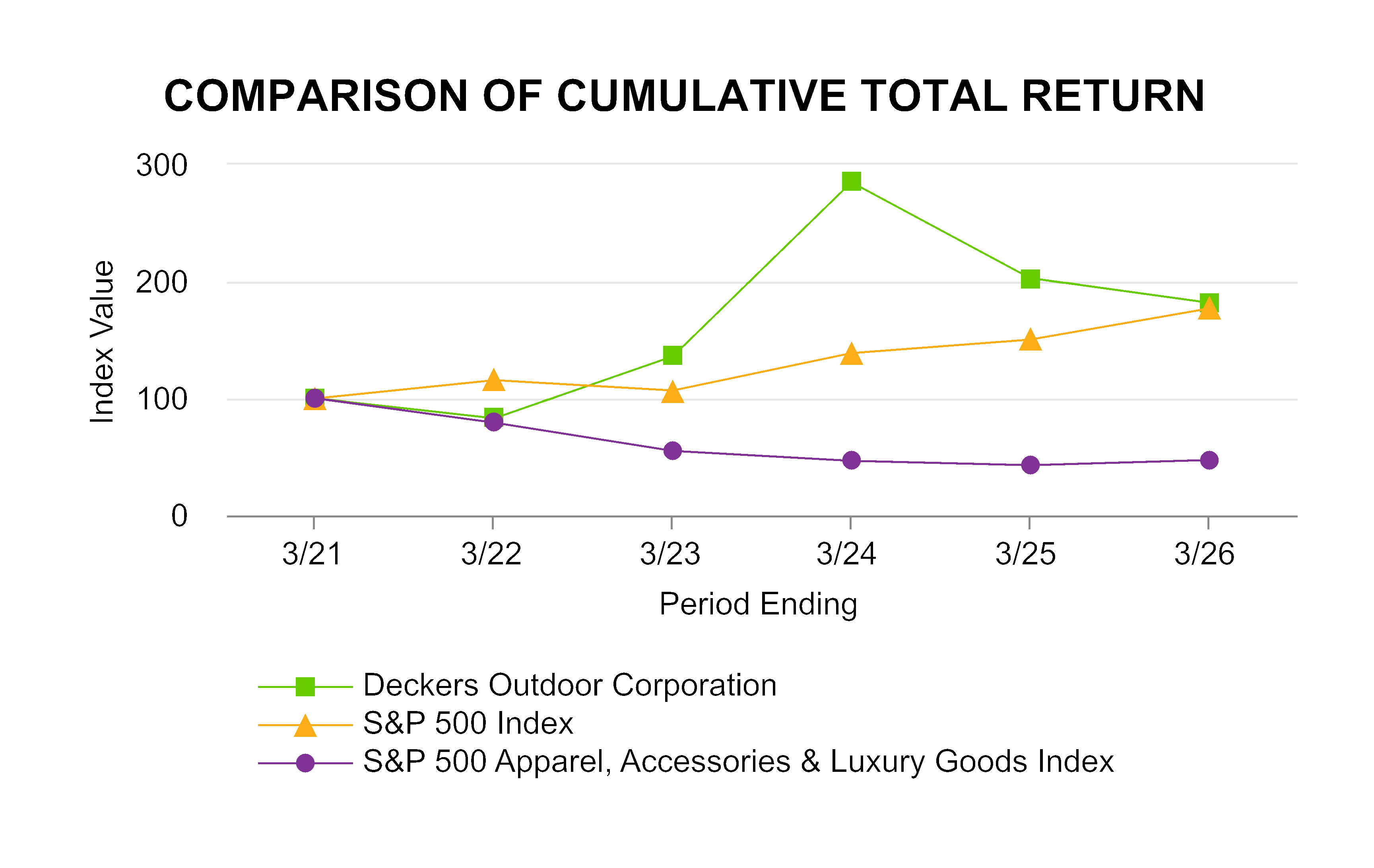
Years Ended March 31, | |||||||||||
2021 | 2022 | 2023 | 2024 | 2025 | 2026 | ||||||
Deckers Outdoor Corporation | $100.00 | $82.86 | $136.04 | $284.80 | $202.96 | $181.66 | |||||
S&P 500 Index | 100.00 | 115.65 | 106.71 | 138.59 | 150.03 | 176.74 | |||||
S&P 500 Apparel, Accessories & Luxury Goods Index | 100.00 | 79.08 | 54.79 | 46.60 | 42.58 | 46.98 | |||||
Dividend Policy
We have not declared or paid any cash dividends on our common stock since our inception. Any future decision to
declare cash dividends will be at the discretion of our Board and will depend on a number of factors, including our
financial condition, operating results, liquidity position, capital allocation strategy, and other factors our Board
considers to be relevant at the time. Our current revolving credit agreements allow us to declare and pay cash
dividends, as long as we do not exceed certain leverage ratios, and no event of default has occurred. We are in
compliance with these leverage ratios as of March 31, 2026, and no event of default has occurred. We currently do
not anticipate declaring or paying any cash dividends in the foreseeable future.
Stock Repurchase Program
Our Board has approved a stock repurchase program which authorizes us to repurchase shares of our common
stock in the open market or in privately negotiated transactions, subject to market conditions, applicable legal
requirements, and other factors (collectively, the stock repurchase program). Our Board last approved an
authorization of $2,250,000 on May 21, 2025, to repurchase shares of our common stock under the same
conditions as the prior stock repurchase program.
Our stock repurchase program does not obligate us to acquire any amount of common stock and may be
suspended at any time at our discretion.
Stock repurchase activity under our stock repurchase program during the three months ended March 31, 2026, was
as follows:
Total Number of Shares Repurchased (1) (2) | Weighted Average Price per Share | Dollar Value of Shares Repurchased (2) (3) | Dollar Value of Shares Remaining for Repurchase (2) | |||||
January 1 - January 31, 2026 | 928,296 | $102.34 | $94,999 | $1,716,214 | ||||
February 1 - February 28, 2026 | 584,036 | 116.43 | 67,999 | 1,648,215 | ||||
March 1 - March 31, 2026 | 964,893 | 102.20 | 98,613 | 1,549,602 | ||||
Total | 2,477,225 | 105.61 | $261,612 | 1,549,602 |
(1) All share repurchases were made pursuant to our stock repurchase program in open-market transactions.
(2) May not calculate on rounded amounts.
(3) The dollar value of shares repurchased excludes the cost of broker commissions, excise taxes, and other costs.
Subsequent to March 31, 2026, through May 1, 2026, we repurchased 1,096,908 shares of our common stock at a
weighted average price of $105.75 per share for $115,999. As of May 1, 2026, we had $1,433,603 remaining
authorized for repurchases under the stock repurchase program.
On May 20, 2026, our Board approved an additional authorization of $3,500,000 to repurchase shares of our
common stock under the same conditions as the prior stock repurchase program, resulting in an aggregate
remaining authorization of approximately $4,840,000 as of that date.
Refer to the section titled “Liquidity” under Part II, Item 7, “Management’s Discussion and Analysis of Financial
Condition and Results of Operations,” and Note 11, “Stockholders’ Equity,” of our consolidated financial statements
in Part IV, within this Annual Report, for further information on our stock repurchase program.
ITEM 7. MANAGEMENT’S DISCUSSION AND ANALYSIS OF FINANCIAL CONDITION AND RESULTS OF OPERATIONS |
The following discussion of our financial condition and results of operations should be read together with our
consolidated financial statements in Part IV within this Annual Report. This discussion includes an analysis of our
financial condition and results of operations for the years ended March 31, 2026, and 2025 and year-over-year
comparisons between those periods. For an analysis of our financial condition and results of operations for the
years ended March 31, 2025, and 2024 and year-over-year comparisons between those periods, refer to Part II,
Item 7, “Management’s Discussion and Analysis of Financial Condition and Results of Operations,” of our Annual
Report on Form 10-K for the fiscal year ended March 31, 2025, filed with the SEC on May 23, 2025.
Certain statements made in this section constitute “forward-looking statements,” which are subject to numerous
risks and uncertainties. Our actual results of operations may differ materially from those expressed or implied by
these forward-looking statements as a result of many factors, including those set forth in the section titled
“Cautionary Note Regarding Forward-Looking Statements” and Part I, Item 1A, “Risk Factors,” within this Annual
Report.
Unless otherwise indicated, all figures herein are expressed in thousands, except per share data. References to
“domestic” refer to the US.
Overview
We are a global leader in designing, marketing, and distributing innovative footwear, apparel, and accessories
developed for both everyday casual lifestyle use and high-performance activities. We market our products primarily
under three proprietary brands: HOKA, UGG, and Teva. Refer to the section below entitled “Reportable Operating
Segments Overview” for information regarding the phase out of standalone operations for the Koolaburra brand and
AHNU brand, and the prior sale of the Sanuk brand.
Our brands compete across the fashion and casual lifestyle, performance, running, and outdoor markets. We
believe our products are distinctive and appeal to a broad demographic. Our brands sell our products through
quality domestic and international retailers and international distributors in our wholesale channel, and directly to
global consumers through our DTC channel, which is comprised of an e‑commerce and retail store presence. We
seek to differentiate our brands and products by offering diverse lines that emphasize fashion, performance,
authenticity, functionality, quality, and comfort, and products tailored to a variety of activities, seasons, and
demographic groups. Independent third-party contractors manufacture all of our products.
Financial Highlights
Consolidated financial performance highlights for fiscal year 2026 (current period), compared to fiscal year 2025
(the prior period), were as follows:
•Net sales increased 9.8% to $5,472,296.
◦Brand
▪HOKA brand net sales increased 15.9% to $2,587,330.
▪UGG brand net sales increased 8.2% to $2,738,758.
▪Other brands net sales decreased 33.9% to $146,208.
◦Channel
▪Wholesale channel net sales increased 12.3% to $3,208,107.
▪DTC channel net sales increased 6.3% to $2,264,189.
◦Geography
▪Domestic net sales increased 0.2% to $3,191,518.
▪International net sales increased 26.8% to $2,280,778.
•Gross profit as a percentage of net sales (gross margin) decreased 20 basis points to 57.7%.
•SG&A expenses increased 11.0% to $1,894,823.
•Income from operations increased 7.1% to $1,262,903.
•Income from operations as a percentage of net sales (operating margin) decreased 50 basis points
to 23.1%.
•Diluted earnings per share increased 10.9% to $7.02 per share.
Trends And Uncertainties Impacting Our Business And Industry
Our business and industry are subject to several important trends and uncertainties, including the following:
Macroeconomic and Geopolitical Factors
•Macroeconomic factors, including inflationary pressures, increased tariffs, rising supply chain costs,
high interest rates, foreign currency exchange rate volatility, escalating global conflicts, changes in
discretionary spending, and recession risks, are creating a complex and challenging environment
for our business and industry that may continue to pressure our results of operations, including our
gross margin. For example, prolonged or escalating conflicts in the Middle East could disrupt our
supply chain and increase energy, transportation, and commodity costs, as well as cause shipping
delays. While these factors did not materially impact our results of operations during the current
period, they could negatively affect us in future periods.
•We are exposed to risks from evolving trade policies, including higher tariffs and restrictions
affecting goods imported from certain regions where we have a concentration of sourcing and
manufacturing. Recent judicial, regulatory, and administrative developments regarding tariffs
imposed under the International Emergency Economic Powers Act and other authorities have
increased uncertainty related to both our future duty costs and potential recovery of previously paid
duties. The US Customs and Border Protection have announced a phased process for submitting
refund requests; however, the availability, timing, and amount of any refunds remain uncertain. As
of March 31, 2026, we have not recognized any amounts related to potential tariff refunds or other
recoveries. We continue to monitor developments and pursue mitigation strategies, including
selective pricing actions, inventory and sourcing management, supplier diversification, and
negotiating cost-sharing arrangements; however, we may be unable to offset tariff-related cost
impacts, which could materially and adversely affect our gross margin and demand for our
products.
Brand and Omnichannel Strategy
•We are focused on increasing global consumer awareness, cultural relevance, and adoption of our
brands, which has contributed positively to our results of operations. Our global brand growth
strategy seeks to drive adoption through product innovation and marketing investments across
geographies and channels, while enhancing the customer experience through category expansion
and loyalty-driven engagement.
•We continue to manage marketplace inventory through product segmentation and differentiation.
During the current period, promotional activity slightly increased compared to exceptionally low
levels in the prior period; however, we continued to achieve high levels of full-price sell through by
aligning product assortments with marketplace demand. These efforts contributed to largely
maintaining our gross margin compared to the prior period, even as the retail environment became
more promotional. We may not realize similar gross margin benefits in our fiscal year ending
March 31, 2027 (next fiscal year) due to various factors, including the macroeconomic and
geopolitical factors discussed above and the potential impact from our pricing strategies.
•Our long-term strategy is to grow our DTC channel to represent a larger portion of our total net
sales by differentiating the consumer experience relative to the wholesale channel and driving
consumer acquisition and retention. We are investing in e-commerce platform upgrades, data
analytics, consumer experience initiatives, and selective global retail store expansion. We expect
growth in our DTC channel’s net sales to continue to positively impact our gross margin; however,
as we also seek to expand distribution with wholesale partners to drive brand awareness and
market share, our wholesale channel may represent a larger portion of our net sales in certain
periods, which could pressure gross margin in those periods.
•We are pursuing growth strategies for the HOKA brand and UGG brand to grow international sales
to represent a larger portion of our total net sales. We continue to selectively expand our HOKA
brand presence through additional wholesale partner locations and targeted DTC channel retail
store expansion. We are also investing in regions that provide influential market presence to build
brand awareness, including through the launch of our US HOKA brand loyalty program during fiscal
year 2026. We expect to continue investing in the UGG brand and HOKA brand global loyalty
programs.
•We continue to take actions to reposition the Teva brand, including refocusing certain wholesale
channel distribution toward outdoor and premium retail partners and emphasizing brand messaging
around its outdoor-adventure heritage. Our efforts to reposition the Teva brand and our future
results of operations remain uncertain. In particular, macroeconomic pressure on value‑oriented
domestic wholesale consumers may continue to adversely affect Teva brand performance.
Supply Chain
•To support our growth, we continue to invest in our global distribution network, including our
warehouses and DCs, as well as 3PLs. We also continue to diversify our independent
manufacturers and the regions in which they operate; however, we maintain a significant
concentration of sourcing and manufacturing in Southeast Asia. In addition, we are currently
transitioning one of our international 3PLs to a new partner, which may create temporary
operational risks. We expect to continue upgrading our global distribution network to continue
meeting customer and consumer demand.
Reportable Operating Segments Overview
As of March 31, 2026, our three reportable operating segments include the worldwide operations of the HOKA
brand, UGG brand, and Other brands.
HOKA Brand. The HOKA brand is an authentic premium line of year-round performance footwear, which offers
enhanced cushioning and inherent stability with minimal weight. Originally designed for ultra-runners, the brand now
appeals to world champions, tastemakers, and everyday athletes. Expansion into additional product categories,
elevated marketing campaigns, and investments in brand experiences, coupled with strategic marketplace presence
have fueled both domestic and international sales growth of the HOKA brand, which has quickly become a leading
brand within run and outdoor specialty wholesale accounts and is growing across its global marketplace. The HOKA
brand’s product line includes running, trail, hiking, fitness, and lifestyle footwear offerings, as well as apparel and
accessories.
We believe demand for HOKA brand products will continue to be driven by the following:
•Leading performance product innovation, a deep connection to culture and community, category
expansion into apparel and lifestyle, and key franchise management, including consumer led
product flow and strategic product lifecycle cadence.
•Increased global brand awareness and new consumer adoption through enhanced global marketing
activations and online consumer acquisition, including building a connected ecosystem through
social media platforms, e-commerce, and retail.
•Thoughtful and strategic distribution choices, allowing the HOKA brand access and introduction to a
broader, more diverse, consumer base.
•Strategic investment in scaling lifestyle footwear, apparel, and accessories.
UGG Brand. The UGG brand is one of the most iconic and recognized brands in our industry, which highlights our
successful track record of building niche brands into consumer-focused fashion lifestyle market leaders. Born on the
California coast to warm surfers after they caught and rode the waves, we create iconic products and experiences
that are made for people to feel comfort, softness, warmth, and confidence. With loyal consumers around the world,
innovative products, and elevated storytelling, the UGG brand has proven to be a highly resilient consumer-focused
line of premium footwear, apparel, and accessories that has driven both domestic and international sales growth
with year-round product offerings that appeal to a growing global audience and a broad demographic.
We believe demand for UGG brand products will continue to be driven by the following:
•Successful acquisition of a diverse global consumer base, and focusing on key markets, through
strategic marketing activations and collaborations that resonate with a fashionable consumer.
•High consumer brand loyalty due to elevated brand experiences and consistent delivery of crafted;
purposefully built and luxuriously comfortable footwear, apparel, and accessories.
•Diversification of our footwear product offerings, such as our spring and summer lines, as well as
expanded category offerings for Men’s products such as the slip-on shoe and sneaker category,
and more iconic fashion product for our Classics line, including reimagining existing iconic styles
into new categories.
•Continued expansion of our apparel and accessories businesses.
Other Brands. Other brands consist primarily of the Teva brand. The Teva brand’s products are built for a range of
outdoor pursuits and include a variety of footwear options, from classic sandals and shoes to boots. The Other
brands reportable operating segment includes financial results of the Koolaburra brand and AHNU brand, for which
the phase out of standalone operations were completed during the third and fourth quarters of fiscal year 2026, as
well as financial results for the former Sanuk brand during the prior period through the sale date of August 15, 2024
(Sanuk Brand Sale Date). Refer to the section titled “Reportable Operating Segments” in Note 1, “General,” of our
consolidated financial statements in Part IV within this Annual Report for further information.
Use of Non-GAAP Financial Measures
We disclose supplemental financial measures calculated and presented in accordance with generally accepted
accounting principles in the United States (US GAAP); however, throughout this Annual Report, including within our
consolidated financial statements, we provide certain financial information on a non-GAAP basis (non-GAAP
financial measures). We provide non-GAAP financial measures and information that may assist investors in
understanding our results of operations and assessing our prospects for future performance, which primarily consist
of certain constant currency measures and total segment-level financial information.
We believe presenting certain financial and operating measures on a constant currency basis is important as it
excludes the impact of foreign currency exchange rate fluctuations that are not indicative of our core results of
operations and are largely outside of our control. We calculate our constant currency non-GAAP financial measures
for current period financial information, such as total net sales using the foreign currency exchange rates that were
in effect during the previous comparable period, excluding the effects of foreign currency exchange rate hedges and
remeasurements in the consolidated financial statements. We also report comparable DTC sales on a constant
currency basis for DTC operations that were open throughout the current and prior reporting periods, and we may
adjust prior reporting periods to conform to current period accounting policies. The information presented on a
constant currency basis, as we present such information, may not necessarily be comparable to similarly titled
information presented by other companies, and may not be appropriate measures for comparing our performance
relative to other companies. Constant currency measures should not be considered in isolation, or as an alternative
to US dollar measures that reflect current period foreign currency exchange rates or to other financial or operating
measures presented in accordance with US GAAP.
We believe presenting certain segment-level operating measures, including total segment income from operations
and total segment SG&A expenses, is important because it allows for an evaluation of operating performance and
cost structure across brands. Our segment-level non-GAAP financial measures represent the results of operations
and expenses for our individual reportable operating segments and differ from our consolidated results because
they exclude certain unallocated enterprise and shared brand expenses. Our segment-level non-GAAP financial
measures should not be considered in isolation, or as an alternative to consolidated financial and operating
measures presented in accordance with US GAAP.
Seasonality
A significant part of the UGG brand’s business has historically been seasonal, with the highest percentage of net
sales occurring in the third fiscal quarter, which has contributed to variation in results of operations from quarter to
quarter. However, as the HOKA brand’s net sales have increased as a percentage of our aggregate net sales, the
impacts of seasonality have been partially mitigated as HOKA brand sales are generally more evenly distributed
throughout the fiscal year, although quarterly results may fluctuate based on the timing of product launches. This
trend is expected to continue. In addition, we have further mitigated the impacts of seasonality by diversifying and
expanding our year-round product offerings across our brands.
Results of Operations
Year Ended March 31, 2026, Compared to Year Ended March 31, 2025. Results of operations were as follows:
Years Ended March 31, | |||||||||||
2026 | 2025 | Change | |||||||||
Amount | % (1) | Amount | % (1) | Amount | % | ||||||
Net sales | $5,472,296 | 100.0% | $4,985,612 | 100.0% | $486,684 | 9.8% | |||||
Cost of sales | 2,314,570 | 42.3 | 2,099,949 | 42.1 | (214,621) | (10.2) | |||||
Gross profit | 3,157,726 | 57.7 | 2,885,663 | 57.9 | 272,063 | 9.4 | |||||
Selling, general, and administrative expenses | 1,894,823 | 34.6 | 1,706,571 | 34.3 | (188,252) | (11.0) | |||||
Income from operations | 1,262,903 | 23.1 | 1,179,092 | 23.6 | 83,811 | 7.1 | |||||
Total other income, net | (63,453) | (1.2) | (64,207) | (1.3) | (754) | (1.2) | |||||
Income before income taxes | 1,326,356 | 24.2 | 1,243,299 | 24.9 | 83,057 | 6.7 | |||||
Income tax expense | 302,285 | 5.5 | 277,208 | 5.5 | (25,077) | (9.0) | |||||
Net income | 1,024,071 | 18.7 | 966,091 | 19.4 | 57,980 | 6.0 | |||||
Total other comprehensive income, net of tax | 13,735 | 0.3 | 1,079 | — | 12,656 | 1,172.9 | |||||
Comprehensive income | $1,037,806 | 19.0% | $967,170 | 19.4% | $70,636 | 7.3% | |||||
Net income per share | |||||||||||
Basic | $7.04 | $6.36 | $0.68 | 10.7% | |||||||
Diluted | $7.02 | $6.33 | $0.69 | 10.9% | |||||||
(1) May not calculate on rounded amounts.
Net Sales. Net sales by brand, channel, and geography were as follows:
Years Ended March 31, | |||||||
2026 | 2025 | Change | |||||
Amount | Amount | Amount | % | ||||
Net sales by brand | |||||||
HOKA brand | |||||||
Wholesale | $1,651,794 | $1,397,776 | $254,018 | 18.2% | |||
Direct-to-Consumer | 935,536 | 835,314 | 100,222 | 12.0 | |||
Total | 2,587,330 | 2,233,090 | 354,240 | 15.9 | |||
UGG brand | |||||||
Wholesale | 1,444,686 | 1,282,319 | 162,367 | 12.7 | |||
Direct-to-Consumer | 1,294,072 | 1,249,032 | 45,040 | 3.6 | |||
Total | 2,738,758 | 2,531,351 | 207,407 | 8.2 | |||
Years Ended March 31, | |||||||
2026 | 2025 | Change | |||||
Amount | Amount | Amount | % | ||||
Other brands | |||||||
Wholesale | 111,627 | 175,770 | (64,143) | (36.5) | |||
Direct-to-Consumer | 34,581 | 45,401 | (10,820) | (23.8) | |||
Total | 146,208 | 221,171 | (74,963) | (33.9) | |||
Total (1) | $5,472,296 | $4,985,612 | $486,684 | 9.8% | |||
Net sales by channel | |||||||
Total Wholesale | $3,208,107 | $2,855,865 | $352,242 | 12.3% | |||
Total Direct-to-Consumer | 2,264,189 | 2,129,747 | 134,442 | 6.3 | |||
Total (1) | $5,472,296 | $4,985,612 | $486,684 | 9.8% | |||
Net sales by geography | |||||||
Domestic | $3,191,518 | $3,186,709 | $4,809 | 0.2% | |||
International | 2,280,778 | 1,798,903 | 481,875 | 26.8 | |||
Total (1) | $5,472,296 | $4,985,612 | $486,684 | 9.8% | |||
(1) The Other brands reportable operating segment for fiscal year 2026, includes financial results for the phase out of the
Koolaburra brand and AHNU brand. The Other brands reportable operating segment for the prior period includes financial
results for the former Sanuk brand through the Sanuk Brand Sale Date. Refer to the section titled “Reportable Operating
Segments Overview,” above for further information.
Total net sales increased primarily due to higher net sales for the HOKA brand and UGG brand, partially offset by
lower net sales for the Other brands. Drivers of significant changes in net sales, compared to the prior period, were
as follows:
•Net sales of the HOKA brand increased due to higher global net sales growth across both
wholesale and DTC channels. Growth was led by international sales, and also included an increase
in domestic sales, driven by our continued marketplace strategy to meet increased global demand
as consumers adopt key franchises, including new innovation introduced during the current period.
•Net sales of the UGG brand increased due to higher global net sales growth across both wholesale
and DTC channels. Growth was led by international sales, with increases in domestic sales for the
wholesale channel and a slight increase in the DTC channel. This collective growth was as a result
of increased global demand for key franchises and further adoption of year-round product offerings.
•Net sales of the Other brands decreased primarily due to lower domestic net sales in the wholesale
channel driven by the phase out of standalone operations of the Koolaburra brand and the sale of
the Sanuk brand in the prior period. The decrease was also due to lower global net sales for the
Teva brand across both channels, primarily driven by lower sales in the value-oriented consumer
segment of the wholesale channel as the Teva brand refocuses its wholesale distribution with
outdoor and premium retailers.
Supplemental Disclosure
•On a constant currency basis, net sales increased by 9.0%, compared to the prior period.
•Comparable DTC channel net sales for the 52 weeks ended March 29, 2026, increased by 4.6%,
compared to the prior period.
•We experienced an increase of 6.2% in the total volume of units sold to 78,700 from 74,100,
compared to the prior period. Units sold include all categories such as footwear, apparel,
accessories, home goods, and care kits across all brands. Percentages may not calculate on
rounded units.
Gross Profit. Gross margin decreased to 57.7% from 57.9%, compared to the prior period, primarily due to
incremental tariffs on domestic goods and a slightly unfavorable channel mix; partially offset by cost‑sharing
arrangements, strategic price increases, and favorable product mix, along with slightly favorable foreign currency
exchange rate fluctuations and freight costs.
Selling, General, and Administrative Expenses. Drivers of significant net changes in SG&A expenses, compared to
the prior period, were as follows:
•Increased advertising, marketing, and promotion expenses of approximately $63,600, primarily due
to higher promotion expenses for the HOKA brand and UGG brand of approximately $71,300 to
drive global brand awareness and market share gains, highlight new product categories, and
provide localized marketing; partially offset by lower promotion expenses for the Other brands of
approximately $7,700 primarily driven by the phase out of standalone operations of the Koolaburra
brand and AHNU brand as well as the sale of the Sanuk brand in the prior period.
•Increased other SG&A expenses of approximately $59,000, primarily due to higher IT expenses,
sales commissions, 3PL service fees, and other miscellaneous expenses. The increase in other
SG&A expenses was comprised of approximately $51,300 of variable expenses specific to our
brands, primarily for the HOKA brand and UGG brand, and approximately $7,700 of unallocated
enterprise and shared brand expenses.
•Increased rent and occupancy of approximately $36,700, primarily due to higher rent expenses for
investments in our global retail store footprint, as well as higher operating expenses for our owned
warehouses and DCs. The increase in rent and occupancy was comprised of approximately
$28,000 of expenses specific to our brands, and approximately $8,700 of unallocated enterprise
and shared brand expenses.
•Increased payroll and related costs of approximately $33,000, primarily due to higher headcount for
our brands, partially offset by unallocated enterprise and shared brand expenses. The increase in
payroll and related costs was comprised of approximately $41,700 of expenses specific to our
brands, partially offset by approximately $8,700 of lower unallocated enterprise and shared brand
expenses primarily due to payroll efficiencies in our owned warehouses and DCs.
Income from Operations. Income (loss) from operations by reportable operating segment was as follows:
Years Ended March 31, | |||||||
2026 | 2025 | Change | |||||
Amount | Amount | Amount | % | ||||
Income (loss) from operations | |||||||
HOKA brand | $910,980 | $848,505 | $62,475 | 7.4% | |||
UGG brand | 1,045,331 | 1,002,873 | 42,458 | 4.2 | |||
Other brands (1) | 16,365 | 34,578 | (18,213) | (52.7) | |||
Unallocated enterprise and shared brand expenses (2) | (709,773) | (706,864) | (2,909) | (0.4) | |||
Total | $1,262,903 | $1,179,092 | $83,811 | 7.1% | |||
(1) The Other brands reportable operating segment for fiscal year 2026, includes financial results for the phase out of the
Koolaburra brand and AHNU brand. The Other brands reportable operating segment for the prior period includes financial
results for the former Sanuk brand through the Sanuk Brand Sale Date. Refer to the section titled “Reportable Operating
Segments Overview,” above for further information.
(2) To the extent that consolidated SG&A expenses exceed reportable operating segment SG&A expenses, the costs are recorded
in unallocated enterprise and shared brand expenses. Refer to Note 13, “Reportable Operating Segments,” of our consolidated
financial statements in Part IV within this Annual Report for further information.
The increase in total income from operations, compared to the prior period, was primarily due to higher net sales,
partially offset by higher SG&A expenses as a percentage of net sales and slightly lower gross margins driven by
tariffs.
Drivers of significant net changes in total income from operations, compared to the prior period, were as follows:
•The increase in income from operations of the HOKA brand was due to higher net sales, partially
offset by lower gross margins driven by tariffs, as well as higher SG&A expenses as a percentage
of net sales driven by other SG&A expenses including sales commissions, as well as higher rent
and occupancy, payroll and related costs, and advertising, marketing and promotional expenses.
•The increase in income from operations of the UGG brand was due to higher net sales, partially
offset by slightly lower gross margins driven by tariffs, as well as higher SG&A expenses as a
percentage of net sales primarily driven by advertising, marketing, and promotion expenses, as well
as other SG&A expenses including sales commissions.
•The decrease in income from operations of Other brands was primarily driven by the Teva brand
from lower net sales and gross margins due to tariffs, along with higher SG&A expenses as a
percentage of net sales; combined with lower income from operations driven by the phase out of
standalone operations of the Koolaburra brand.
•The increase in unallocated enterprise and shared brand expenses was primarily due to higher rent
and occupancy for our owned warehouses and DCs, as well as higher other SG&A expenses
primarily related to IT expenses and 3PL service fees, partially offset by payroll efficiencies in our
owned warehouses and DCs.
Income Tax Expense. Income tax expense and our effective income tax rate were as follows:
Years Ended March 31, | |||
2026 | 2025 | ||
Income tax expense | $302,285 | $277,208 | |
Effective income tax rate | 22.8% | 22.3% | |
The net increase in our effective income tax rate, compared to the prior period, was primarily due to increases in net
unrecognized tax benefits, partially offset by tax benefits from changes to our jurisdictional mix of earnings.
Net Income. The increase in net income, compared to the prior period, was due to higher net sales, partially offset
by lower operating margin. Net income per share increased, compared to the prior period, due to higher net income
and lower weighted-average common shares outstanding driven by stock repurchases.
Total Other Comprehensive Income, Net of Tax. The increase in total other comprehensive income, net of tax,
compared to the prior period, was primarily due to higher foreign currency translation gains relating to changes in
our net asset position against European and Asian foreign currency exchange rates and higher unrealized gains on
derivative contracts.
Liquidity and Capital Resources
Our liquidity may be impacted by a number of factors, including our results of operations, the strength of our brands
and market acceptance of our products, impacts of seasonality and weather conditions, our ability to respond to
changes in consumer preferences and tastes, the timing of capital expenditures and lease payments, our ability to
collect our trade accounts receivable in a timely manner and effectively manage our inventories, our ability to
manage supply chain constraints, our ability to respond to macroeconomic, geopolitical and international trade
developments, and various other risks and uncertainties described in the section titled “Trends and Uncertainties
Impacting our Business and Industry” above and in Part I, Item 1A, “Risk Factors,” within this Annual Report.
Furthermore, our liquidity needs may evolve due to a number of factors, including changes in business conditions,
changes in strategic initiatives, including any investments or acquisitions we may decide to pursue, changes in our
capital allocation strategy, including the timing and scope of share repurchases, and changes in the macroeconomic
or geopolitical landscape.
If there are unexpected material impacts on our business in future periods, we may need to raise additional cash to
fund our operations or pursue our business strategy, in which case we may seek to borrow under our revolving
credit facilities, seek new or modified borrowing arrangements, or sell additional debt or equity securities. Incurring
indebtedness under new or modified borrowing arrangements would subject us to debt service obligations and
additional covenants that could restrict our operations and further encumber our assets. The sale of convertible debt
or equity securities could result in additional dilution to our stockholders, and equity securities may have rights or
preferences that are superior to those of our existing stockholders. Although we believe we have adequate sources
of liquidity to support our cash needs and business strategy over the long term, factors such as changes in
consumer preferences or tastes and changes in the macroeconomic or geopolitical environment could adversely
affect our liquidity and capital resources.
Sources of Liquidity. We finance our working capital and operating requirements using a combination of cash and
cash equivalents balances, cash provided by operating activities, and repatriation of cash. We also have available
borrowing capacity under our revolving credit facilities. We believe our sources of cash and cash equivalents will
provide sufficient liquidity to enable us to meet our working capital requirements and contractual obligations for at
least the next 12 months and will be sufficient to allow us to pursue our business strategies and plans.
Cash and Cash Equivalents. As of March 31, 2026, and 2025, our cash and cash equivalents balance is $1,907,249
and $1,889,188, respectively, the majority of which is held in highly rated money market funds and interest-bearing
bank deposit accounts with established national and global financial institutions.
Cash Provided by Operating Activities. For the years ended March 31, 2026, and 2025, we generated $1,181,955
and $1,044,523, respectively, of cash from operating activities. Refer to the section titled “Cash Flows” below for
further discussion on cash flows generated from ongoing operating activities.
Repatriation of Cash. Our cash repatriation strategy, and by extension, our liquidity, may be impacted by several
additional considerations, which include future changes to, or our interpretations of, global tax law and regulations,
and our actual earnings in various jurisdictions in future periods. During the years ended March 31, 2026, and 2025,
no cash and cash equivalents were repatriated from an international subsidiary that were subject to income taxes.
As of March 31, 2026, and 2025, we have $653,924 and $481,836, respectively, of cash and cash equivalents held
by international subsidiaries, a portion of which may be subject to additional foreign withholding taxes if it were to be
repatriated. We continue to evaluate our cash repatriation strategy and currently anticipate repatriating current and
future unremitted earnings of non-US subsidiaries to the extent they have been subject to US income tax, if such
cash is not required to fund ongoing international operations. Refer to Note 5, “Income Taxes,” of our consolidated
financial statements in Part IV within this Annual Report for further information regarding our cash repatriation
strategy.
During the years ended March 31, 2026, and 2025, we did not generate significant pre-tax earnings from any
countries which do not impose a corporate income tax. A small portion of our unremitted accumulated earnings of
non-US subsidiaries, for which no US federal or state income tax have been paid, are currently expected to be
reinvested outside of the US indefinitely. Such earnings would become taxable upon the sale or liquidation of these
subsidiaries.
Revolving Credit Facilities. Information about our revolving credit facilities available as of March 31, 2026, is as
follows:
•Primary Credit Facility. We have a five-year unsecured revolving credit facility, which provides for
borrowings up to $400,000 (Primary Credit Facility) and contains a $25,000 sublimit for the
issuance of letters of credit. Under the Primary Credit Facility, there is no outstanding balance,
$399,407 of available borrowings, and $593 of outstanding letters of credit.
•China Credit Facility. We have an uncommitted revolving line of credit of up to CNY300,000, or
$43,512, with an overdraft facility sublimit of CNY100,000, or $14,504 (China Credit Facility). Under
the China Credit Facility, there is no outstanding balance, $43,032 of available borrowings, and
$480 of outstanding bank guarantees.
•Debt Covenants. We are in compliance with all financial covenants under our Primary Credit Facility
and China Credit Facility.
Refer to Note 6, “Revolving Credit Facilities,” of our consolidated financial statements in Part IV within this Annual
Report for further information regarding the terms of our revolving credit facilities.
Primary Cash Requirements. Our primary cash requirements include working capital, purchase obligations,
payments to fulfill operating lease obligations, capital expenditures, and our stock repurchase program.
Working Capital. Our working capital requirements begin when we purchase materials and inventories and continue
until we collect the resulting trade accounts receivable. A significant portion of the UGG brand’s business has
historically been seasonal, with a higher concentration of net sales in the third fiscal quarter, which contributes to
variability in our working capital requirements and necessitates the use of available cash to build inventory levels in
advance of higher selling seasons. While the impact of seasonality has been partially mitigated by the increasing
contribution of HOKA brand net sales, which are generally more evenly distributed throughout the fiscal year, as
well as by the diversification and expansion of our year-round product offerings across our brands, we expect
working capital requirements to continue to fluctuate period to period.
Purchase Obligations. We have various types of purchase obligations, including obligations to purchase product,
commodities, and other purchase obligations such as service contracts, which are incurred in the normal course of
business but are considered commitments and contingencies that are not recorded in our consolidated financial
statements. As of March 31, 2026, our purchase obligations total $1,374,265. Refer to Note 8, “Commitments and
Contingencies,” of our consolidated financial statements in Part IV within this Annual Report for further information
on our purchase obligations.
Operating Lease Obligations. We primarily lease retail stores, showrooms, offices, and distribution facilities. As of
March 31, 2026, undiscounted operating lease payments recorded in the consolidated balance sheets total
$436,556. This amount excludes undiscounted minimum operating lease payments totaling $22,727 related to
leases signed during fiscal year 2026 that had not yet commenced. Refer to Note 7, “Leases,” of our consolidated
financial statements in Part IV within this Annual Report for further information on our operating lease obligations.
Capital Expenditures and Cloud Computing Arrangements. We estimate that aggregate capital expenditures and
certain implementation costs for cloud computing arrangements to be made before the end of our next fiscal year
will range from approximately $145,000 to $155,000. We anticipate these expenditures will primarily relate to
expanding and upgrading our HOKA brand and UGG brand retail store fleet, completing IT infrastructure and
system improvements, upgrading our office facilities, and upgrading our existing warehouses and DCs. However,
the actual amount of our future capital expenditures may differ significantly from this estimate depending on
numerous factors, including the timing of facility and retail store openings, as well as unforeseen needs to upgrade
or replace facilities.
Stock Repurchase Program. We continue to evaluate our capital allocation strategy and consider further
opportunities to utilize our cash resources in a way that will profitably grow our business, meet our strategic
objectives, and drive stockholder value, including by potentially repurchasing additional shares of our common
stock. As of March 31, 2026, the aggregate remaining approved amount under our stock repurchase program is
$1,549,602. Our stock repurchase program does not obligate us to acquire any amount of common stock and may
be suspended at any time at our discretion.
On May 20, 2026, our Board approved an additional authorization of $3,500,000 to repurchase shares of our
common stock under the same conditions as the prior stock repurchase program, resulting in an aggregate
remaining authorization of approximately $4,840,000 as of that date.
Refer to Note 11, “Stockholders’ Equity,” of our consolidated financial statements in Part IV and to Part II, Item 5,
“Market for Registrant’s Common Equity, Related Stockholder Matters and Issuer Purchases of Equity Securities,”
within this Annual Report for further information regarding our stock repurchase program.
Cash Flows
The following table summarizes the major components of our consolidated statements of cash flows for the periods
presented:
Years Ended March 31, | |||||||
2026 | 2025 | Change | |||||
Amount | Amount | Amount | % | ||||
Net cash provided by operating activities | $1,181,955 | $1,044,523 | $137,432 | 13.2% | |||
Net cash used in investing activities | (84,612) | (75,003) | (9,609) | (12.8) | |||
Net cash used in financing activities | (1,084,044) | (581,334) | (502,710) | (86.5) | |||
Effect of foreign currency exchange rates on cash and cash equivalents | 4,762 | (1,049) | 5,811 | 554.0 | |||
Net change in cash and cash equivalents | $18,061 | $387,137 | $(369,076) | (95.3)% | |||
Operating Activities. Our primary source of liquidity was net cash provided by operating activities, which was
driven by our net income after non-cash adjustments and changes in operating assets and liabilities.
The increase in net cash provided by operating activities during the year ended March 31, 2026, compared to the
prior period, was due to $80,635 of favorable net income after non-cash adjustments, as well as $56,797 of
favorable changes in operating assets and liabilities. Changes in operating assets and liabilities were primarily due
to favorable impacts from (1) timing of tax payments and receipts; (2) a higher rate of collections for trade accounts
receivable, net, on higher net sales; and (3) timing of purchases of inventory; partially offset by unfavorable impacts
from (4) net trade accounts payable from timing of receipts of goods and services and related disbursements; (5)
timing of derivative contract cash settlements recorded to prepaid expenses and other current assets; and (6) timing
of commodity deposits and investments in cloud computing arrangements recorded in other assets.
Investing Activities. The increase in net cash used in investing activities during the year ended March 31, 2026,
compared to the prior period, was primarily due to cash proceeds from the sale of assets received during the prior
period, partially offset by a decrease in purchases of property and equipment.
Financing Activities. The increase in net cash used in financing activities during the year ended March 31, 2026,
compared to the prior period, was primarily due to a higher dollar value of stock repurchases, inclusive of excise
taxes.
Critical Accounting Estimates
The preparation of our consolidated financial statements in accordance with US GAAP requires management to
make estimates and assumptions that affect the amounts reported. Management bases these estimates and
assumptions upon historical experience, existing and known circumstances, authoritative accounting
pronouncements, and other factors it believes to be reasonable. In addition, management has considered the
potential impact of macroeconomic and geopolitical factors on our financial condition, results of operations, and
liquidity, including inflationary pressures, increased tariffs, rising supply chain costs, high interest rates, foreign
currency exchange rate volatility, escalating global conflicts, changes in discretionary spending, and recession risks.
Although the full impact of these factors is unknown, management believes it has made appropriate accounting
estimates and assumptions based on the facts and circumstances available as of the reporting date. However,
actual results could differ materially from these estimates and assumptions, which may result in material effects on
our financial condition, results of operations and liquidity.
We believe the following critical accounting estimates involve a significant level of estimation uncertainty and the
balances have had or are reasonably likely to have a material impact on our financial condition or results of
operations. Refer to Note 1, “General,” of our consolidated financial statements in Part IV within this Annual Report
for further discussion of our significant accounting policies and use of estimates, as well as the impact of recent
accounting pronouncements.
Sales Returns and Chargebacks. Revenue is recognized net of estimates, including for sales returns and
chargebacks. Actual sales returns and chargebacks may differ from our estimates and are based on various factors
including the following:
Sales Return Liability. The estimate of the sales return liability is determined based on several factors, including
known and actual returns, historical returns, and any recent events that could result in a change from historical
return rates. For our wholesale channel, we base our estimate of sales returns on approved customer return
requests, historical returns experience, and recent events that may affect expected return rates. For our DTC
channel, we estimate sales returns using a lag compared to the prior period and consider historical experience and
recent events or trends that may affect expected return rates.
Allowance for Chargebacks. We record a chargeback allowance based primarily on known circumstances, such as
price adjustments and short shipments, as well as unknown circumstances based on historical trends related to the
timing and amount of chargebacks taken against customer invoices.
Refer to Note 2, “Revenue Recognition and Business Concentrations,” of our consolidated financial statements and
Schedule II, “Total Valuation and Qualifying Accounts,” in Part IV within this Annual Report for further information
regarding the sales return liability and the allowance for chargebacks.
Allowance for Doubtful Accounts. We provide an allowance against trade accounts receivable for estimated
losses that may result from customers’ inability to pay. We determine the amount of the allowance by analyzing
known uncollectible accounts, aged trade accounts receivable, macroeconomic and geopolitical conditions and
forecasts, historical experience, and the customers’ creditworthiness. Changes in the characteristics of our trade
accounts receivable including the aforementioned factors, are reviewed periodically and may lead to adjustments in
our allowance for doubtful accounts. Actual future losses from uncollectible accounts may differ from our estimates.
Refer to Schedule II, “Total Valuation and Qualifying Accounts,” in Part IV within this Annual Report for further
information on our allowance for doubtful accounts.
Inventories. Inventories, which are primarily comprised of finished goods on hand and in transit, are stated at the
lower of cost (weighted moving average) or net realizable value at each financial statement date. Net realizable
value is the estimated selling price in the ordinary course of business, less reasonably predictable costs to sell.
We regularly review inventory for excess, obsolete, and impaired inventory to evaluate write-downs to the lower of
cost or net realizable value. Factors that may trigger inventory write-downs include damage, obsolescence, excess
quantities, discontinued styles, and declines in estimated selling prices, among others. Our evaluation considers
current and anticipated demand, historical liquidation and shrinkage experience, aging of inventory, and current
market conditions.
While we believe that adequate write-downs for inventory have been provided for in the consolidated financial
statements, our evaluation may be affected by factors outside our control, and we could experience additional
inventory write-downs in the future.
Income Taxes. Income taxes are accounted for using the asset and liability method. Deferred tax assets and
liabilities are recognized for the future tax consequences attributable to temporary differences between the financial
statement carrying amounts of existing assets and liabilities and their respective tax bases. Deferred tax assets and
liabilities are measured using enacted tax rates that will be in effect for the years in which those tax assets and
liabilities are expected to be realized or settled.
We record a valuation allowance to reduce deferred tax assets to the amount that is believed more likely than not to
be realized. We believe it is more likely than not that forecasted income, together with future reversals of existing
taxable temporary differences, will be sufficient to recover our net deferred tax assets, after consideration of
valuation allowances, which primarily relate to foreign losses in certain jurisdictions. If we determine all, or part of
our deferred tax assets are not realizable, or that additional deferred tax assets have become realizable, we will
adjust the valuation allowance accordingly, with a corresponding impact to earnings in the period such
determination is made.
We make estimates to determine income tax expense, deferred tax assets and liabilities, and uncertain tax
positions. Our estimates, relative to income tax expense, consider current global tax laws and regulations (and our
interpretations thereof) and possible outcomes of current and future audits conducted by foreign and domestic tax
authorities. Changes in tax laws and regulations (and our interpretations thereof), and the resolution of current and
future tax audits, could significantly affect the amounts provided for income tax expense in our results of operations.
Our estimates related to tax benefits from uncertain tax positions consider whether a tax position is more likely than
not to be sustained on examination by the taxing authorities, based on the technical merits of the position and the
largest benefit that has a greater than 50% likelihood of being realized upon ultimate settlement. Resolution of these
uncertainties may result in the recognition of a tax benefit or an additional tax charge in the period our assessment
changes.
We determine on a regular basis the amount of undistributed earnings that will be indefinitely reinvested in our non-
US operations. This assessment is based on the cash flow projections and operational and fiscal objectives of each
of our US and international subsidiaries. We have not changed our indefinite reinvestment assertion of foreign
earnings other than previously taxed earnings and profits.
Refer to Note 5, “Income Taxes,” of our consolidated financial statements in Part IV within this Annual Report for
further information on our income taxes and tax strategy.
ITEM 7A. QUANTITATIVE AND QUALITATIVE DISCLOSURES ABOUT MARKET RISK |
In the normal course of business, our financial condition and results of operations are subject to a variety of market
risks, including those associated with commodity prices; foreign currency exchange rates; and inflation, and, to a
lesser extent, interest rates and credit risks. We regularly assess these risks and have established policies and
business practices designed to mitigate their effects. There have been no material changes in our primary risk
exposures or management of market risks since the prior year.
Commodity Price Risk
We are exposed to commodity price fluctuations associated with the cost of raw materials used in our
manufacturing process, including sheepskin and sugarcane-derived ethylene-vinyl acetate (sugarcane-derived EVA)
(collectively, commodities). The supply of sheepskin, which is used to manufacture a significant portion of our UGG
brand products, is in high demand and there are limited suppliers that are able to provide the quantity and quality of
sheepskin that we require. To manage price volatility and ensure availability for our commodities, we currently enter
into fixed purchasing contracts with designated suppliers of sheepskin and sugarcane-derived EVA. Our fixed
pricing agreements are non-cancellable and may be subject to fees, including certain sheepskin purchasing
contracts requiring deposits when minimum volumes are not fully consumed. In the event of significant price
increases for our commodities, we will likely not be able to adjust our selling prices sufficiently to eliminate the
impact of such increases on our profitability. We continue to evaluate our fixed pricing agreement strategy for our
commodities.
Refer to Note 8, “Commitments and Contingencies,” of our consolidated financial statements in Part IV within this
Annual Report for further information on purchase obligations for commodities.
Foreign Currency Exchange Rate Risk
Although most of our sales and inventory purchases are denominated in US dollars, our global operations in the
international markets where our products are sold and manufactured expose us to risk of foreign currency exchange
rate fluctuations between the US dollar and primarily the currencies of Europe, Asia, Canada, and Latin America.
We are exposed to financial statement transaction gains and losses as a result of remeasuring our monetary assets
and liabilities that are denominated in currencies other than our subsidiaries’ functional currencies. We hedge
certain foreign currency exchange rate risks arising from existing assets and liabilities, as well as forecasted sales.
As our international operations grow and we increase purchases and sales in foreign currencies, we will continue to
evaluate our hedging strategy and may utilize additional derivative instruments to hedge our foreign currency
exchange rate risk.
Foreign currency exchange rate fluctuations affect our results of operations and can make comparisons from year to
year more difficult. Foreign currency exchange rates at the end of the reporting period used to remeasure monetary
assets and liabilities (excluding the effect from derivative instruments) had a positive but immaterial impact on our
income from operations for the year ended March 31, 2026.
We use a sensitivity analysis technique to evaluate the effect that changes in the market value of foreign exchange
currencies will have on our forward foreign exchange contracts. As of March 31, 2026, a hypothetical 10% foreign
currency exchange rate fluctuation would have caused the fair value of our financial instruments on our
consolidated balance sheets to change by approximately $34,500. As of March 31, 2026, there are no known
factors that we expect to result in a material change in the near-term in the general nature of our primary foreign
currency exchange rate risk exposure. Refer to the section titled “Summary of Significant Accounting Policies” in
Note 1, “General,” and Note 10, “Derivative Instruments,” of our consolidated financial statements in Part IV within
this Annual Report for further information on our use of derivative contracts and related accounting policies.
We do not, and do not intend to, engage in the practice of trading forward foreign currency exchange rate derivative
securities for profit.
Inflation Risk
Inflationary pressures, including higher supply chain, labor and overhead, and raw material costs, may adversely
affect our financial condition and operating results unless we are able to offset these increases through strategic
product price increases, negotiating cost-sharing arrangements with suppliers, or generating operating cost
efficiencies. Inflation could also reduce consumer confidence and discretionary spending, which could negatively
impact the demand for our products.
Interest Rate Risk
Our exposure to market risk for interest rates primarily relates to our cash and cash equivalents balances, and our
revolving credit facilities.
As of March 31, 2026, we had a cash and cash equivalents balance of $1,907,249. Our cash and cash equivalents
balances include cash on hand, demand deposits, and other highly liquid investments, such as money-market
funds, with an original maturity of three months or less. Cash and cash equivalents held by us are affected by
variable, short-term, market interest rates. Interest rates fluctuate as a result of many factors, including
governmental monetary policies, domestic and international economic and political considerations, and other factors
that are beyond our control. Using our average invested cash equivalents balance for the year ended March 31,
2026, the hypothetical effect of a 100 basis point change in applicable interest rates would result in a change of
approximately $16,300 to interest income recorded in our consolidated statements of comprehensive income, along
with our operating cash flows, but would not impact the fair market value of the related underlying instruments.
Refer to the section titled “Summary of Significant Accounting Policies” in Note 1, “General,” and Note 4, “Fair Value
Measurements,” of our consolidated financial statements in Part IV within this Annual Report for further information
on our cash and cash equivalents.
Because our revolving credit facilities bear interest at variable, short-term rates we are exposed to changes in
market interest rates that could impact the cost of servicing debt. As there were no outstanding balances under our
revolving credit facilities as of March 31, 2026, a 100 basis point change in applicable interest rates would have
resulted in no change to interest expense recorded in our consolidated statements of comprehensive income during
the year ended March 31, 2026. Refer to Note 6, “Revolving Credit Facilities,” of our consolidated financial
statements in Part IV within this Annual Report for further information on our revolving credit facilities.
We do not, and do not intend to, engage in any interest rate hedging activity. We also do not, and do not intend to,
engage in the practice of trading interest rate derivative securities for profit.
Credit Risk
We have cash on deposit with various large, reputable financial institutions and have invested in highly rated money
market funds. The amount of cash and cash equivalents held with certain financial institutions exceeds government‐
insured limits, and we may purchase investments not guaranteed by the government. Accordingly, there is a risk
that we will not recover the full principal of our investments or that their liquidity may be diminished.
We are also exposed to credit‐related losses in the event of nonperformance by the financial institutions that are
counterparties to our forward currency exchange rate forward contracts. The credit risk amount is our unrealized
gains on our derivative instruments, based on foreign currency exchange rates at the time of nonperformance.
To mitigate our credit risk, we have adopted the global investment policy and the foreign exchange risk
management policy that emphasizes preservation of principal and liquidity. Consistent with these policies, we seek
to enter into transactions with creditworthy and reputable financial institutions, by monitoring their credit standing,
and by limiting exposure to any one counterparty. We have not experienced material credit losses, and do not
believe our credit risk exposure is significant.
ITEM 8. FINANCIAL STATEMENTS AND SUPPLEMENTARY DATA |
The Consolidated Financial Statements, the Financial Statement Schedule, and the Reports of Independent
Registered Public Accounting Firm, are filed in a separate section following Part IV, as shown on the index under
Item 15, “Exhibits and Financial Statement Schedules,” within this Annual Report.
ITEM 9A. CONTROLS AND PROCEDURES |
Disclosure Controls and Procedures
We maintain a system of disclosure controls and procedures, as defined in Rule 13a-15(e) under the Exchange Act,
which are designed to provide reasonable assurance that information required to be disclosed in the reports that we
file or submit under the Exchange Act is recorded, processed, summarized, and reported within the time periods
specified in the SEC’s rules and forms. Our disclosure controls and procedures also include controls and
procedures designed to reasonably ensure that such information is accumulated and communicated to
management, including our Principal Executive Officer (PEO) and Principal Financial and Accounting Officer
(PFAO), as appropriate, to allow timely decisions regarding required disclosure.
In designing and evaluating our disclosure controls and procedures, our management recognized that any system
of controls and procedures, no matter how well designed and operated, can provide only reasonable assurance of
achieving the desired control objectives and management necessarily is required to apply its judgment in evaluating
the cost-benefit relationship of possible controls and procedures. In addition, the design of any system of controls is
based in part upon certain assumptions about the likelihood of future events, and there can be no assurance that
any design will succeed in achieving its stated goals under all potential future conditions. Over time, controls may
become inadequate because of changes in conditions, or the degree of compliance with policies or procedures may
deteriorate. Because of the inherent limitations in any system of controls, misstatements due to error or fraud may
occur and not be detected, and controls may be circumvented or overridden.
Under the supervision and with the participation of management, we conducted an evaluation of the effectiveness of
the design and operation of our disclosure controls and procedures as of March 31, 2026. Based on that evaluation,
our PEO and PFAO concluded that our disclosure controls and procedures are effective at a reasonable assurance
level as of March 31, 2026.
Management’s Report on Internal Control over Financial Reporting
Management is responsible for establishing and maintaining adequate internal control over financial reporting (as
defined in Rule 13a-15(f) under the Exchange Act). Our internal control over financial reporting is a process
designed by, or under the supervision of, our PEO and PFAO to provide reasonable assurance regarding the
reliability of financial reporting and the preparation of our financial statements for external reporting purposes in
accordance with US GAAP. Our internal control over financial reporting includes those policies and procedures that
(1) pertain to the maintenance of records that, in reasonable detail, accurately and fairly reflect our transactions and
dispositions of assets; (2) provide reasonable assurance that transactions are recorded as necessary to permit
preparation of financial statements in accordance with US GAAP, and that our receipts and expenditures are being
made only in accordance with authorizations of our management and directors; and (3) provide reasonable
assurance regarding prevention or timely detection of unauthorized acquisition, use, or disposition of our assets that
could have a material effect on our financial statements. Because of inherent limitations, internal control over
financial reporting may not prevent or detect misstatements. Also, projections of any evaluation of effectiveness to
future periods are subject to the risk that controls may become inadequate because of changes in conditions, or that
the degree of compliance with the policies or procedures may deteriorate.
As of March 31, 2026, our management, including our PEO and PFAO, assessed the effectiveness of our internal
control over financial reporting using the criteria set forth in Internal Control — Integrated Framework (2013) issued
by the Committee of Sponsoring Organizations of the Treadway Commission (commonly referred to as COSO).
Based on this assessment, our management concluded that our internal control over financial reporting was
effective based on these criteria. The registered public accounting firm that audited our consolidated financial
statements in Part IV within this Annual Report has issued an attestation report on our internal control over financial
reporting. Refer to Part IV, “Report of Independent Registered Public Accounting Firm - Internal Control Over
Financial Reporting,” within this Annual Report.
Changes in Internal Control over Financial Reporting
There were no changes in our internal control over financial reporting identified in management’s evaluation
pursuant to Rule 13a-15(d) of the Exchange Act during the three months ended March 31, 2026, that have
materially affected, or are reasonably likely to materially affect, our internal control over financial reporting.
PEO and PFAO Certifications
The certifications of our PEO and PFAO required by Rule 13a-14(a) of the Exchange Act, adopted pursuant to
Section 302 of the Sarbanes-Oxley Act of 2002 (“SOX”), are filed as Exhibit 31.1 and Exhibit 31.2, and the
certifications required by 18 U.S.C. Section 1350, adopted pursuant to Section 906 of SOX, are furnished as Exhibit
32.1, to this Annual Report. This Part II, Item 9A, should be read in conjunction with such certifications for a more
complete understanding of the topics presented.
ITEM 9B. OTHER INFORMATION |
Director and Executive Officer Trading Plans and Arrangements
Our directors and executive officers may enter into trading plans or other arrangements with financial institutions to
purchase or sell shares of our common stock. These plans or arrangements may constitute Rule 10b5-1 trading
arrangements or non-Rule 10b5-1 trading arrangements, in each case as defined under Item 408(a) of Regulation
S-K.
officers with respect to Rule 10b5-1 trading plans during the three months ended March 31, 2026:
Name & Title | Adoption Date | Termination Date | Contract End Date | Aggregate Shares Covered (in ones) (1) | ||||
* | ||||||||
* |
*Not applicable.
(1) The actual number of shares sold under the plan may depend on the vesting of certain performance-based equity awards and
the number of shares withheld by us to satisfy our income tax withholding obligations and may vary from the number provided
herein.
During the three months ended March 31, 2026, no non-Rule 10b5-1 trading arrangements were adopted , modified,
or terminated by our directors or executive officers.

PART III
ITEM 10. DIRECTORS, EXECUTIVE OFFICERS, AND CORPORATE GOVERNANCE |
The information required by this item will be disclosed in our definitive proxy statement on Schedule 14A (Proxy
Statement) for our 2026 annual meeting of stockholders and is incorporated herein by reference. Our Proxy
Statement will be filed with the SEC within 120 days after the end of the year ended March 31, 2026, pursuant to
Regulation 14A under the Exchange Act.
ITEM 11. EXECUTIVE COMPENSATION |
The information required by this item will be disclosed in the Proxy Statement and is incorporated herein by
reference.
ITEM 12. SECURITY OWNERSHIP OF CERTAIN BENEFICIAL OWNERS AND MANAGEMENT AND RELATED STOCKHOLDER MATTERS |
The information required by this item will be disclosed in the Proxy Statement and is incorporated herein by
reference.
ITEM 13. CERTAIN RELATIONSHIPS AND RELATED TRANSACTIONS, AND DIRECTOR INDEPENDENCE |
The information required by this item will be disclosed in the Proxy Statement and is incorporated herein by
reference.
ITEM 14. PRINCIPAL ACCOUNTANT FEES AND SERVICES |
The information required by this item will be disclosed in the Proxy Statement and is incorporated herein by
reference.

PART IV
ITEM 15. EXHIBITS AND FINANCIAL STATEMENT SCHEDULES |
Refer to Part IV, “Index to Consolidated Financial Statements and Financial Statement Schedules,” on page F-1
within this Annual Report for our Consolidated Financial Statements and the Reports of Independent Registered
Public Accounting Firm.
EXHIBIT INDEX
Exhibit Number | Description of Exhibit | |
3.1 | ||
3.2 | ||
4.1 | ||
10.1 | ||
†10.2 | ||
†10.3 | ||
10.4 | ||
†10.5 | ||
†10.6 | ||
#10.7 |
Exhibit Number | Description of Exhibit | |
#10.8 | ||
#10.9 | ||
#10.10 | ||
#10.11 | ||
#10.12 | ||
#10.13 | ||
#10.14 | ||
#10.15 | ||
#10.16 | ||
†#10.17 | ||
#10.18 | ||
†#10.19 | ||
#10.20 | ||
†#10.21 | ||
19.1 | ||
*21.1 | ||
*23.1 | ||
*24.1 | ||
*31.1 | ||
*31.2 | ||
**32.1 | ||
97.1 |
Exhibit Number | Description of Exhibit | |
*101.INS | Inline XBRL Instance Document (the instance document does not appear in the Interactive Data File because its XBRL tags are embedded within the Inline XBRL document) | |
*101.SCH | Inline XBRL Taxonomy Extension Schema Document | |
*101.CAL | Inline XBRL Taxonomy Extension Calculation Linkbase Document | |
*101.DEF | Inline XBRL Taxonomy Extension Definition Linkbase Document | |
*101.LAB | Inline XBRL Taxonomy Extension Label Linkbase Document | |
*101.PRE | Inline XBRL Taxonomy Extension Presentation Linkbase Document | |
*104 | Cover Page Interactive Data File (formatted as Inline XBRL and contained in Exhibit 101) |
* Filed herewith.
** Furnished herewith.
# Management contract or compensatory plan or arrangement.
† Certain of the schedules (and similar attachments) to this exhibit have been omitted in accordance with Item
601(a)(5) of Regulation S-K. A copy of any omitted schedule (or similar attachment) will be furnished to the
Securities and Exchange Commission upon request.
SIGNATURES
Pursuant to the requirements of Section 13 or 15(d) of the Securities Exchange Act of 1934, the registrant has duly
caused this report to be signed on its behalf by the undersigned, thereunto duly authorized.
DECKERS OUTDOOR CORPORATION (Registrant) |
/s/ STEVEN J. FASCHING |
Steven J. Fasching Chief Financial Officer (Principal Financial and Accounting Officer) |
Date: May 22, 2026
Power of Attorney
KNOW ALL PERSONS BY THESE PRESENTS, that each person whose signature appears below constitutes and
appoints Stefano Caroti and Steven J. Fasching, jointly and severally, his or her attorneys-in-fact, each with the
power of substitution, for him or her in any and all capacities, to sign any amendments to this Annual Report on
Form 10-K, and to file the same, with exhibits thereto and other documents in connection therewith, with the
Securities and Exchange Commission, hereby ratifying and confirming all that each of said attorneys-in-fact, or his
substitute or substitutes, may do or cause to be done by virtue hereof.
Pursuant to the requirements of the Securities Exchange Act of 1934, this report has been signed below by the
following persons on behalf of the registrant and in the capacities and on the dates indicated.
/s/ STEFANO CAROTI | Chief Executive Officer, President, and Director (Principal Executive Officer) | May 22, 2026 |
Stefano Caroti | ||
/s/ STEVEN J. FASCHING | Chief Financial Officer (Principal Financial and Accounting Officer) | May 22, 2026 |
Steven J. Fasching | ||
/s/ CYNTHIA (CINDY) L. DAVIS | Chair of the Board | May 22, 2026 |
Cynthia (Cindy) L. Davis | ||
/s/ DAVID A. BURWICK | Director | May 22, 2026 |
David A. Burwick | ||
/s/ NELSON C. CHAN | Director | May 22, 2026 |
Nelson C. Chan | ||
/s/ JUAN R. FIGUEREO | Director | May 22, 2026 |
Juan R. Figuereo | ||
/s/ PATRICK J. GRISMER | Director | May 22, 2026 |
Patrick J. Grismer | ||
/s/ MAHA S. IBRAHIM | Director | May 22, 2026 |
Maha S. Ibrahim | ||
/s/ VICTOR LUIS | Director | May 22, 2026 |
Victor Luis | ||
/s/ LAURI M. SHANAHAN | Director | May 22, 2026 |
Lauri M. Shanahan | ||
/s/ BONITA C. STEWART | Director | May 22, 2026 |
Bonita C. Stewart |
DECKERS OUTDOOR CORPORATION AND SUBSIDIARIES
INDEX TO CONSOLIDATED FINANCIAL STATEMENTS
AND FINANCIAL STATEMENT SCHEDULES
All other schedules are omitted because they are not applicable, or the required information is shown in the
consolidated financial statements or accompanying notes thereto.
Report of Independent Registered Public Accounting Firm
To the Stockholders and Board of Directors
Deckers Outdoor Corporation:
Opinion on the Consolidated Financial Statements
We have audited the accompanying consolidated balance sheets of Deckers Outdoor Corporation and subsidiaries (the
Company) as of March 31, 2026, and 2025, the related consolidated statements of comprehensive income, stockholders’
equity, and cash flows for each of the years in the three-year period ended March 31, 2026, and the related notes and
financial statement schedule (collectively, the consolidated financial statements). In our opinion, the consolidated financial
statements present fairly, in all material respects, the financial position of the Company as of March 31, 2026, and 2025,
and the results of its operations and its cash flows for each of the years in the three-year period ended March 31, 2026, in
conformity with U.S. generally accepted accounting principles.
We also have audited, in accordance with the standards of the Public Company Accounting Oversight Board (United
States) (PCAOB), the Company’s internal control over financial reporting as of March 31, 2026, based on criteria
established in Internal Control – Integrated Framework (2013) issued by the Committee of Sponsoring Organizations of
the Treadway Commission, and our report dated May 22, 2026 expressed an unqualified opinion on the effectiveness of
the Company’s internal control over financial reporting.
Basis for Opinion
These consolidated financial statements are the responsibility of the Company’s management. Our responsibility is to
express an opinion on these consolidated financial statements based on our audits. We are a public accounting firm
registered with the PCAOB and are required to be independent with respect to the Company in accordance with the U.S.
federal securities laws and the applicable rules and regulations of the Securities and Exchange Commission and the
PCAOB.
We conducted our audits in accordance with the standards of the PCAOB. Those standards require that we plan and
perform the audit to obtain reasonable assurance about whether the consolidated financial statements are free of material
misstatement, whether due to error or fraud. Our audits included performing procedures to assess the risks of material
misstatement of the consolidated financial statements, whether due to error or fraud, and performing procedures that
respond to those risks. Such procedures included examining, on a test basis, evidence regarding the amounts and
disclosures in the consolidated financial statements. Our audits also included evaluating the accounting principles used
and significant estimates made by management, as well as evaluating the overall presentation of the consolidated
financial statements. We believe that our audits provide a reasonable basis for our opinion.
Critical Audit Matter
The critical audit matter communicated below is a matter arising from the current period audit of the consolidated financial
statements that was communicated or required to be communicated to the audit and risk management committee and
that: (1) relates to accounts or disclosures that are material to the consolidated financial statements and (2) involved our
especially challenging, subjective, or complex judgments. The communication of a critical audit matter does not alter in
any way our opinion on the consolidated financial statements, taken as a whole, and we are not, by communicating the
critical audit matter below, providing a separate opinion on the critical audit matter or on the accounts or disclosures to
which it relates.
Wholesale sales return liability
As discussed in Note 1 and Note 2 to the consolidated financial statements, the Company has recorded a sales
return liability as of March 31, 2026, of $80,055, of which $63,907 is related to the wholesale channel. The Company
records an allowance for anticipated future returns of goods shipped prior to the end of the reporting period. Amounts
of these reserves are based on known and actual returns, historical returns, and any recent events that could result
in a change from historical return rates.
We identified the evaluation of the wholesale sales return liability as a critical audit matter. There was a high degree
of auditor judgment required to evaluate recent events that could result in a change from historical return rates used
to estimate the wholesale sales return liability.
Report of Independent Registered Public Accounting Firm
The following are the primary procedures we performed to address this critical audit matter. We evaluated the design
and tested the operating effectiveness of certain internal controls related to the Company’s process for estimating
the wholesale sales return liability, including controls related to the development of estimated return rates. We
evaluated the wholesale sales return liability using a combination of Company internal data, known recent trends,
and actual and historical known information. We analyzed the Company’s internal data and external correspondence
to assess adjustments made by management, if any, to historical return rates based on consideration of recent
events. We assessed the Company’s ability to accurately estimate the wholesale sales return liability by comparing
the historically recorded sales return liability to actual subsequent product returns. We also analyzed actual product
returns received after year-end but prior to the issuance of the consolidated financial statements.
/s/ KPMG LLP
We have served as the Company’s auditor since 1992.
Los Angeles, California
May 22, 2026
Report of Independent Registered Public Accounting Firm
To the Stockholders and Board of Directors
Deckers Outdoor Corporation:
Opinion on Internal Control Over Financial Reporting
We have audited Deckers Outdoor Corporation and subsidiaries’ (the Company) internal control over financial reporting as
of March 31, 2026, based on criteria established in Internal Control – Integrated Framework (2013) issued by the
Committee of Sponsoring Organizations of the Treadway Commission. In our opinion, the Company maintained, in all
material respects, effective internal control over financial reporting as of March 31, 2026, based on criteria established in
Internal Control – Integrated Framework (2013) issued by the Committee of Sponsoring Organizations of the Treadway
Commission.
We also have audited, in accordance with the standards of the Public Company Accounting Oversight Board (United
States) (PCAOB), the consolidated balance sheets of the Company as of March 31, 2026 and 2025, the related
consolidated statements of comprehensive income, stockholders’ equity, and cash flows for each of the years in the three-
year period ended March 31, 2026, and the related notes and financial statement schedule (collectively, the consolidated
financial statements), and our report dated May 22, 2026 expressed an unqualified opinion on those consolidated financial
statements.
Basis for Opinion
The Company’s management is responsible for maintaining effective internal control over financial reporting and for its
assessment of the effectiveness of internal control over financial reporting, included in the accompanying Management’s
Report on Internal Control over Financial Reporting. Our responsibility is to express an opinion on the Company’s internal
control over financial reporting based on our audit. We are a public accounting firm registered with the PCAOB and are
required to be independent with respect to the Company in accordance with the U.S. federal securities laws and the
applicable rules and regulations of the Securities and Exchange Commission and the PCAOB.
We conducted our audit in accordance with the standards of the PCAOB. Those standards require that we plan and
perform the audit to obtain reasonable assurance about whether effective internal control over financial reporting was
maintained in all material respects. Our audit of internal control over financial reporting included obtaining an
understanding of internal control over financial reporting, assessing the risk that a material weakness exists, and testing
and evaluating the design and operating effectiveness of internal control based on the assessed risk. Our audit also
included performing such other procedures as we considered necessary in the circumstances. We believe that our audit
provides a reasonable basis for our opinion.
Definition and Limitations of Internal Control Over Financial Reporting
A company’s internal control over financial reporting is a process designed to provide reasonable assurance regarding the
reliability of financial reporting and the preparation of financial statements for external purposes in accordance with
generally accepted accounting principles. A company’s internal control over financial reporting includes those policies and
procedures that (1) pertain to the maintenance of records that, in reasonable detail, accurately and fairly reflect the
transactions and dispositions of the assets of the company; (2) provide reasonable assurance that transactions are
recorded as necessary to permit preparation of financial statements in accordance with generally accepted accounting
principles, and that receipts and expenditures of the company are being made only in accordance with authorizations of
management and directors of the company; and (3) provide reasonable assurance regarding prevention or timely
detection of unauthorized acquisition, use, or disposition of the company’s assets that could have a material effect on the
financial statements.
Because of its inherent limitations, internal control over financial reporting may not prevent or detect misstatements. Also,
projections of any evaluation of effectiveness to future periods are subject to the risk that controls may become
inadequate because of changes in conditions, or that the degree of compliance with the policies or procedures may
deteriorate.
/s/ KPMG LLP
Los Angeles, California
May 22, 2026
DECKERS OUTDOOR CORPORATION AND SUBSIDIARIES
CONSOLIDATED BALANCE SHEETS
(amounts in thousands, except par value)
As of March 31, | |||
2026 | 2025 | ||
ASSETS | |||
Cash and cash equivalents | $ | $ | |
Inventories | |||
Prepaid expenses | |||
Other current assets | |||
Income tax receivable | |||
Total current assets | |||
Property and equipment, net of accumulated depreciation ($ | |||
Operating lease assets | |||
Other intangible assets, net of accumulated amortization ($ | |||
Other assets | |||
Total assets | $ | $ | |
LIABILITIES AND STOCKHOLDERS’ EQUITY | |||
Trade accounts payable | $ | $ | |
Accrued payroll | |||
Other accrued expenses | |||
Income tax payable | |||
Value added tax payable | |||
Total current liabilities | |||
Income tax liability | |||
Other long-term liabilities | |||
Total long-term liabilities | |||
Commitments and contingencies (Note 8) | |||
Stockholders’ equity | |||
Common stock ($ and March 31, 2025, respectively) | |||
Additional paid-in capital | |||
Retained earnings | |||
( | ( | ||
Total stockholders’ equity | |||
Total liabilities and stockholders’ equity | $ | $ | |
See accompanying notes to the consolidated financial statements.
DECKERS OUTDOOR CORPORATION AND SUBSIDIARIES
CONSOLIDATED STATEMENTS OF COMPREHENSIVE INCOME
(amounts in thousands, except per share data)
Years Ended March 31, | |||||
2026 | 2025 | 2024 | |||
$ | $ | $ | |||
Cost of sales | |||||
Gross profit | |||||
Interest income | ( | ( | ( | ||
Interest expense | |||||
Other (income) expense, net | ( | ( | |||
Total other income, net | ( | ( | ( | ||
Income before income taxes | |||||
Net income | |||||
Other comprehensive income (loss), net of tax | |||||
Unrealized gain on cash flow hedges | |||||
Foreign currency translation gain (loss) | ( | ( | |||
Total other comprehensive income (loss), net of tax | ( | ||||
Comprehensive income | $ | $ | $ | ||
Net income per share | |||||
Basic | $ | $ | $ | ||
Diluted | $ | $ | $ | ||
Basic | |||||
Diluted | |||||
See accompanying notes to the consolidated financial statements.
DECKERS OUTDOOR CORPORATION AND SUBSIDIARIES
CONSOLIDATED STATEMENTS OF STOCKHOLDERS’ EQUITY
(amounts in thousands)
Common Stock | Additional Paid-in Capital | Retained Earnings | Accumulated Other Comprehensive Income (Loss) | Total Stockholders’ Equity | |||||||
Shares | Amount | ||||||||||
Balance, March 31, 2023 | $ | $ | $ | $( | $ | ||||||
Stock-based compensation | — | — | — | ||||||||
Shares issued upon vesting | — | — | |||||||||
Exercise of stock options | — | — | |||||||||
Shares withheld for taxes | — | — | ( | — | — | ( | |||||
Repurchases of common | ( | ( | — | ( | — | ( | |||||
Excise taxes related to repurchases of common stock | — | — | — | ( | — | ( | |||||
Net income | — | — | — | — | |||||||
Total other comprehensive loss | — | — | — | — | ( | ( | |||||
Balance, March 31, 2024 | ( | ||||||||||
Stock-based compensation | — | — | — | ||||||||
Shares issued upon vesting | — | — | |||||||||
Exercise of stock options | — | — | |||||||||
Shares withheld for taxes | — | — | ( | — | — | ( | |||||
Repurchases of common | ( | ( | — | ( | — | ( | |||||
Excise taxes related to repurchases of common stock | — | — | — | ( | — | ( | |||||
Net income | — | — | — | — | |||||||
Total other comprehensive income | — | — | — | — | |||||||
Balance, March 31, 2025 | ( | ||||||||||
Stock-based compensation | — | — | — | ||||||||
Shares issued upon vesting | — | — | |||||||||
Shares withheld for taxes | — | — | ( | — | — | ( | |||||
Repurchases of common | ( | ( | — | ( | — | ( | |||||
Excise taxes related to repurchases of common stock | — | — | — | ( | — | ( | |||||
Net income | — | — | — | — | |||||||
Total other comprehensive income | — | — | — | — | |||||||
Balance, March 31, 2026 | $ | $ | $ | $( | $ | ||||||
See accompanying notes to the consolidated financial statements.
DECKERS OUTDOOR CORPORATION AND SUBSIDIARIES
CONSOLIDATED STATEMENTS OF CASH FLOWS
(amounts in thousands)
Years Ended March 31, | |||||
2026 | 2025 | 2024 | |||
OPERATING ACTIVITIES | |||||
Net income | $ | $ | $ | ||
Reconciliation of net income to net cash provided by (used in) operating activities: | |||||
Depreciation, amortization, and accretion | |||||
Amortization on cloud computing arrangements | |||||
Bad debt expense | |||||
Deferred tax expense (benefit) | ( | ( | |||
Stock-based compensation | |||||
Loss on disposal of assets | |||||
Impairment of intangible assets | |||||
Impairment of property and equipment and cloud computing arrangements | |||||
Changes in operating assets and liabilities: | |||||
Trade accounts receivable, net | ( | ||||
Inventories | ( | ||||
Prepaid expenses and other current assets | ( | ( | |||
Income tax receivable | ( | ||||
Net operating lease assets and lease liabilities | ( | ( | ( | ||
Other assets | ( | ( | |||
Trade accounts payable | ( | ||||
Other accrued expenses | |||||
Income tax payable | ( | ||||
Other long-term liabilities | ( | ( | |||
Net cash provided by operating activities | |||||
INVESTING ACTIVITIES | |||||
Purchases of property and equipment | ( | ( | ( | ||
Proceeds from sale of assets | |||||
Net cash used in investing activities | ( | ( | ( | ||
FINANCING ACTIVITIES | |||||
Proceeds from issuance of stock | |||||
Proceeds from exercise of stock options | |||||
Repurchases of common stock | ( | ( | ( | ||
Cash paid for excise taxes related to repurchases of common stock | ( | ( | |||
Cash paid for shares withheld for taxes | ( | ( | ( | ||
Net cash used in financing activities | ( | ( | ( | ||
Effect of foreign currency exchange rates on cash and cash equivalents | ( | ( | |||
Net change in cash and cash equivalents | |||||
Cash and cash equivalents at beginning of period | |||||
Cash and cash equivalents at end of period | $ | $ | $ | ||
DECKERS OUTDOOR CORPORATION AND SUBSIDIARIES
CONSOLIDATED STATEMENTS OF CASH FLOWS
(amounts in thousands)
(continued)
Years Ended March 31, | |||||
2026 | 2025 | 2024 | |||
SUPPLEMENTAL CASH FLOW DISCLOSURE | |||||
Cash paid during the period | |||||
Interest | $ | $ | $ | ||
Operating leases | |||||
Non-cash investing activities | |||||
Changes in trade accounts payable and other accrued expenses for purchases of property and equipment | ( | ( | |||
Accrued for asset retirement obligation assets related to leasehold improvements | |||||
Leasehold improvements acquired through tenant allowances | |||||
Non-cash financing activities | |||||
Accrued for shares withheld for taxes | |||||
Accrued excise taxes related to repurchases of common stock | |||||
See accompanying notes to the consolidated financial statements.
Table of Contents F-10
DECKERS OUTDOOR CORPORATION AND SUBSIDIARIES
NOTES TO CONSOLIDATED FINANCIAL STATEMENTS
For the Fiscal Years Ended March 31, 2026, 2025, and 2024
(amounts in thousands, except per share data)
Note 1. General
The Company. Deckers Outdoor Corporation and its wholly owned subsidiaries (collectively, the Company) is a
global leader in designing, marketing, and distributing innovative footwear, apparel, and accessories developed for
both everyday casual lifestyle use and high-performance activities. The Company’s three proprietary brands include
the HOKA® (HOKA), UGG® (UGG), and Teva® (Teva) brands. Refer to the section below entitled “Reportable
Operating Segments” for information regarding the phase out of standalone operations for the Koolaburra by UGG®
(Koolaburra) brand and AHNU® (AHNU) brand, and the prior sale of the Sanuk brand.
The Company sells its products through quality domestic and international retailers and international distributors in
its wholesale channel, and directly to global consumers through its Direct-to-Consumer (DTC) channel, which is
comprised of an e‑commerce and retail store presence. Independent third-party contractors manufacture all of the
Company’s products.
as consolidated financial statements) as of March 31, 2026, and 2025, and for the years ended March 31, 2026,
2025, and 2024 (referred to herein as “year ended” or “years ended,” or as “fiscal year 2026,” “fiscal year 2025,” and
“fiscal year 2024,” respectively) are prepared in accordance with generally accepted accounting principles in the
subsidiaries. All intercompany balances and transactions have been eliminated in consolidation.
include the worldwide operations of the HOKA brand, UGG brand, and Other brands (primarily consisting of the
Teva brand) (collectively, the Company’s reportable operating segments). The Other brands reportable operating
segment includes current and historical results of brands previously sold and brands for which standalone
operations have been phased out, as discussed below.
Consistent with the Company’s continuous focus on pursuing its most profitable long-term opportunities,
management has taken the following strategic actions to streamline its brand portfolio within the Other brands
reportable operating segment:
•During the second quarter of fiscal year 2026, the Company began phasing out standalone
operations for the AHNU brand. The Company closed Ahnu.com as of October 1, 2025, and
completed the phase out of the AHNU brand in the wholesale channel during the third and fourth
quarters of fiscal year 2026. The Company did not incur material exit costs or obligations
associated with this plan.
•During the third quarter of fiscal year 2025, the Company began phasing out standalone operations
for the Koolaburra brand. The Company closed Koolaburra.com as of the end of fiscal year 2025
and completed the phase out of the Koolaburra brand in the wholesale channel during third and
fourth quarters of fiscal year 2026. The Company did not incur material exit costs or obligations
associated with this plan.
•The Company completed the sale of the Sanuk brand during the second quarter of fiscal year 2025.
The financial results for the Company’s reportable operating segments during fiscal year 2025
present the former Sanuk brand through August 15, 2024 (Sanuk Brand Sale Date).
Refer to Note 13, “Reportable Operating Segments,” for further information on the Company’s reportable operating
segments.
Table of Contents F-11
DECKERS OUTDOOR CORPORATION AND SUBSIDIARIES
NOTES TO CONSOLIDATED FINANCIAL STATEMENTS
For the Fiscal Years Ended March 31, 2026, 2025, and 2024
(amounts in thousands, except per share data)
GAAP requires management to make estimates and assumptions that affect the amounts reported. Management
bases these estimates and assumptions upon historical experience, existing and known circumstances,
authoritative accounting pronouncements and other factors it believes to be reasonable. In addition, management
has considered the potential impact of macroeconomic and geopolitical factors on its business and results of
operations, including inflationary pressures, increased tariffs, rising supply chain costs, high interest rates, foreign
currency exchange rate volatility, escalating global conflicts, changes in discretionary spending, and recession risks.
Although the full impact of these factors is unknown, the Company believes it has made appropriate accounting
estimates and assumptions based on the facts and circumstances available as of the reporting date. However,
actual results could differ materially from these estimates and assumptions, which may result in material effects on
the Company’s financial condition, results of operations, and liquidity.
Significant accounting policies that require the use of management estimates and assumptions include those
related to revenue recognition such as sales returns, chargebacks, and sales discounts as well as contract
liabilities; accounts receivable allowances; inventory; income taxes including valuation of deferred income taxes;
stock-based compensation; impairment assessments, including for long-lived assets; the fair value of financial
instruments; those related to operating lease assets and lease liabilities including term, classification, and the
The Company’s wholly owned foreign subsidiaries have various assets and liabilities, primarily cash, receivables,
and payables, which are denominated in currencies other than its functional currency. The Company remeasures
these monetary assets and liabilities using the exchange rate at the end of the reporting period, which results in
gains and losses that are recorded in selling, general, and administrative (SG&A) expenses in the consolidated
statements of comprehensive income as incurred. In addition, the Company translates assets and liabilities of
subsidiaries with reporting currencies other than US dollars into US dollars using the exchange rates at the end of
the reporting period, which results in financial statement translation gains and losses recorded in other
comprehensive income or loss (OCI), net of tax, in the consolidated statements of comprehensive income.
Seasonality. A significant part of the UGG brand’s business has historically been seasonal, with the highest
percentage of net sales occurring in the third fiscal quarter, which has contributed to variation in results of
operations from quarter to quarter. However, as the HOKA brand’s net sales have increased as a percentage of
aggregate net sales, the impacts of seasonality have been partially mitigated as HOKA brand sales are generally
more evenly distributed throughout the fiscal year, although quarterly results may fluctuate based on the timing of
product launches. This trend is expected to continue. In addition, the Company has further mitigated the impacts of
seasonality by diversifying and expanding its year-round product offerings across its brands.
Standards Updates (ASUs) that have been adopted and not yet adopted by the Company as stated below.
Recently Adopted. The following is a summary of an ASU adopted by the Company and its impact upon adoption:
Standard | Description | Impact upon Adoption | ||
ASU 2023-09 - Improvements to Income Tax Disclosures (ASU 2023-09) | This ASU requires annual disclosures of prescribed standard categories for the components of the effective tax rate reconciliation, disclosure of income taxes paid disaggregated by jurisdiction, and other income-tax related disclosures. This ASU is effective on a prospective basis, with retrospective application permitted, for fiscal years beginning after December 15, 2024. Early adoption is permitted. | The Company prospectively adopted this ASU beginning with this Annual Report. This ASU did not have a material impact on the Company’s consolidated financial statements other than additional disclosures under Note 5, “Income Taxes.” |
Table of Contents F-12
DECKERS OUTDOOR CORPORATION AND SUBSIDIARIES
NOTES TO CONSOLIDATED FINANCIAL STATEMENTS
For the Fiscal Years Ended March 31, 2026, 2025, and 2024
(amounts in thousands, except per share data)
Not Yet Adopted. The following is a summary of each ASU that has been issued through May 1, 2026, and is
applicable to the Company, but which has not yet been adopted, as well as the planned period of adoption, and the
expected impact on the Company upon adoption:
Standard | Description | Planned Period of Adoption | Expected Impact on Adoption | |||
ASU 2024-03 - Disaggregation of Income Statement Expenses (as amended by ASU 2025-01) | This ASU requires disaggregated disclosure of relevant statement of comprehensive income expense captions including tabular presentation of prescribed expense categories such as purchases of inventory, employee compensation, depreciation, intangible asset amortization, and other specific expense, gains, and losses required by existing US GAAP. This ASU is effective on a prospective basis, with retrospective application permitted, for fiscal years beginning after December 15, 2026, and interim periods within fiscal years beginning after December 15, 2027. Early adoption is permitted. | Q4 FY 2028 and Q1 FY 2029 | The Company is currently evaluating the impact of the adoption of this ASU on its disclosures in its annual and interim consolidated financial statements. | |||
ASU 2025-05 - Measurement of Credit Losses for Accounts Receivable and Contract Assets | This ASU provides a practical expedient to assume that current conditions as of the balance sheet date do not change for the remaining life of the asset when estimating expected credit losses on trade accounts receivable and contract assets. This ASU is effective on a prospective basis for fiscal years beginning after December 15, 2025. Early adoption is permitted. | Q1 FY 2027 | The Company does not expect the adoption of this ASU to have a material impact on its annual consolidated financial statements and interim condensed consolidated financial statements. | |||
ASU 2025-06 - Internal-Use Software | This ASU amends recognition and disclosure guidance for internal-use software costs, removing the previous software development stage model with a more principles-based, probable-to-complete recognition threshold. This ASU is effective on either a retrospective, prospective, or modified prospective basis, for fiscal years beginning after December 15, 2027, including interim periods within those fiscal years. Early adoption is permitted. | Q1 FY 2029 | The Company is currently evaluating the impact of the adoption of this ASU on its annual consolidated financial statements and interim condensed consolidated financial statements. | |||
ASU 2025-09 - Derivatives and Hedging (Topic 815): Hedge Accounting Improvements | This ASU clarifies and improves certain aspects of hedge accounting, including guidance on the assessment of similar risk exposure for groups of forecasted transactions related to cash flow hedges and other targeted amendments intended to better align hedge accounting with an entity’s risk management activities. This ASU is effective on a prospective basis for fiscal years beginning after December 15, 2026, including interim periods within those fiscal years. Early adoption is permitted. | Q1 FY 2028 | The Company is currently evaluating the impact of the adoption of this ASU on its annual consolidated financial statements and interim condensed consolidated financial statements. | |||
ASU 2025-11 - Interim Reporting: Narrow-Scope Improvements | This ASU requires disclosure of events since the most recent annual reporting period that have a material impact on interim results, provides a comprehensive list of required interim disclosures, and clarifies the form and content requirements for interim financial statements. This ASU is effective on either a prospective or retrospective basis for interim periods within fiscal years beginning after December 15, 2027. Early adoption is permitted. | Q1 FY 2029 | The Company is currently evaluating the impact of the adoption of this ASU on disclosures in its interim condensed consolidated financial statements. |
Table of Contents F-13
DECKERS OUTDOOR CORPORATION AND SUBSIDIARIES
NOTES TO CONSOLIDATED FINANCIAL STATEMENTS
For the Fiscal Years Ended March 31, 2026, 2025, and 2024
(amounts in thousands, except per share data)
Summary of Significant Accounting Policies. The following is a summary of the Company’s significant
accounting policies applied to its consolidated financial statements:
liquid investments, such as money-market funds, with an original maturity of three months or less. The carrying
value of money-market funds approximates the fair value as it is considered a highly liquid investment when
purchased. Money-market funds are recorded in cash and cash equivalents in the consolidated balance sheets.
Refer to Note 4, “Fair Value Measurements,” for further information on the fair value of money-market funds.
The Company maintains a portion of its cash in Federal Deposit Insurance Corporation insured bank deposit
accounts which, at times, may exceed federally insured limits. The Company did not experience any losses in such
accounts during the years ended March 31, 2026, 2025, and 2024. Based on the size and strength of the banking
institutions used, the Company does not believe it is exposed to any significant credit risks in cash.
estimated losses that may result from customers’ inability to pay. The Company determines the amount of the
allowance by analyzing known uncollectible accounts, aged trade accounts receivable, economic conditions and
forecasts, historical experience, and the customers’ creditworthiness. Trade accounts receivable that are
subsequently determined to be uncollectible are charged or written off against this allowance. The allowance
includes specific allowances for trade accounts, for which all or a portion are identified as potentially uncollectible
based on known or anticipated losses. Additions to the allowance represent bad debt expense estimates which are
recorded in SG&A expenses in the consolidated statements of comprehensive income.
the lower of cost (weighted moving average) or net realizable value at each financial statement date. Net realizable
value is the estimated selling price in the ordinary course of business, less reasonably predictable costs to sell. The
Company regularly reviews inventory for excess, obsolete, and impaired inventory to evaluate write-downs to the
lower of cost or realizable value.
The Company outsources the production of its finished goods to independent third-party contractors that
manufacture all of its products (independent manufacturers), the majority of which are in Southeast Asia. During the
year ended March 31, 2026, production of finished goods was predominantly from Vietnam and Indonesia, while
less than 5 % was from China or any other individual country. The majority of raw materials and components used by
independent manufacturers are purchased from affiliates, manufacturers, factories, and other agents (designated
suppliers), who work with other subcontractors that extract, process, or convert these raw materials. Sheepskin is
used to manufacture a significant portion of the Company’s UGG brand products and is sourced primarily from
designated suppliers in Australia and processed by two tanneries in China.
contracts (hosting arrangements) to support operations. Application development stage implementation costs
(implementation costs) of a hosting arrangement are deferred and recorded to prepaid expenses and other assets
in the consolidated balance sheets. Amortization of implementation costs begins when the software is ready for its
intended use. Amortization of implementation costs are calculated on a straight-line basis over the term of the
hosting arrangement, including reasonably certain renewals, which are generally one to three years . Amortization
Table of Contents F-14
DECKERS OUTDOOR CORPORATION AND SUBSIDIARIES
NOTES TO CONSOLIDATED FINANCIAL STATEMENTS
For the Fiscal Years Ended March 31, 2026, 2025, and 2024
(amounts in thousands, except per share data)
As of March 31, | |||
2026 | 2025 | ||
Prepaid expenses: | |||
Net CCAs placed in service | $ | $ | |
Other assets: | |||
Net CCAs placed in service | |||
CCAs in process | |||
Total | $ | $ | |
Refer to the section titled “Recoverability of Definite-Lived Intangible and Other Long-Lived Assets” below, within
this footnote, for further information on an impairment of a CCA recorded during the year ended March 31, 2025.
generally have a useful life of at least one year . Property and equipment include tangible, non-consumable items
owned by the Company. Software implementation costs are capitalized if they are incurred during the application
development stage and relate to costs to obtain computer software from third parties, including related consulting
expenses, or costs incurred to modify existing software that results in additional upgrades or enhancements that
provide additional functionality.
Depreciation of property and equipment is calculated using the straight-line method based on the estimated useful
life. Leasehold improvements are amortized to their residual value, if any, on the straight-line basis over their
estimated economic useful lives or the lease term, whichever is shorter. Changes in the estimate of the useful life of
an asset may occur after an asset is placed in service. For example, this may occur as a result of the Company
incurring costs that prolong the useful life of an asset, which would be recorded as an adjustment to depreciation
over the revised remaining useful life. Depreciation is recorded in SG&A expenses in the consolidated statements of
comprehensive income. Depreciation was $74,590 , $67,579 , and $54,958 during the years ended March 31, 2026,
2025, and 2024, respectively.
inception of a contract. The Company recognizes operating lease assets and lease liabilities in the consolidated
balance sheets on the lease commencement date, based on the present value of the outstanding lease payments
over the reasonably certain lease term. The lease term includes the non-cancelable period at the lease
commencement date, plus any additional period covered by the Company’s option to extend (or not to terminate)
the lease that is reasonably certain to be exercised, or an option to extend (or not to terminate) a lease that is
controlled by the lessor.
Operating lease assets are initially measured at cost, which comprises the initial amount of the associated lease
liabilities, adjusted for lease payments made at or before the lease commencement date, plus any initial direct costs
incurred, less any lease incentives, such as tenant allowances. Operating lease assets are subsequently measured
throughout the lease term at the carrying amount of the associated lease liabilities, plus initial direct costs, plus or
minus any prepaid or accrued lease payments, less the unamortized balance of lease incentives received.
Operating lease assets and lease liabilities are presented separately in the consolidated balance sheets on a
discounted basis. The current portion of operating lease liabilities is presented within current liabilities, while the
long-term portion is presented separately as long-term operating lease liabilities. Refer to Note 7, “Leases,” for
further information on the discount rate methodology used to measure operating lease assets and lease liabilities.
Rent expense for operating lease payments is recognized on a straight-line basis over the lease term and recorded
in SG&A expenses in the consolidated statements of comprehensive income. Lease payments recorded in the
operating lease liabilities (1) are fixed payments, including in-substance fixed payments and fixed rate increases,
owed over the lease term and (2) exclude any lease prepayments as of the periods presented. Refer to Note 7,
Table of Contents F-15
DECKERS OUTDOOR CORPORATION AND SUBSIDIARIES
NOTES TO CONSOLIDATED FINANCIAL STATEMENTS
For the Fiscal Years Ended March 31, 2026, 2025, and 2024
(amounts in thousands, except per share data)
“Leases,” for further information on the nature of variable lease payments and the timing of recognition of rent
expense.
The Company has elected not to recognize operating lease assets and lease liabilities for short-term leases, which
are defined as those operating leases with a term of 12 months or less. Instead, lease payments for short-term
leases are recognized on a straight-line basis over the lease term in rent expense and recorded as a component of
SG&A expenses in the consolidated statements of comprehensive income.
The Company monitors for events that require a change in estimates for its operating lease assets and lease
liabilities, such as modifications to the terms of the contract, including the lease term, economic events that may
trigger a contractual term contingency, such as minimum lease payments or termination rights, and related changes
in discount rates used to measure the operating lease assets and lease liabilities, as well as events or
circumstances that result in lease abandonment or operating lease asset impairments. When a change in estimates
results in the remeasurement of the operating lease liabilities, a corresponding adjustment is made to the carrying
amount of the operating lease assets. The operating lease assets are remeasured and amortized on a straight-line
titled “Recoverability of Definite-Lived Intangible and Other Long-Lived Assets” below, within this footnote, for further
information on the Company’s accounting policy for evaluating the carrying amount of its operating lease assets and
related leasehold improvements for indicators of impairment.
agreements to restore certain retail, office, and warehouse facilities back to their original conditions. At lease
inception, the present value of the estimated fair value of these liabilities is recorded along with the related asset.
The liability is estimated based on assumptions requiring management’s judgment, including facility closing costs
and discount rates, and is accreted to its projected future value over the life of the asset.
as follows:
Years Ended March 31, | |||
2026 | 2025 | ||
Beginning balance | $ | $ | |
Additions and changes in estimate | |||
Liabilities settled during the period | ( | ( | |
Accretion expenses | |||
Foreign currency translation gains | |||
Ending balance | $ | $ | |
estimated fair value of net assets acquired in a business combination. As of March 31, 2026, and 2025, the carrying
value of goodwill recorded in the consolidated balance sheets was $13,990 7,889 6,101
attributable to the HOKA brand and UGG brand reportable operating segments, respectively. The Company also
holds an indefinite-lived intangible asset for a trademark related to the Teva brand. As of March 31, 2026, and 2025,
the carrying value of the indefinite-lived intangible asset recorded within other intangible assets in the consolidated
balance sheets was $15,454
Goodwill and indefinite-lived intangible assets are not amortized and are assessed for impairment at least annually
and if events or changes in circumstances indicate that the carrying value may not be recoverable. The Company
performs its annual goodwill assessment at the reporting unit level (the wholesale channel of each of the HOKA
brand and UGG brand) as of December 31st and performs its annual indefinite-lived intangible asset assessment
for the Teva brand as of October 31st. When evaluating for impairment, the Company first performs a qualitative
assessment. If the qualitative assessment indicates potential impairment, the Company performs a quantitative
assessment to estimate fair value using discounted cash flow models (such as an income approach) and other
Table of Contents F-16
DECKERS OUTDOOR CORPORATION AND SUBSIDIARIES
NOTES TO CONSOLIDATED FINANCIAL STATEMENTS
For the Fiscal Years Ended March 31, 2026, 2025, and 2024
(amounts in thousands, except per share data)
market-based valuation techniques. An impairment charge is recognized for the excess of the carrying value over
ended March 31, 2026, 2025, and 2024. Accumulated goodwill impairment losses were $15,831
2026, and 2025.
trademarks. As of March 31, 2026, and 2025, the definite-lived intangible asset net carrying value is immaterial.
Other long-lived assets include operating lease assets and property and equipment (primarily machinery and
equipment, internal-use software (including CCAs), and related leasehold improvements).
Definite-lived intangible and other long-lived assets are amortized on a straight-line basis over their estimated useful
lives. Definite-lived intangible assets and other long-lived assets are reviewed for impairment at the asset group
level, which is the lowest level for which identifiable cash flows are largely independent, when events or changes in
circumstances indicate that the carrying amount may not be recoverable. If indicators are present, recoverability is
assessed by comparing the carrying value of the asset group to estimated undiscounted future cash flows; if not
recoverable, an impairment loss is recognized for the excess of carrying value over estimated fair value. Estimated
fair value is generally determined using discounted future cash flows or other market -based valuation techniques.
Impairment losses, if any, are recorded within SG&A expenses in the consolidated statements of comprehensive
and 2025. During the year ended March 31, 2024, the Company recorded an $8,164 impairment loss within SG&A
expenses in the consolidated statements of comprehensive income related to the Sanuk brand definite-lived
trademark in the Other brands reportable operating segment. The impairment was driven by lower-than-expected
results of operations in the wholesale channel, which resulted in the carrying value exceeding its estimated fair
value, determined by using discounted future cash flows.
the years ended March 31, 2025, and 2024, the Company recorded impairment charges of $4,290 and $1,015 ,
respectively, within SG&A expenses in the consolidated statements of comprehensive income. The impairment
charge recorded during the year ended March 31, 2025, related primarily to an underperforming CCA and was
included within unallocated enterprise and shared brand expenses. The impairment charge recorded during the
year ended March 31, 2024, related primarily to underperformance of certain retail store‑related operating lease
assets and related leasehold improvements within the UGG brand and HOKA brand reportable operating segments.
business exposure to foreign currency risk on expected cash flows and certain existing assets and liabilities,
primarily intercompany balances. To reduce the volatility in earnings from fluctuations in foreign currency exchange
rates, the Company may hedge a portion of forecasted sales denominated in foreign currencies. The Company
enters into foreign currency forward or option contracts (derivative contracts), generally with maturities up to 18
months or less to manage foreign currency risk and certain of these derivative contracts are designated as cash
flow hedges of forecasted sales (Designated Derivative Contracts). The Company may also enter into derivative
contracts that are not designated as cash flow hedges (Non-Designated Derivative Contracts), to offset a portion of
anticipated gains and losses on certain intercompany balances until the expected time of repayment. The Company
does not use derivative contracts for trading purposes.
Designated and Non-Designated Derivative Contracts are recorded at fair value measured using Level 2 fair value
inputs, consisting of quoted forward spot rates from counterparties at the end of the applicable periods, which are
corroborated by market-based pricing. The related assets and liabilities are classified based on their maturity dates
and recorded in other current assets or other assets, and in other accrued expenses or other long-term liabilities, as
applicable, in the consolidated balance sheets.
Table of Contents F-17
DECKERS OUTDOOR CORPORATION AND SUBSIDIARIES
NOTES TO CONSOLIDATED FINANCIAL STATEMENTS
For the Fiscal Years Ended March 31, 2026, 2025, and 2024
(amounts in thousands, except per share data)
Changes in the fair value of Designated Derivative Contracts are recorded, net of tax, in OCI in the consolidated
statements of comprehensive income and in accumulated other comprehensive loss (AOCL) in the consolidated
balance sheets. Amounts are reclassified from AOCL to net sales in the consolidated statements of comprehensive
income when the related sales are recognized and to SG&A expenses in the consolidated statements of
comprehensive income after maturity. When it is probable that a forecasted transaction will not occur, the Company
discontinues hedge accounting and the accumulated gains or losses in AOCL related to the hedging relationship are
immediately recorded in OCI in the consolidated statements of comprehensive income. The Company includes all
hedge components in its assessment of effectiveness for its derivative contracts. Refer to Note 4, “Fair Value
Measurements,” for further information on the fair value of derivative instruments.
Changes in the fair value of Non-Designated Derivative Contracts are recorded in SG&A expenses in the
consolidated statements of comprehensive income. The changes in fair value for these contracts are generally
offset by the remeasurement gains or losses associated with the underlying foreign currency-denominated
intercompany balances, which are recorded in SG&A expenses in the consolidated statements of comprehensive
income.
The Company generally enters into over-the-counter derivative contracts with high-credit-quality counterparties, and
therefore considers the risk that counterparties fail to perform according to the terms of the contract as low. The
Company factors the nonperformance risk of the counterparties into the fair value measurements of its derivative
and hedging activities.
repurchased shares is deducted from common stock, and the excess repurchase price over par value as well as the
“Stockholders’ Equity,” for further information on the Company’s stock repurchase program.
when the customer has obtained control. Control passes to the customer when they have the ability to direct the use
of and obtain substantially all the remaining benefits from the goods transferred. The amount of revenue recognized
is based on the transaction price, which represents the invoiced amount less known actual amounts or estimates of
variable consideration. The Company recognizes revenue at the transaction price, net of variable consideration,
including sales returns and allowances for sales discounts and chargebacks, and excludes taxes that are collected
from customers and remitted to governmental authorities, such as sales, use, certain excise, and value-added
taxes. Revenue excludes fees and sales commissions, which are expensed as incurred and are recorded in SG&A
expenses in the consolidated statements of comprehensive income. The Company’s customer contracts do not
have a significant financing component due to their short durations, which are typically effective for one year or less,
and have payment terms that are generally 30 to 60 days.
Wholesale and international distributor revenue is recognized either when products are shipped or when delivered,
depending on the applicable contract terms. Retail store and e-commerce revenue transactions are recognized at
the point of sale and upon shipment, respectively. Shipping and handling costs paid to third-party shipping
companies are recorded as cost of sales in the consolidated statements of comprehensive income. Shipping and
handling costs are a fulfillment service, and, for certain wholesale and all e-commerce transactions, revenue is
Recognition and Business Concentrations,” for further information regarding the Company’s components of variable
consideration.
Finished goods include material costs, including commodities, for products; allocation of initial molds; and tooling
cost that are amortized based on minimum contractual quantities of related product and recorded in cost of sales in
Table of Contents F-18
DECKERS OUTDOOR CORPORATION AND SUBSIDIARIES
NOTES TO CONSOLIDATED FINANCIAL STATEMENTS
For the Fiscal Years Ended March 31, 2026, 2025, and 2024
(amounts in thousands, except per share data)
related costs, and other SG&A expenses within other segment items for owned warehousing, third-party logistics
provider (3PL) service fees, and receiving, inspecting, allocating, and packaging product. Distribution costs include
fixed costs and variable costs that fluctuate with net sales and are expensed as incurred, which are primarily
$238,312 for the years ended March 31, 2026, 2025, and 2024, respectively, and are recorded in SG&A expenses
in the consolidated statements of comprehensive income. Refer to Note 13, “Reportable Operating Segments,” for
further information on the Company’s unallocated enterprise and shared brand expenses.
other SG&A expenses within other segment items. R&D costs are expensed as incurred, and included within each
costs amounted to $68,899 , $56,676 , and $49,171 for the years ended March 31, 2026, 2025, and 2024,
respectively, and are recorded in SG&A expenses in the consolidated statements of comprehensive income. Refer
to Note 13, “Reportable Operating Segments,” for further information on the Company’s unallocated enterprise and
shared brand expenses.
advertising (television, radio, print, social, digital), tactical advertising (signs, banners, point-of-sale materials) and
other promotional costs; and are specific to the Company’s brands and allocated to each reportable operating
segment, as applicable. Such costs amounted to $495,838 , $432,198 , and $348,852 for the years ended March 31,
2026, 2025 and 2024, respectively, and are recorded in SG&A expenses in the consolidated statements of
comprehensive income. Advertising costs are expensed the first time the advertisement is run or communicated. All
March 31, 2026, and 2025 are $3,519 and $4,045 , respectively, related to prepaid advertising, marketing, and
promotion expenses for programs expected to take place after such dates.
equity. Stock-based compensation expense is measured at the grant date based on the fair value of the award and
is recorded, net of forfeitures, in SG&A expenses in the consolidated statements of comprehensive income ratably
over the vesting period. The grant date fair value of time-based restricted stock units (RSUs) and of employees’
purchase rights under the employee stock purchase plans is determined based on the closing market price of the
Company’s common stock on the date of grant. The grant date fair value of long-term incentive plan performance-
based stock units (LTIP PSUs), which include a market condition based on the Company’s relative total stockholder
return (TSR) as well as financial performance conditions and service requirements, is estimated as of the grant date
using a Monte Carlo simulation.
Determining the fair value and related expense of stock-based compensation requires judgment, including
estimating the percentage of awards that will be forfeited and probabilities of meeting the awards’ performance
criteria, as well as the Company’s reliance on the closing price of its stock on the New York Stock Exchange at or
near the time of grant. If actual forfeitures differ significantly from the estimates or if probabilities change during a
Refer to Note 9, “Stock-Based Compensation,” for further information on grant activity, types of awards, and
additional disclosure related to stock-based compensation.
participate through tax-deferred contributions or other deferrals. The Company matches 50 % of each eligible
participant’s deferrals on up to 6 % of eligible compensation. Internationally, the Company has various defined
contribution plans. Certain international locations require mandatory contributions under social programs, and the
Company contributes at least the statutory minimums. US 401(k) matching contributions totaled $6,824 , $6,528 ,
and $5,129 during the years ended March 31, 2026, 2025, and 2024, respectively, and were recorded in SG&A
expenses in the consolidated statements of comprehensive income. In addition, the Company may also make
for the years ended March 31, 2026, 2025, and 2024.
Table of Contents F-19
DECKERS OUTDOOR CORPORATION AND SUBSIDIARIES
NOTES TO CONSOLIDATED FINANCIAL STATEMENTS
For the Fiscal Years Ended March 31, 2026, 2025, and 2024
(amounts in thousands, except per share data)
plan (NQDC Plan) that provides certain members of its management team with the opportunity to defer
compensation into the NQDC Plan. The NQDC Plan year is from January 1st to December 31st. Participants may
defer up to 50 % of their annual base salary and up to 95 % of any cash incentive bonus under the NQDC Plan. The
Company may utilize a trust as an informal reserve for the benefits payable under the NQDC Plan, though assets
remain subject to claims of general creditors. The Company primarily funds its obligations under the NQDC Plan
through corporate-owned life insurance. Deferred compensation is recognized based on the fair value of the
deferred compensation assets and liabilities.
and dental liability exposures. Liabilities for self-insured exposures are accrued for the amounts expected to be paid
based on historical claims experience and actuarial data for forecasted settlements of claims filed and for incurred
but not yet reported claims. Accruals for self-insured exposures are included in accrued payroll in the consolidated
balance sheets. Excess liability insurance has been purchased to limit the amount of self-insured risk on claims.
liabilities are recognized for the future tax consequences attributable to net operating loss carryforwards and
temporary differences between the financial statement carrying amounts of existing assets and liabilities and their
respective tax bases. Deferred tax assets and liabilities are measured using enacted tax rates expected to apply to
taxable income during the years in which those temporary differences are expected to be recovered or settled. The
effect on deferred taxes of a change in tax rates is recorded in the consolidated statements of comprehensive
income in the period that includes the enactment date.
The Company recognizes the effect of income tax positions in the consolidated financial statements only if those
positions are more likely than not to be sustained upon examination. Recognized income tax positions are
measured at the largest amount of tax benefit that is more than 50% likely to be realized upon settlement. Changes
in recognition or measurement are recorded in the period in which the change in judgment occurs. The Company
records interest and penalties accrued for income tax contingencies as interest expense in the consolidated
components of tax balances in the consolidated financial statements.
changes in equity. Comprehensive income or loss includes net income or loss, foreign currency translation
further information on components of OCI.
average number of common shares outstanding for the period. Diluted net income or loss per share represents net
income or loss divided by the weighted-average number of shares outstanding, including the dilutive impact of
reconciliation of basic to diluted weighted-average common shares outstanding.
Table of Contents F-20
DECKERS OUTDOOR CORPORATION AND SUBSIDIARIES
NOTES TO CONSOLIDATED FINANCIAL STATEMENTS
For the Fiscal Years Ended March 31, 2026, 2025, and 2024
(amounts in thousands, except per share data)
Note 2. Revenue Recognition and Business Concentrations
Disaggregated Revenue. Refer to Note 13, “Reportable Operating Segments,” for further information on the
Company’s disaggregation of revenue by reportable operating segment.
Channel Concentration. Net sales by channel were as follows:
Years Ended March 31, | |||||
2026 | 2025 | 2024 | |||
Wholesale | $ | $ | $ | ||
Direct-to-Consumer | |||||
Total | $ | $ | $ | ||
Geographic Concentration. Net sales by geography were as follows:
Years Ended March 31, | |||||
2026 | 2025 | 2024 | |||
Domestic | $ | $ | $ | ||
International | |||||
Total | $ | $ | $ | ||
Foreign Currency Concentration. For the years ended March 31, 2026, 2025, and 2024, no single international
country comprised 10.0% or more of the Company’s total net sales. For the years ended March 31, 2026, 2025, and
2024, net sales in foreign currencies, which exclude US denominated distributor sales, were $1,748,061 ,
$1,376,782 , and $1,105,057 , respectively.
Customer Concentration. For the years ended March 31, 2026, 2025, and 2024, no single global customer
comprised 10.0% or more of the Company’s total net sales. As of March 31, 2026, the Company has one customer
that represents 18.5 % of trade accounts receivable, net, compared to one customer that represents 13.6 % of trade
accounts receivable, net, as of March 31, 2025. Management performs regular evaluations concerning the ability of
the Company’s customers to satisfy their obligations to the Company and recognizes an allowance for doubtful
accounts based on these evaluations.
liability, as well as allowances for chargebacks and sales discounts. Estimated variable consideration is included in
the transaction price only to the extent it is probable that a significant reversal of cumulative revenue recognized will
not occur in a future period. The Company reassesses these estimates at each reporting period and adjusts them,
as necessary, to reflect changes in facts and circumstances.
Sales Return Asset and Liability. Reserves are recorded for anticipated future returns of goods shipped prior to the
end of the reporting period. In general, the Company accepts returns for damaged or defective products for up to
one year. Returns are generally accepted from customers and end consumers up to 90 days from the point of sale
for cash or credit.
Sales returns are a refund asset for the right to recover the inventory and a refund liability for the stand-ready right
of return. Changes to the refund asset for the right to recover the inventory are recorded against cost of sales and
changes in the refund liability are recorded against gross sales in the consolidated statements of comprehensive
income. The refund asset for the right to recover the inventory is recorded in other current assets and the related
refund liability is recorded in other accrued expenses in the consolidated balance sheets. The amounts of these
reserves are determined based on several factors, including known and actual returns, historical returns, and any
recent events that could result in a change from historical return rates.
Table of Contents F-21
DECKERS OUTDOOR CORPORATION AND SUBSIDIARIES
NOTES TO CONSOLIDATED FINANCIAL STATEMENTS
For the Fiscal Years Ended March 31, 2026, 2025, and 2024
(amounts in thousands, except per share data)
Sales Return Asset | Sales Return Liability | ||
Balance, March 31, 2024 | $ | $( | |
Net additions to sales return liability (1) | ( | ||
Actual returns | ( | ||
Balance, March 31, 2025 (2) | ( | ||
Net additions to sales return liability (1) | ( | ||
Actual returns | ( | ||
Balance, March 31, 2026 (2) | $ | $( |
(1) Net additions to the sales return liability include a provision for anticipated sales returns, which consists of both contractual
return rights and discretionary authorized returns.
(2) As of March 31, 2026, and 2025, the sales return liability includes $63,907 and $47,216 , respectively, for the wholesale
channel and $16,148 and $16,246 , respectively, for the DTC channel.
wholesale channel sales. When customers pay their invoices, they may take deductions against their invoices that
can include chargebacks for price adjustments, short shipments, and other reasons. Therefore, the Company
records an allowance primarily for known circumstances as well as unknown circumstances based on historical
trends related to the timing and amount of chargebacks taken against customer invoices. Additions to the allowance
are recorded against gross sales or SG&A expenses in the consolidated statements of comprehensive income.
Allowance for Sales Discounts. The Company provides a trade accounts receivable allowance for sales discounts
for wholesale channel sales, which reflects a discount that customers may take, generally based on meeting certain
order, shipment or prompt payment terms. The Company uses the amount of the discounts that are available to be
taken against the period end trade accounts receivable to estimate and record a corresponding reserve for sales
discounts. Additions to the allowance are recorded against gross sales in the consolidated statements of
comprehensive income.
Contract Liabilities. Contract liabilities are performance obligations that the Company expects to satisfy or relieve
within the next 12 months, advance consideration obtained prior to satisfying a performance obligation, or
unconditional obligations to provide goods or services under non-cancelable contracts before the transfer of goods
or services to the customer has occurred. Contract liabilities are recorded in other accrued expenses in the
consolidated balance sheets and include loyalty programs and other deferred revenue.
Loyalty Programs. The Company has certain loyalty programs in its DTC channel where consumers can earn
rewards from qualifying purchases that are considered a material right for discounts on future purchases. The
Company defers recognition of revenue for unredeemed loyalty awards acquired through qualifying purchases until
the earlier of actual or estimated redemption or expiration. Estimates are determined based on historical redemption
expenses in the consolidated balance sheets was as follows:
Years Ended March 31, | |||
2026 | 2025 | ||
Beginning balance | $( | $( | |
Redemptions and expirations for loyalty certificates and points recognized in net sales | |||
Deferred revenue for loyalty points and certificates issued | ( | ( | |
Ending balance | $( | $( | |
Table of Contents F-22
DECKERS OUTDOOR CORPORATION AND SUBSIDIARIES
NOTES TO CONSOLIDATED FINANCIAL STATEMENTS
For the Fiscal Years Ended March 31, 2026, 2025, and 2024
(amounts in thousands, except per share data)
the contract terms, including the transfer of control or delivery of product, have not occurred, such as when a
liability recorded in other accrued expenses in the consolidated balance sheets was as follows:
Years Ended March 31, | |||
2026 | 2025 | ||
Beginning balance | $( | $( | |
Additions of customer cash payments | ( | ( | |
Revenue recognized | |||
Ending balance | $( | $( | |
Note 3. Property and Equipment
As of March 31, | |||||
Useful Life (Years) | 2026 | 2025 | |||
Land | Indefinite | $ | $ | ||
Building | |||||
Machinery and equipment | |||||
Furniture and fixtures | |||||
Computer software | |||||
Leasehold improvements | |||||
Construction in progress | |||||
Gross property and equipment | |||||
Less accumulated depreciation and amortization | ( | ( | |||
Total | $ | $ | |||
Geographic Concentration. Property and equipment, net, by geography was as follows:
As of March 31, | |||
2026 | 2025 | ||
United States | $ | $ | |
International (1) | |||
Total | $ | $ | |
(1) As of March 31, 2026, and 2025, no property and equipment, net, associated with any single international country represented
10.0% or more of the Company’s total property and equipment, net.
Note 4. Fair Value Measurements
defined as the price that would be received for an asset or the exit price that would be paid to transfer a liability in
the principal or most advantageous market in an orderly transaction between market participants on the
measurement date. The fair value hierarchy under this accounting standard requires an entity to maximize the use
of observable inputs, where available.
Table of Contents F-23
DECKERS OUTDOOR CORPORATION AND SUBSIDIARIES
NOTES TO CONSOLIDATED FINANCIAL STATEMENTS
For the Fiscal Years Ended March 31, 2026, 2025, and 2024
(amounts in thousands, except per share data)
The following summarizes the three levels of inputs required:
•Level 1: Quoted prices in active markets for identical assets and liabilities.
•Level 2: Observable inputs other than quoted prices in active markets for identical assets and
liabilities.
•Level 3: Unobservable inputs in which little or no market activity exists, therefore requiring the
Company to develop its own assumptions.
The carrying amount of the Company’s financial instruments, which principally include cash and cash equivalents,
trade accounts receivable, net, trade accounts payable, accrued payroll, and other accrued expenses, approximates
fair value due to their short-term nature. When the Company makes short-term borrowings, the carrying amounts,
which are considered Level 2 liabilities, approximate fair value based upon current rates and terms available to the
Company for similar debt. The Company does not currently have any Level 3 assets or liabilities.
follows:
As of | Measured Using | ||||||
March 31, 2026 | Level 1 | Level 2 | Level 3 | ||||
Assets: | |||||||
Cash equivalents: | |||||||
Money-market funds | $ | $ | $ | $ | |||
Other current assets: | |||||||
Designated Derivative Contracts asset | |||||||
Non-Designated Derivative Contracts asset | |||||||
Other assets: | |||||||
Non-qualified deferred compensation asset | |||||||
Total assets measured at fair value | $ | $ | $ | $ | |||
Liabilities: | |||||||
Other accrued expenses: | |||||||
Non-qualified deferred compensation liability | $( | $( | $ | $ | |||
Other long-term liabilities: | |||||||
Non-qualified deferred compensation liability | ( | ( | |||||
Total liabilities measured at fair value | $( | $( | $ | $ | |||
As of | Measured Using | ||||||
March 31, 2025 | Level 1 | Level 2 | Level 3 | ||||
Assets: | |||||||
Cash equivalents: | |||||||
Money-market funds | $ | $ | $ | $ | |||
Other current assets: | |||||||
Designated Derivative Contracts asset | |||||||
Non-Designated Derivative Contracts asset | |||||||
Other assets: | |||||||
Non-qualified deferred compensation asset | |||||||
Total assets measured at fair value | $ | $ | $ | $ | |||
Table of Contents F-24
DECKERS OUTDOOR CORPORATION AND SUBSIDIARIES
NOTES TO CONSOLIDATED FINANCIAL STATEMENTS
For the Fiscal Years Ended March 31, 2026, 2025, and 2024
(amounts in thousands, except per share data)
As of | Measured Using | ||||||
March 31, 2025 | Level 1 | Level 2 | Level 3 | ||||
Liabilities: | |||||||
Other accrued expenses: | |||||||
Designated Derivative Contracts liability | $( | $ | $( | ||||
Non-qualified deferred compensation liability | ( | ( | |||||
Other long-term liabilities: | |||||||
Non-qualified deferred compensation liability | ( | ( | |||||
Total liabilities measured at fair value | $( | $( | $( | $ | |||
The fair value of Designated Derivative Contracts and Non-Designated Derivative Contracts is determined by using
quoted market prices of the same or similar instruments, including spot and forward currency exchange rates,
adjusted for counterparty exposure and the Company’s own credit risk, if any. Refer to Note 10, “Derivative
Instruments,” for further information regarding Designated Derivative Contracts and Non-Designated Derivative
Contracts.
The Company’s non-financial assets, such as other long-lived assets and definite-lived intangible assets, which
include operating lease assets, machinery and equipment, leasehold improvements, definite-lived trademarks; as
well as indefinite-lived intangible assets and goodwill, are not required to be carried at fair value on a recurring basis
and are reported at carrying value. Instead, these assets are tested for impairment annually, or when an event
occurs or changes in circumstances indicate the carrying value may not be recoverable. When determining fair
value, Level 3 measurements are used for the estimates and assumptions, including undiscounted future cash flows
expected to be generated by the asset groups based upon historical experience, expected market conditions, as
well as management’s plans.
Note 5. Income Taxes
Income Before Income Taxes. Components of income before income taxes recorded in the consolidated
statements of comprehensive income were as follows:
Years Ended March 31, | |||||
2026 | 2025 | 2024 | |||
Domestic (1) | $ | $ | $ | ||
Foreign | |||||
Total | $ | $ | $ | ||
(1) Domestic income before income taxes for the year ended March 31, 2024, is presented net of intercompany dividends (or
repatriated cash) of $250,000 . No
foreign subsidiary were declared during years ended March 31, 2026, and 2025.
Table of Contents F-25
DECKERS OUTDOOR CORPORATION AND SUBSIDIARIES
NOTES TO CONSOLIDATED FINANCIAL STATEMENTS
For the Fiscal Years Ended March 31, 2026, 2025, and 2024
(amounts in thousands, except per share data)
Income Tax Expense. Components of income tax expense (benefit) recorded in the consolidated statements of
comprehensive income were as follows:
Years Ended March 31, | |||||
2026 | 2025 | 2024 | |||
Current income taxes | |||||
Federal | $ | $ | $ | ||
State | |||||
Foreign | |||||
Total current income taxes | |||||
Deferred income taxes | |||||
Federal | ( | ( | |||
State | ( | ||||
Foreign | ( | ( | |||
Total deferred income taxes | ( | ( | |||
Total income tax expense | $ | $ | $ | ||
Income Tax Expense Reconciliation. The following tables provide the reconciliation of income tax expense
(benefit) to the amount computed by applying the US federal statutory tax rate to income before income taxes. The
following table reflects the prospective adoption of ASU 2023-09 and the subsequent table provides prior year
reconciliations before the adoption of ASU 2023-09.
Year Ended March 31, | |||
2026 | |||
US federal statutory tax rate | $ | ||
Domestic | |||
United States | |||
State income taxes, net of federal income tax benefit (1) | |||
Effect of cross-border tax laws | |||
Foreign tax credits | ( | ( | |
Global intangible low-taxed income (commonly known as GILTI) | |||
Foreign derived intangible income (commonly known as FDII) | ( | ( | |
Other | |||
Tax credits | ( | ( | |
Changes in valuation allowances | ( | ( | |
Nontaxable or nondeductible items | |||
Other adjustments | |||
Effects of changes in tax laws or rates enacted in the current period (2) | |||
Foreign tax effects | |||
Other foreign jurisdictions | ( | ( | |
Changes in net unrecognized tax benefits | |||
Effective income tax expense and rate | $ | ||
(1) State taxes in California, New York, and Pennsylvania made up the majority (greater than 50 percent) of the tax effect in this
category.
(2) No impact applicable to the periods presented.
Table of Contents F-26
DECKERS OUTDOOR CORPORATION AND SUBSIDIARIES
NOTES TO CONSOLIDATED FINANCIAL STATEMENTS
For the Fiscal Years Ended March 31, 2026, 2025, and 2024
(amounts in thousands, except per share data)
Years Ended March 31, | |||
2025 | 2024 | ||
Computed expected income taxes | $ | $ | |
State income taxes, net of federal income tax benefit | |||
Foreign rate differential | ( | ( | |
Gross unrecognized tax benefits | ( | ||
Intercompany transfers of assets | ( | ||
US tax on foreign earnings | ( | ||
Other | ( | ( | |
Total | $ | $ | |
2023-09:
Year Ended March 31, | |
2026 | |
Federal | $ |
State | |
Foreign | |
China | |
Other foreign jurisdictions | |
Total foreign | |
Total cash paid for income taxes, net of refunds | $ |
For the years ended March 31, 2025, and 2024, cash paid for income taxes was $345,397 and $234,062 ,
respectively, gross of immaterial tax refunds.
Deferred Taxes. The tax effects of temporary differences that give rise to significant portions of deferred tax assets
and deferred tax liabilities are as follows:
As of March 31, | |||
2026 | 2025 | ||
Deferred tax assets | |||
Amortization of intangible assets | $ | $ | |
Operating lease liabilities | |||
Uniform capitalization adjustment to inventory | |||
State related taxes and credit carryforwards | |||
Reserves and accruals | |||
Net operating loss carry-forwards | |||
Other | |||
Gross deferred tax assets | |||
Valuation allowances | ( | ( | |
Total deferred tax assets | |||
Deferred tax liabilities | |||
Table of Contents F-27
DECKERS OUTDOOR CORPORATION AND SUBSIDIARIES
NOTES TO CONSOLIDATED FINANCIAL STATEMENTS
For the Fiscal Years Ended March 31, 2026, 2025, and 2024
(amounts in thousands, except per share data)
As of March 31, | |||
2026 | 2025 | ||
Prepaid expenses | ( | ( | |
Operating lease assets | ( | ( | |
Depreciation of property and equipment | ( | ( | |
Other | ( | ( | |
Total deferred tax liabilities | ( | ( | |
Deferred tax assets, net | $ | $ | |
The deferred tax assets are currently expected to be realized between fiscal years 2027 and 2032. Based on the
level of historical taxable income and projections for future taxable income over the periods in which the deferred
tax assets are deductible, management believes it is more likely than not that the results of future operations will
generate sufficient taxable income to realize the net deferred tax assets. The Company’s tax valuation allowances,
and changes therein, are primarily driven by foreign losses in jurisdictions in which the Company expects limited
future profitability, as well as the release of a valuation allowance on domestic tax attributes.
Repatriation of Cash. Certain earnings of the Company’s non‑US subsidiaries are subject to US taxation, including
amounts treated as global intangible low-taxed income (commonly known as GILTI), which limits the differences
between the financial reporting and income tax basis of foreign undistributed earnings. In addition, as of March 31,
2026, foreign withholding taxes have not been provided on unremitted earnings of the Company’s non‑US
subsidiaries, as these amounts are considered to be indefinitely reinvested. The Company expects to repatriate
foreign earnings, and the related cash, only to the extent such earnings have been or will be subject to US income
tax and such cash is not required to fund ongoing operations. Due to the number of foreign jurisdictions involved
and the variability in applicable tax laws, the Company is unable to reasonably estimate the amount of foreign
withholding taxes that may be incurred upon repatriation. No intercompany dividends subject to foreign withholding
tax were declared by the Company during the year ended March 31, 2026.
Changes in Tax Law. The Company has evaluated and is currently monitoring the impact of recent tax law
changes on its consolidated financial statements for the following:
•On July 4, 2025, H.R. 1, also known as the One Big Beautiful Bill Act, was signed into law.
Elements relevant to the Company include the reinstatement of bonus depreciation, the deductibility
of domestic research and development expenses, and modifications to international provisions. The
legislation has multiple effective dates, with certain provisions effective during fiscal year 2026 and
other relevant provisions effective during the fiscal year ending March 31, 2027 (next fiscal year).
The Company applied the applicable provisions of the new tax law during fiscal year 2026, which
did not have a material impact on the effective tax rate, but did provide cash tax benefits due to
accelerated tax deductions.
•Various jurisdictions in which the Company operates have enacted legislation in response to Pillar
Two model rules (Pillar Two) that were previously released by the Organization for Economic Co-
operation and Development (commonly known as OECD), introducing a 15% global minimum tax
rate applied on a country-by-country basis for large multinational corporations. The Company
applied the applicable provisions of the new tax law during fiscal year 2026. The effects of the new
tax law are included in the ‘Foreign tax effects’ line item in the section above titled “Income Tax
Expense Reconciliation,” but did not have a material impact on the Company’s consolidated
financial statements. The Company will continue to monitor Pillar Two developments and reflect the
impact of legislative changes in future periods including the additional guidance released in January
2026 regarding the Side-by-Side Framework to exclude US parented companies from the scope of
some Pillar Two taxes.
Unrecognized Tax Benefits. When tax returns are filed, some positions taken are subject to uncertainty about the
merits of the position taken or the amount that would be ultimately sustained upon examination. The benefit of a tax
Table of Contents F-28
DECKERS OUTDOOR CORPORATION AND SUBSIDIARIES
NOTES TO CONSOLIDATED FINANCIAL STATEMENTS
For the Fiscal Years Ended March 31, 2026, 2025, and 2024
(amounts in thousands, except per share data)
position is recorded in the consolidated financial statements during the period in which the Company believes it is
more likely than not that the position will be sustained upon examination by taxing authorities, and is presented in
the ‘Changes in net unrecognized tax benefits’ line item in the section above titled “Income Tax Expense
Reconciliation.” The recognition threshold is measured as the largest amount of tax benefit that is more than 50%
likely to be realized upon settlement. The portion of the benefit that exceeds the amount measured, as described
above, is recorded as a liability for unrecognized tax benefits, along with any associated interest and penalties, in
the consolidated balance sheets.
Years Ended March 31, | |||||
2026 | 2025 | 2024 | |||
Beginning balance | $ | $ | $ | ||
Gross increase related to current year tax positions | |||||
Gross increase related to prior year tax positions | |||||
Gross decrease related to prior year tax positions | ( | ( | ( | ||
Settlements with taxing authorities | ( | ( | ( | ||
Lapse of statute of limitations | ( | ( | ( | ||
Ending balance | $ | $ | $ | ||
As of March 31, | |||
2026 | 2025 | ||
Current liability | |||
Income tax payable | $ | $ | |
Long-term liability | |||
Income tax liability | |||
Total | $ | $ | |
As of March 31, 2026, and 2025, gross unrecognized tax benefits exclude immaterial federal benefits for state
income taxes related to uncertain tax positions in the Company’s income tax returns that would affect the
Company’s effective tax rate, if recognized. Interest and penalties recorded in income tax liability in the consolidated
balance sheets as of March 31, 2026, and 2025, and in interest expense in the consolidated statements of
comprehensive income during the years ended March 31, 2026, 2025, and 2024, were immaterial.
The Company has on-going income tax examinations in various state and foreign tax jurisdictions and regularly
assesses tax positions taken during years open to examination. The Company files income tax returns in the US
federal jurisdiction and various state, local, and foreign jurisdictions. With few exceptions, the Company is no longer
subject to US federal, state, local, or foreign income tax examinations by tax authorities before fiscal year 2022.
Although the Company believes its tax estimates are reasonable and prepares its tax filings in accordance with all
applicable tax laws, the final determination with respect to any tax audits, and any related litigation, could be
materially different from the Company’s estimates or from its historical income tax provisions and accruals. The
results of an audit or litigation could have a material impact on results of operations or cash flows in the periods for
which that determination is made. In addition, future period earnings may be adversely impacted by litigation costs,
settlements, penalties, or interest assessments. However, management does not currently expect any such audits
and inquiries to have a material impact on the Company’s consolidated financial statements.
Note 6. Revolving Credit Facilities
Table of Contents F-29
DECKERS OUTDOOR CORPORATION AND SUBSIDIARIES
NOTES TO CONSOLIDATED FINANCIAL STATEMENTS
For the Fiscal Years Ended March 31, 2026, 2025, and 2024
(amounts in thousands, except per share data)
Primary Credit Facility. In December 2022, the Company refinanced in full and terminated its prior credit
agreement originally entered into in September 2018. The refinanced revolving credit facility agreement is with
Citibank, N.A. (Citibank), as administrative agent, Comerica Bank, as sole syndication agent, which was assumed
by Fifth Third bank, as successor by merger with Comerica Bank and the lenders party thereto (Credit Agreement).
The Credit Agreement provides for a five-year , $400,000 unsecured revolving credit facility (Primary Credit Facility),
contains a $25,000 sublimit for the issuance of letters of credit, and matures on December 19, 2027, subject to
extension on early termination as described in the Credit Agreement.
In addition to allowing borrowings in US dollars, the Primary Credit Facility provides a $175,000 sublimit for
borrowings in Euros, Sterling, Canadian dollars, and any other foreign currency that is subsequently approved by
Citibank, each lender, and each bank issuing letters of credit. Subject to customary conditions, the Company has
the option to increase the maximum principal amount available up to an additional $300,000 , resulting in a
maximum available principal amount of $700,000 . However, none of the lenders have committed at this time to
provide any such increase in the commitment.
The obligations of the Company and each other borrower under the Primary Credit Facility are guaranteed by the
Company’s existing and future wholly owned domestic subsidiaries that meet certain materiality thresholds, subject
to limited exceptions. All obligations under the Primary Credit Facility and the foregoing guaranty are unsecured,
and amounts borrowed may be prepaid at any time without a premium or penalty, subject to limited exceptions.
Certain of the Company’s international subsidiaries may also borrow under the Primary Credit Facility, which permits
the Company, subject to customary conditions, to designate one or more additional subsidiaries organized in
international jurisdictions to borrow. The Company is liable for the obligations of each international borrower, but the
obligations of the international borrowers are several (not joint) in nature.
Interest Rate Terms. At the Company’s election, revolving loans issued under the Primary Credit Facility will bear
interest at the adjusted term SOFR, the adjusted Euro InterBank Offered Rate (EURIBOR), the Sterling Overnight
Index Average (SONIA), the Canadian Dollar Offered Rate (CDOR), or the adjusted Alternate Base Rate (ABR), in
each case plus the applicable interest rate margin.
Interest for borrowings in US dollars will fluctuate between SOFR, plus 1.00 % and 0.10 % based on the Company’s
total net leverage ratio, and ABR, plus 0 % per annum. The applicable interest rate margin is based on a pricing grid
based on the Company’s total net leverage ratio and ranges from 1.00 % to 1.625 % per annum in the case of loans
based on the SOFR, EURIBOR, SONIA, or CDOR, and from 0.00 % to 0.625 % per annum in the case of loans
based on ABR. As of March 31, 2026, the effective interest rates for the 1-month SOFR and ABR are 4.75 % and
Commitment Fees. The Company is required to pay a fee rate that fluctuates between 0.125 % and 0.20 % per
annum on the daily unused amount of the Primary Credit Facility, with the exact commitment fee based on the
Company’s total net leverage ratio.
Borrowing Activity. During the year ended March 31, 2026, the Company made no
the Primary Credit Facility. As of March 31, 2026, the Company has no outstanding balance, $593 of outstanding
letters of credit, and available borrowings of $399,407 under the Primary Credit Facility.
China Credit Facility. In October 2021, Deckers (Beijing) Trading Co., LTD (DBTC), a wholly owned subsidiary of
the Company, entered into a credit agreement in China (as amended, the China Credit Facility) that provides for an
uncommitted revolving line of credit of up to CNY300,000 , or $43,512 , with an overdraft facility sublimit of
CNY100,000 , or $14,504 . The China Credit Facility is payable on demand and subject to annual review with a
defined aggregate period of borrowing of up to 24 months, which was amended to increase from 12 months in
November 2023. The obligations under the China Credit Facility are guaranteed by the Company for 108.5 % of the
facility amount in US dollars.
Table of Contents F-30
DECKERS OUTDOOR CORPORATION AND SUBSIDIARIES
NOTES TO CONSOLIDATED FINANCIAL STATEMENTS
For the Fiscal Years Ended March 31, 2026, 2025, and 2024
(amounts in thousands, except per share data)
Interest Rate Terms. Interest is based on the People’s Bank of China market rate multiplied by a variable liquidity
factor. As of March 31, 2026, the effective interest rate is 3.30 %.
Borrowing Activity. During the year ended March 31, 2026, the Company made no
the China Credit Facility. As of March 31, 2026, the Company has no outstanding balance, outstanding bank
guarantees of $480 , and available borrowings of $43,032 under the China Credit Facility.
Debt Covenants. Under the Credit Agreement, the Company is subject to usual and customary representations and
warranties, and contains usual and customary affirmative and negative covenants, which include limitations on
liens, additional indebtedness, investments, restricted payments, indemnification provisions in favor of the lenders
and transactions with affiliates. The financial covenant requires the total net leverage ratio to be no greater than
Under the Credit Agreement, the Company is also subject to other customary limitations, as well as usual and
customary events of default, which include non-payment of principal, interest, fees and other amounts; breach of a
representation or warranty; non-performance of covenants and obligations; default on other material debt;
bankruptcy or insolvency; material judgments; incurrence of certain material Employee Retirement Income Security
Act of 1974 (ERISA) liabilities; and a change of control of the Company. Under the China Credit Facility, DBTC is
subject to usual and customary representations and warranties, and usual and customary affirmative and negative
covenants, which include limitations on liens and additional indebtedness. As of March 31, 2026, the Company is in
compliance with all financial covenants under the Primary Credit Facility and China Credit Facility.
Note 7. Leases
contracts which vary in lease terms. Some of the Company’s operating leases contain extension options between
one to 15 years. Historically, the Company has not entered into finance leases, and its lease agreements generally
do not contain residual value guarantees, options to purchase underlying assets, or material restrictive covenants.
Variable Lease Payments. Certain leases require additional payments based on (1) actual or forecasted sales
volume (either monthly or annually), (2) reimbursement for real estate taxes (tax), (3) common area maintenance
(CAM), and (4) insurance (collectively, variable lease payments). Variable lease payments are generally excluded
from operating lease assets and lease liabilities and are recorded in rent expense as a component of SG&A
expenses in the consolidated statements of comprehensive income. Some leases are dependent upon forecasted
annual sales volume, and lease payments are recognized on a straight-line basis as rent expense over each annual
period when the achievement of the related sales target is reasonably likely to occur. Other variable lease
payments, such as tax, CAM, and insurance, are recognized in rent expense as incurred. Some leases contain one
fixed lease payment that includes variable lease payments, which are considered non-lease components. The
Company has elected to account for these instances as a single lease component and the total of these fixed
payments is used to measure the operating lease assets and lease liabilities.
Discount Rate. The Company discounts its unpaid lease payments using the interest rate implicit in the lease or, if
the rate cannot be readily determined, its IBR. Generally, the Company cannot determine the interest rate implicit in
the lease because it does not have access to the lessor’s estimated residual value or the amount of the lessor’s
deferred initial direct costs. The Company has a centralized treasury function, which enables the Company to use a
portfolio approach to discount lease obligations. Therefore, the Company generally derives a discount rate at the
lease commencement date by utilizing its IBR, which is based on what the Company would have to pay on a
collateralized basis to borrow an amount equal to its lease payments under similar terms. Because the Company
does not currently borrow on a collateralized basis under its revolving credit facilities, it uses the interest rate it pays
on its non-collateralized borrowings under its Primary Credit Facility as an input for deriving an appropriate IBR,
adjusted for the amount of the lease payments, the lease term, and the effect on that rate of designating specific
collateral with a value equal to the unpaid lease payments for that lease.
Table of Contents F-31
DECKERS OUTDOOR CORPORATION AND SUBSIDIARIES
NOTES TO CONSOLIDATED FINANCIAL STATEMENTS
For the Fiscal Years Ended March 31, 2026, 2025, and 2024
(amounts in thousands, except per share data)
Rent Expense. The components of rent expense for operating leases, excluding certain occupancy costs such as
maintenance and utilities, primarily recorded in SG&A expenses in the consolidated statements of comprehensive
income were as follows:
Years Ended March 31, | |||||
2026 | 2025 | 2024 | |||
Operating | $ | $ | $ | ||
Variable | |||||
Short-term | |||||
Total | $ | $ | $ | ||
Operating Lease Liabilities. Maturities of undiscounted operating lease payments remaining as of March 31, 2026,
with a reconciliation to the present value of operating lease liabilities recorded in the consolidated balance sheets,
are as follows:
Years Ending March 31, | Amount | |
2027 | $ | |
2028 | ||
2029 | ||
2030 | ||
2031 | ||
Thereafter | ||
Total undiscounted operating lease payments | ||
Less: Imputed interest | ( | |
Total | $ |
As of March 31, 2026, operating lease liabilities recorded in the consolidated balance sheets exclude undiscounted
minimum operating lease payments totaling $22,727 related to leases signed during fiscal year 2026 that had not
yet commenced. These primarily relate to showroom and new retail store leases and are expected to commence
during the next fiscal year.
are outstanding and presented in the consolidated balance sheets are as follows:
As of March 31, | |||
2026 | 2025 | ||
Weighted-average remaining lease term in years | |||
Weighted-average discount rate | |||
Supplemental non-cash information for amounts presented in the consolidated statements of cash flows related to
operating leases, were as follows (1):
Years Ended March 31, | |||||
2026 | 2025 | 2024 | |||
Operating lease assets obtained in exchange for lease liabilities | $ | $ | $ | ||
Reductions to operating lease assets for reductions to lease liabilities | ( | ( | ( | ||
Table of Contents F-32
DECKERS OUTDOOR CORPORATION AND SUBSIDIARIES
NOTES TO CONSOLIDATED FINANCIAL STATEMENTS
For the Fiscal Years Ended March 31, 2026, 2025, and 2024
(amounts in thousands, except per share data)
(1) Amounts disclosed include non-cash additions or reductions resulting from lease remeasurements, as well as reductions for
tenant improvement allowances. Non-cash additions during fiscal year 2026 primarily relate to investments in the Company’s
global retail store footprint made in the ordinary course of business.
Note 8. Commitments and Contingencies
Purchase Obligations. The Company has various types of purchase obligations for which no liability has been
recorded in the consolidated balance sheets, as it expects to fulfill these commitments in the normal course of
business, as follows:
Payments Due by Period | |||||||
Less than 1 Year | 1-3 Years | 3-5 Years | Total | ||||
Purchase obligations for product (1) | $ | $ | $ | $ | |||
Purchase obligations for commodities (2) | |||||||
Other purchase obligations (3) | |||||||
Total | $ | $ | $ | $ | |||
(1) Purchase obligations for product consist primarily of open purchase orders issued to independent manufacturers in the ordinary
course of business and reflect the Company’s estimate of future payment commitments based on information currently
available. These obligations may be cancelled in limited situations and such cancellations are infrequent.
(2) Purchase obligations for commodities represent remaining commitments under existing supply agreements, which are subject
to minimum volume commitments (collectively, commodity contracts). The Company currently enters into fixed purchasing
contracts with designated suppliers of sheepskin and sugarcane-derived (EVA). The Company expects purchases under
commodity contracts in the ordinary course of business will eventually exceed the minimum commitment levels. The reported
amount generally reflects remaining minimum commitments expected to be consumed in future periods in the ordinary course
of business, and any remaining deposits expected to become fully refundable or to be reflected as a credit against future
purchases which are recorded in other assets in the consolidated balance sheets. As of March 31, 2026, and 2025, the
Company had no no refunds were received during the year ended March 31,
2026, as a result of such agreements. During the year ended March 31, 2025, the Company received a $16,243 refund for
outstanding deposits on supply agreements related to year ended March 31, 2024. Subsequent to March 31, 2026, through
May 1, 2026, the Company entered into additional commodity contracts for an aggregate minimum volume commitment of
$111,800 .
(3) Other purchase obligations consist of non-cancellable fixed and estimated variable minimum commitments for information
technology (IT) services, 3PL service fees and other supply chain services, promotional expenses, and other commitments
under service and collaboration contracts.
Litigation. From time to time, the Company is involved in various legal proceedings, disputes, and other claims
arising in the ordinary course of business, including employment, intellectual property, product liability, and breach of
contract claims. Although the results of these matters cannot be predicted with certainty, the Company believes it is
not currently a party to any legal proceedings, disputes, or other claims for which a material loss is considered
probable and for which the amount (or range) of loss is reasonably estimable. However, regardless of the merit of
the claims raised or the outcome, these matters can have an adverse impact on the Company as a result of legal
costs, diversion of management’s time and resources, and other factors.
Indemnification. The Company has agreed to indemnify certain of its licensees, distributors, and promotional
partners in connection with claims related to the use of the Company’s intellectual property. The terms of such
agreements generally do not provide for a limitation on the maximum potential future payments. These agreements
may or may not be made pursuant to a written contract. In addition, from time to time, the Company also agrees to
standard indemnification provisions in commercial agreements in the ordinary course of business. Management
believes the likelihood of any payments under any of these arrangements is remote and would be immaterial. This
determination is made based on a prior history of insignificant claims and related payments.
Table of Contents F-33
DECKERS OUTDOOR CORPORATION AND SUBSIDIARIES
NOTES TO CONSOLIDATED FINANCIAL STATEMENTS
For the Fiscal Years Ended March 31, 2026, 2025, and 2024
(amounts in thousands, except per share data)
Note 9. Stock-based Compensation
Stock Incentive Plans. In September 2015, the Company’s stockholders approved the 2015 Stock Incentive Plan
(2015 SIP), which initially reserved 7,650,000 shares of the Company’s common stock for issuance to employees,
directors, consultants, independent contractors, and advisors. The 2015 SIP provided for the issuance of a variety of
stock-based compensation awards, including RSUs, performance-based restricted stock units (PSUs), LTIP PSUs,
stock appreciation rights, stock bonuses, incentive stock options (ISOs), and non-qualified stock options (NQSOs).
In September 2024, the Company’s stockholders approved the 2024 Stock Incentive Plan (2024 SIP), which
replaced the 2015 SIP. Like the 2015 SIP, the primary purpose of the 2024 SIP is to encourage ownership in the
Company by key personnel, whose long-term service is considered essential to the Company’s continued success.
The 2024 SIP initially reserved 7,800,000 shares of the Company’s common stock for issuance to employees,
directors, consultants, independent contractors, and advisors. The maximum aggregate number of shares that may
be issued to employees under the 2024 SIP through the exercise of ISOs is 4,500,000 . As of March 31, 2026,
adjustment for future stock splits, stock dividends, and similar changes in capitalization.
Annual Stock Awards. During the years ended March 31, 2026, 2025, and 2024, the Company granted RSU and
LTIP PSU awards to certain members of the Company’s management team, which entitle the recipients to receive
shares of the Company’s common stock upon vesting. No
PSU awards.
RSUs | LTIP PSUs | ||||||
Number of Shares | Weighted- Average Grant-Date Fair Value | Number of Shares | Weighted- Average Grant-Date Fair Value | ||||
Nonvested, March 31, 2023 | $ | $ | |||||
Granted (1) | |||||||
Vested (2) | ( | ( | ( | ( | |||
Forfeited | ( | ( | ( | ( | |||
Nonvested, March 31, 2024 | |||||||
Granted (1) | |||||||
Vested (2) | ( | ( | ( | ( | |||
Forfeited | ( | ( | ( | ( | |||
Nonvested, March 31, 2025 | |||||||
Granted (1) | |||||||
Vested (2) | ( | ( | ( | ( | |||
Forfeited | ( | ( | ( | ( | |||
Nonvested, March 31, 2026 | $ | $ | |||||
(1) The amounts granted are the maximum amounts under the terms of the applicable LTIP PSUs.
(2) The amounts vested include shares withheld to cover taxes that are not issued to the recipient.
Restricted Stock Units. RSUs are subject to a time-based vesting condition and typically vest in equal annual
installments over three years following the date of grant.
Table of Contents F-34
DECKERS OUTDOOR CORPORATION AND SUBSIDIARIES
NOTES TO CONSOLIDATED FINANCIAL STATEMENTS
For the Fiscal Years Ended March 31, 2026, 2025, and 2024
(amounts in thousands, except per share data)
Long-Term Incentive Plan Awards. LTIP PSU awards have a multi-fiscal year performance period, generally three
fair value of LTIP PSUs is determined using a Monte-Carlo simulation model, which estimates a range of possible
future stock prices for the Company and each member of a peer group over the Measurement Period. For each
grant, the model incorporates key assumptions, including the Company’s common stock price at the grant date,
risk-free interest rate, expected dividend yield, stock price volatility, and correlation coefficients. The model also
incorporates a market condition based on the Company’s relative TSR compared to a peer group of companies
(peer market condition), which is reflected in the grant date fair value and not subsequently adjusted.
In addition to the peer market condition reflected in grant date fair value, LTIP PSU awards include financial
performance conditions and service requirements that affect the recognition of compensation expense and the
ultimate vesting of the awards. Financial performance conditions are tied to specified revenue and pre-tax income
targets (financial performance conditions). The Company evaluates the probability of achieving the financial
performance conditions based on its most recent long-range forecast at least quarterly and may adjust stock-based
compensation expense to reflect updated expectations.
Following a determination of achievement of the financial performance conditions for the applicable Measurement
Period, vesting of each LTIP PSU award is subject to adjustment for the peer market condition through the
application of the TSR modifier. The number of LTIP PSUs that ultimately vest may increase up to a maximum of
LTIP PSU awards are subject to time-based service requirements and will not vest if minimum threshold financial
performance conditions are not met. For LTIP PSUs granted during the fiscal years 2026, 2025, and 2024, the
Company expects to exceed the minimum threshold target performance criteria based on its long-range forecast as
of March 31, 2026.
total value of $170 for annual service on the Board of Directors (Board) during the year ended March 31, 2026. The
shares are issued in equal quarterly installments with the number of shares being determined using the rolling
average of the closing price of the Company’s common stock during the last ten trading days leading up to, and
including, the grant date, which is in alignment with the Company’s equity grant guidelines. Each of these shares is
fully vested and recorded as compensation expense in the consolidated statements of comprehensive income on
the date of issuance.
Employee Stock Purchase Plans. In September 2024, the Company’s stockholders approved the 2024 Employee
Stock Purchase Plan (2024 ESPP). The 2024 ESPP reserves 6,000,000 shares of the Company’s common stock
for sale to eligible employees using after-tax payroll deductions, which are refundable until purchases are made,
and are liability-classified. Each offering period under the 2024 ESPP is anticipated to run for approximately six
on the closing price on that date. The first offering period commenced on March 1, 2025. As of March 31, 2026,
adjustment for future stock splits, stock dividends, and similar changes in capitalization.
Stock-Based Compensation. Components of stock-based compensation recorded, net of estimated forfeitures, in
SG&A expenses in the consolidated statements of comprehensive income were as follows:
Years Ended March 31, | |||||
2026 | 2025 | 2024 | |||
Stock-based compensation | |||||
RSUs | $ | $ | $ | ||
LTIP PSUs | |||||
Grants to Directors | |||||
Subtotal | |||||
Table of Contents F-35
DECKERS OUTDOOR CORPORATION AND SUBSIDIARIES
NOTES TO CONSOLIDATED FINANCIAL STATEMENTS
For the Fiscal Years Ended March 31, 2026, 2025, and 2024
(amounts in thousands, except per share data)
Years Ended March 31, | |||||
2026 | 2025 | 2024 | |||
Other stock-based compensation | |||||
Employee Stock Purchase Plan | |||||
Total stock-based compensation, pre-tax | |||||
Income tax benefit | ( | ( | ( | ||
Total stock-based compensation, net of tax | $ | $ | $ | ||
Unrecognized Stock-Based Compensation. Total remaining unrecognized stock-based compensation as of
March 31, 2026, related to non-vested awards that the Company considers probable to vest and the weighted-
average period over which the cost is expected to be recognized in future periods, is as follows:
Unrecognized Stock-Based Compensation | Weighted- Average Remaining Vesting Period (Years) | ||
RSUs | $ | ||
LTIP PSUs | |||
Total | $ |
Note 10. Derivative Instruments
March 31, 2026 | |||||
Designated Derivative Contracts | Non-Designated Derivative Contracts | Total | |||
Notional value | $ | $ | $ | ||
Fair value recorded in other current assets | |||||
March 31, 2025 | |||||
Designated Derivative Contracts | Non-Designated Derivative Contracts | Total | |||
Notional value | $ | $ | $ | ||
Fair value recorded in other current assets | |||||
Fair value recorded in other accrued expenses | ( | ( | |||
The maximum amount of loss the Company would incur if derivative counterparties failed completely to perform
according to the terms of the contracts is limited to the derivative gross fair value of contracts in asset positions. The
non-performance risk of the Company and its counterparties did not have a material impact on the fair value of its
derivative contracts. As of March 31, 2026, unrealized gains on derivative contracts recorded in AOCL are expected
to be reclassified into net sales within the next twelve months . Refer to Note 11, “Stockholders’ Equity,” for further
information on the components of AOCL.
Table of Contents F-36
DECKERS OUTDOOR CORPORATION AND SUBSIDIARIES
NOTES TO CONSOLIDATED FINANCIAL STATEMENTS
For the Fiscal Years Ended March 31, 2026, 2025, and 2024
(amounts in thousands, except per share data)
Years Ended March 31, | |||||
2026 | 2025 | 2024 | |||
Designated Derivative Contracts | $ | $ | $ | ||
Non-Designated Derivative Contracts | |||||
Total | $ | $ | $ | ||
including the effect of Designated Derivative Contracts and the related income tax effects of unrealized gains or
losses that are recorded in OCI in the consolidated statements of comprehensive income:
Years Ended March 31, | |||||
2026 | 2025 | 2024 | |||
Beginning balance | $ | $ | $ | ||
(Loss) gain recorded in OCI | ( | ||||
Gain (loss) reclassified into net sales | ( | ( | |||
Income tax expense in OCI | ( | ( | |||
Ending balance | $ | $ | $ | ||
Subsequent to March 31, 2026, through May 1, 2026, the Company entered into Designated Derivative Contracts
and Non-Designated Derivative Contracts with notional values totaling $71,135 and $14,722 , respectively, which are
Note 11. Stockholders’ Equity
Stock Repurchase Program. The Board has approved a stock repurchase program which authorizes the
Company to repurchase shares of its common stock in the open market or in privately negotiated transactions,
subject to market conditions, applicable legal requirements, and other factors (collectively, the stock repurchase
program). The Board last approved an authorization of $2,250,000 on May 21, 2025, to repurchase shares of the
Company’s common stock under the same conditions as the prior stock repurchase program. As of March 31, 2026,
the aggregate remaining approved amount under the stock repurchase program is $1,549,602 .
The stock repurchase program does not obligate the Company to acquire any amount of common stock and may be
suspended at any time at the Company’s discretion. The credit agreements governing the Company’s revolving
credit facilities allow it to make stock repurchases under this program, so long as it does not exceed certain
leverage ratios. As of March 31, 2026, the Company has not exceeded the stated leverage ratios, and no defaults
have occurred under these credit agreements.
Years Ended March 31, | |||||
2026 | 2025 | 2024 | |||
Total number of shares repurchased (1) | |||||
Weighted average price per share | $ | $ | $ | ||
Dollar value of shares repurchased (2) (3) | $ | $ | $ | ||
(1) All share repurchases were made pursuant to the stock repurchase program in open-market transactions.
(2) May not calculate on rounded amounts.
(3) The dollar value of shares repurchased excludes the cost of broker commissions, excise taxes, and other costs.
Table of Contents F-37
DECKERS OUTDOOR CORPORATION AND SUBSIDIARIES
NOTES TO CONSOLIDATED FINANCIAL STATEMENTS
For the Fiscal Years Ended March 31, 2026, 2025, and 2024
(amounts in thousands, except per share data)
Subsequent to March 31, 2026, through May 1, 2026, the Company repurchased 1,096,908 shares of its common
stock at a weighted average price of $105.75 per share for $115,999 . As of May 1, 2026, the Company had
$1,433,603 for repurchases remaining authorized under the stock repurchase program.
On May 20, 2026, the Board approved an additional authorization of $3,500,000 , for the Company to repurchase its
common stock under the same conditions as the prior stock repurchase program, resulting in an aggregate
remaining authorization of approximately $4,840,000 as of that date.
Accumulated Other Comprehensive Loss. The components within AOCL, net of tax, recorded in the consolidated
balance sheets, are as follows:
As of March 31, | |||
2026 | 2025 | ||
Unrealized gain on cash flow hedges | $ | $ | |
Cumulative foreign currency translation loss | ( | ( | |
Total | $( | $( | |
Note 12. Basic and Diluted Shares
Years Ended March 31, | |||||
2026 | 2025 | 2024 | |||
Basic | |||||
Dilutive effect of equity awards | |||||
Diluted | |||||
Excluded | |||||
RSUs | |||||
LTIP PSUs | |||||
Deferred Non-Employee Director Equity Awards | |||||
Employee Stock Purchase Plan | |||||
one of the following: (1) the shares were antidilutive or (2) the necessary conditions had not been satisfied for the
shares to be deemed issuable based on the Company’s performance for the relevant performance period. The
number of shares stated for each of these excluded awards is the maximum number of shares issuable pursuant to
these awards. For those awards subject to the achievement of performance criteria, the actual number of shares to
be issued pursuant to such awards will be based on Company performance in future periods, net of forfeitures, and
Note 9, “Stock-Based Compensation,” for further information on the Company’s equity incentive plans.
Note 13. Reportable Operating Segments
organized into the Company’s three
HOKA brand, UGG brand, and Other brands. The operations of each brand within these reportable operating
segments are managed separately because each requires different marketing, research and development, design,
sourcing, and sales strategies.
Table of Contents F-38
DECKERS OUTDOOR CORPORATION AND SUBSIDIARIES
NOTES TO CONSOLIDATED FINANCIAL STATEMENTS
For the Fiscal Years Ended March 31, 2026, 2025, and 2024
(amounts in thousands, except per share data)
Segment Net Sales, Gross Margin, and Income from Operations. The CODM regularly evaluates the
performance of each reportable operating segment based on net sales, gross profit as a percentage of net sales
(gross margin), and income from operations when making decisions about resource allocations to each reportable
operating segment. Income from operations of each reportable operating segment includes certain costs which are
specifically related to each reportable operating segment and that are regularly provided to the CODM. These costs
consist of cost of sales; payroll and related expenses, including stock-based compensation; advertising, marketing,
and promotion expenses; rent and occupancy (including maintenance and utilities); depreciation and other related
costs; and other segment items. There are no inter-segment sales for any period presented. The accounting policies
applicable to the Company’s reportable operating segments are consistent with those described in Note 1,
“General.”
Income from operations of each reportable operating segment excludes enterprise and shared brand expenses as
well as total other income, net, which are not used to assess reportable operating segment performance.
Unallocated enterprise and shared brand expenses are costs that are managed centrally and not specific to any one
brand. These costs are primarily comprised of certain payroll and related expenses, including stock-based
compensation; global IT expenses; 3PL service fees; depreciation, rent, and occupancy for owned warehouses and
DCs and offices; and other SG&A expenses, such as costs for contract services, materials, supplies, and travel.
These costs span multiple functions including owned warehouses and DCs and 3PL service fees, along with
enterprise costs which include centralized commercial operations, IT, finance, human resources, legal, supply chain,
The Company does not regularly provide total assets or capital expenditures information by reportable operating
segment to the CODM because that information is not used to evaluate performance or allocate resources to each
reportable operating segment.
income, was as follows:
Year Ended March 31, 2026 | HOKA | UGG | Other Brands (3) | Total | |||
Net sales | $ | $ | $ | $ | |||
Less: Cost of sales | |||||||
Segment gross profit | |||||||
Segment gross margin | |||||||
Less: | |||||||
Payroll and related costs | |||||||
Advertising, marketing, and promotion expenses | |||||||
Rent and occupancy | |||||||
Depreciation and other related costs (1) | |||||||
Other segment items (2) | |||||||
Segment SG&A expenses | |||||||
Segment income from operations | $ | $ | $ | $ | |||
Segment operating margin |
Year Ended March 31, 2025 | HOKA | UGG | Other Brands (3) | Total | |||
Net sales | $ | $ | $ | $ | |||
Less: Cost of sales | |||||||
Segment gross profit | |||||||
Segment gross margin |
Table of Contents F-39
DECKERS OUTDOOR CORPORATION AND SUBSIDIARIES
NOTES TO CONSOLIDATED FINANCIAL STATEMENTS
For the Fiscal Years Ended March 31, 2026, 2025, and 2024
(amounts in thousands, except per share data)
Year Ended March 31, 2025 | HOKA | UGG | Other Brands (3) | Total | |||
Less: | |||||||
Payroll and related costs | |||||||
Advertising, marketing, and promotion expenses | |||||||
Rent and occupancy | |||||||
Depreciation and other related costs (1) | |||||||
Other segment items (2) | |||||||
Segment SG&A expenses | |||||||
Segment income from operations | $ | $ | $ | $ | |||
Segment operating margin |
Year Ended March 31, 2024 | HOKA | UGG | Other Brands (3) | Total | |||
Net sales | $ | $ | $ | $ | |||
Less: Cost of sales | |||||||
Segment gross profit | |||||||
Segment gross margin | |||||||
Less: | |||||||
Payroll and related costs | |||||||
Advertising, marketing, and promotion expenses | |||||||
Rent and occupancy | |||||||
Depreciation and other related costs (1) | |||||||
Other segment items (2) | |||||||
Segment SG&A expenses | |||||||
Segment income from operations | $ | $ | $ | $ | |||
Segment operating margin |
(1) Depreciation and other related costs generally include depreciation of property and equipment, amortization and impairment of
intangible assets or other-long lived assets, accretion, loss on disposal of assets, and other miscellaneous costs. During the
year ended March 31, 2024, the Company recorded an impairment to intangible assets of $8,164 for the Sanuk brand definite-
lived trademark. Refer to the section titled “Recoverability of Definite-Lived Intangible and Other Long-Lived Assets,” in Note 1,
“General,” for further information on the impairment loss.
(2) Other segment items are comprised of other SG&A expenses, which primarily include credit card fees, sales commissions,
materials and supplies, travel, and certain 3PL service fees, and other miscellaneous expenses.
(3) The Other brands reportable operating segment for fiscal year 2026, includes financial results for the phase out of the
Koolaburra brand and AHNU brand. The Other brands reportable operating segment for the prior period includes financial
results for the former Sanuk brand through the Sanuk Brand Sale Date. Refer to the section titled “Reportable Operating
Segments,” in Note 1, “General,” for further information.
Table of Contents F-40
DECKERS OUTDOOR CORPORATION AND SUBSIDIARIES
NOTES TO CONSOLIDATED FINANCIAL STATEMENTS
For the Fiscal Years Ended March 31, 2026, 2025, and 2024
(amounts in thousands, except per share data)
was as follows:
Years Ended March 31, | |||||
2026 | 2025 | 2024 | |||
Segment income from operations | $ | $ | $ | ||
Unallocated enterprise and shared brand expenses (1) | ( | ( | ( | ||
Total other income, net | |||||
Consolidated income before income taxes | $ | $ | $ | ||
(1) To the extent that consolidated SG&A expenses exceed reportable operating segment SG&A expenses, they are recorded in
unallocated enterprise and shared brand expenses, which are costs that are managed centrally and not specific to any one
brand.
Note 14. Supplier Finance Program
provides the Company’s independent manufacturers that supply its inventory (inventory suppliers) the opportunity to
sell their receivables due from the Company to participating financial institutions in advance of the invoice due date,
at the sole discretion of both inventory suppliers and the financial institutions The Company is not party to the
agreements between these third parties and has no economic interest in an inventory suppliers’ decision to sell a
receivable.
The Company’s payment obligations, including the amounts due and payment terms, which generally do not exceed
90 days, are not impacted by the inventory suppliers’ election to participate in the SFP, and the Company provides
no guarantees to any third parties under the SFP. Accordingly, amounts due to inventory suppliers that elect to
As of March 31, | |||
2026 | 2025 | ||
Beginning balance | $ | $ | |
Obligations added | |||
Obligations settled | ( | ( | |
Ending balance | $ | $ | |
Payments made in connection with the SFP are reported as cash used in operating activities in the trade accounts
payable line item of the consolidated statements of cash flows.
Table of Contents F-41
Schedule II
DECKERS OUTDOOR CORPORATION AND SUBSIDIARIES
TOTAL VALUATION AND QUALIFYING ACCOUNTS
(dollar amounts in thousands)
recorded in the consolidated balance sheets and related to wholesale channel sales, are as follows:
Years Ended March 31, | |||||
2026 | 2025 | 2024 | |||
Allowance for doubtful accounts (1) | |||||
Beginning balance | $( | $( | $( | ||
Additions | ( | ( | ( | ||
Deductions | |||||
Ending balance | $( | $( | $( | ||
Allowance for sales discounts (2) | |||||
Beginning balance | $( | $( | $( | ||
Additions | ( | ( | ( | ||
Deductions | |||||
Ending balance | $( | $( | $( | ||
Allowance for chargebacks (3) | |||||
Beginning balance | $( | $( | $( | ||
Additions | ( | ( | ( | ||
Deductions | |||||
Ending balance | $( | $( | $( | ||
Total | $( | $( | $( | ||
(1) The additions to the allowance for doubtful accounts primarily represent estimates of bad debt expense or recovery derived
from the Company’s evaluation of accounts receivable collectability. Deductions are for the actual collections of doubtful
accounts.
(2) The additions to the allowance for sales discounts primarily represent estimates of discounts to be taken by the Company’s
customers based on the amount of outstanding discounts for meeting shipment or prompt payments terms. Deductions are for
the actual discounts taken by the Company’s customers against outstanding trade accounts receivable.
(3) The additions to the allowance for chargebacks are primarily for price adjustments, short shipments, and other immaterial
chargeback activity taken in the respective year, as well as an estimate of amounts that will be taken in the future related to
sales in the current reporting period. Deductions are for the actual amounts written off against outstanding trade accounts
receivable.